
- Email info@shantijuniors.com
- Phone +91 99796 66660
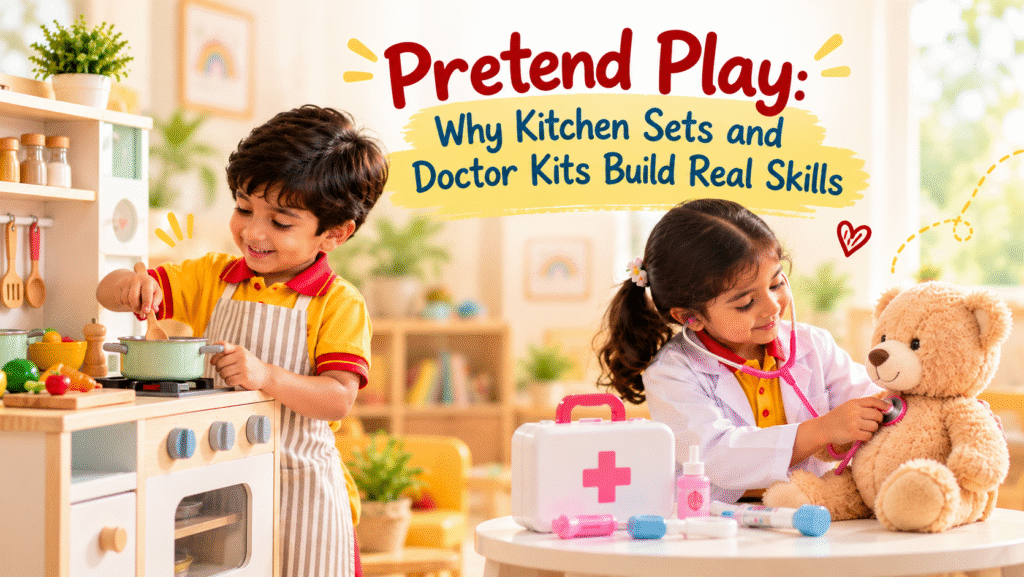
Your three-year-old hands you a cup of “chai” made of nothing. Then a plate of “rotis” made of blocks. Then a bill for ₹500.
It looks like play — and it is. But it’s also one of the most powerful learning activities in early childhood. Here’s why the benefits of pretend play run so deep, the best toys for it, and how you can join in.
Pretend play (also called imaginative play, role play, or dramatic play) is when children act out roles and situations — cooking, shopping, doctor visits, school, weddings, train journeys — using toys, objects or just their imagination.
It usually begins around 18 months, with simple actions like feeding a doll, and grows into complex, shared stories with friends by 4–5 years.
Age | What it usually looks like |
12–18 months | Copies simple actions — “talks” on a phone, stirs a spoon in a cup |
18–24 months | Pretends with dolls — feeding, putting to sleep; uses objects as they’re meant |
2–3 years | Short sequences (cook, then serve, then eat); starts using one object as another — a block as a phone |
3–4 years | Takes on roles — doctor, teacher, Mumma; plays alongside and starts playing with friends |
4–5 years | Plans stories with friends; assigns roles; makes up rules; plays for longer |
5–6 years | Complex, detailed play — restaurants, weddings, train journeys — often over several days |
A toy kitchen is one of the most valuable toys you can buy — for boys and girls. Everyone eats; everyone can cook.
What it builds: vocabulary (vegetable names, cooking words), sequencing (wash, cut, cook, serve), maths (counting, sharing equally, setting places), social play (serving guests), and life skills.
Indian kitchen play ideas: make “roti” with play dough and a rolling pin, cook “dal” with real dried dal in a pot (supervised for younger kids), run a chai stall, pack a “tiffin” — then link it to real life with our healthy lunchbox ideas for preschoolers.
What they build: body part names, empathy, and — importantly — reduced fear of real doctor visits and vaccinations. Children who’ve “given” injections to teddy often handle their own better.
Play ideas: set up a clinic with a waiting room, check teddy’s temperature, write a “prescription”, bandage a doll’s arm, play “vaccination day”.
You don’t need expensive toys. Boxes, dupattas, old phones (battery removed), steel utensils and cushions are wonderful.
Every child plays differently. Speak to your paediatrician if, by around 2.5–3 years, your child shows very little interest in pretend play, plays only by lining up or spinning objects, doesn’t respond to their name, or rarely shares interest with you by pointing or showing. These signs are worth a check-up; early support helps.
At Shanti Juniors, classrooms include role-play corners — a kitchen, a clinic, a shop — that change with the theme of the month. It’s central to our I-Cube approach, where children learn by imagining, investigating and creating. You can see examples in our activities, and our five must-have toys for brain development post covers more toy ideas.
It builds language, social skills, emotional understanding, empathy, problem solving, early maths and motor skills. It also develops symbolic thinking — the ability to let one thing stand for another, which underpins reading and maths.
Simple pretend actions begin around 12–18 months. By 2–3 years children act out short sequences, and by 4–5 they plan shared stories with friends.
Yes. Kitchen play builds vocabulary, sequencing, maths and social skills for all children. Everyone eats, and everyone can learn to cook.
A kitchen set, doctor kit, dolls or soft toys, a toy phone, play money and a shop set, and dress-up clothes. Household items like boxes, dupattas and steel utensils work just as well.
Offer simple props, follow your child's lead, take on a role, ask open questions, and limit screen time.
Children vary, but if by around 2.5–3 years your child shows very little pretend play along with limited eye contact, not responding to their name, or repetitive play, speak to your paediatrician.
The next time your child hands you an imaginary cup of chai, drink it. Ask what’s for dinner. You’re doing more for their development than you might think.
To see role play and imaginative learning in a real classroom, find your nearest Shanti Juniors centre or book an admission enquiry.
Read next: Sibling Rivalry and the New Baby · How to Teach Your Child Their Address and Emergency Information · How to Encourage Independent Play

Comments are closed