
- Email info@shantijuniors.com
- Phone +91 99796 66660

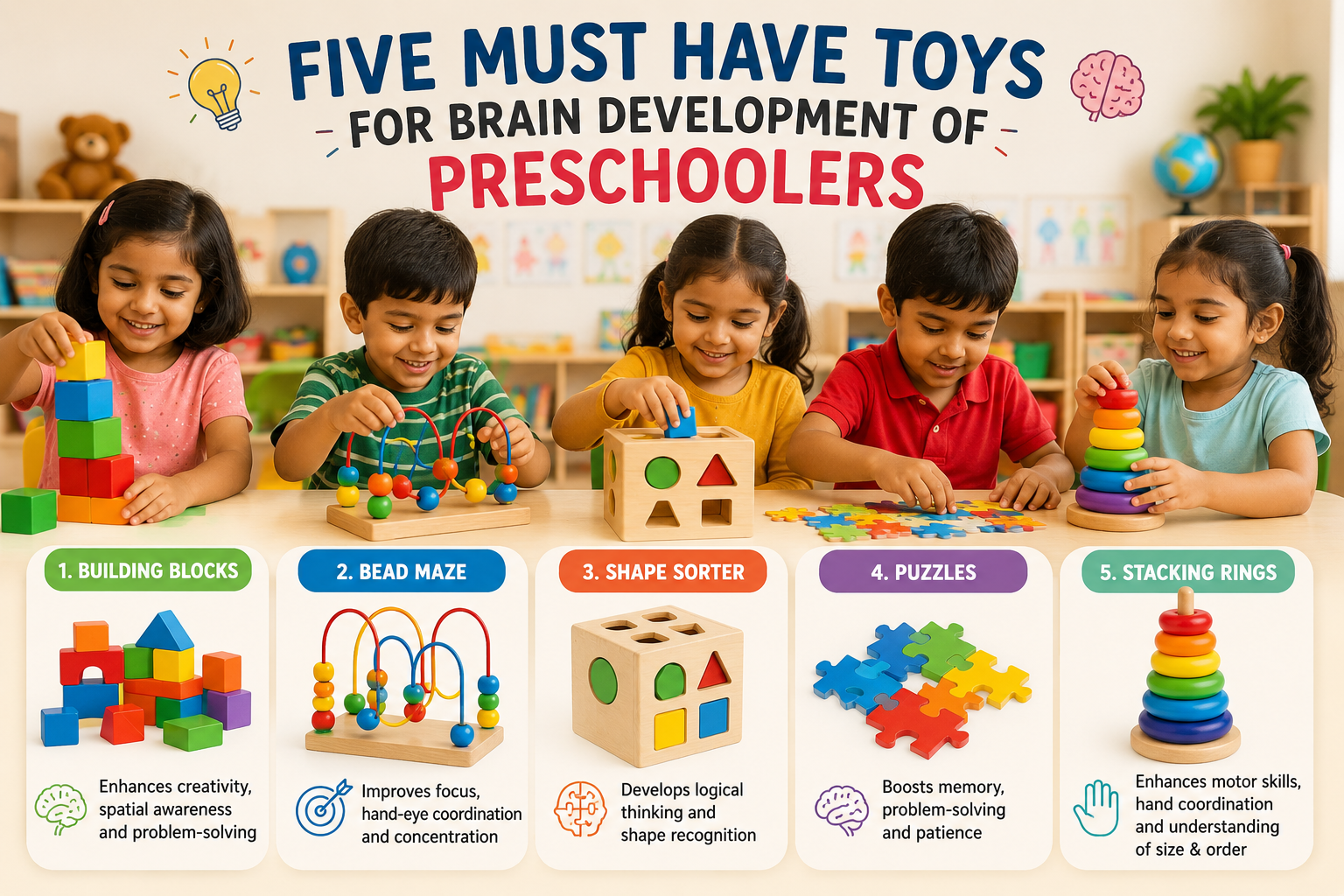
The first years of life set the stage for lifelong learning. The right toys do more than pass the time — they help form neural pathways, encourage problem solving, and build coordination. This guide highlights five age-appropriate toys that entertain while supporting cognitive and motor development. Parents and educators will find practical explanations of how each toy supports growth, how to match choices to developmental milestones, and simple ways to weave learning into everyday play. Throughout, the emphasis is on open-ended materials and activities that invite exploration, repetition, and social interaction, because those features reliably deepen learning.
Preschool brain development moves through distinct, fast-paced stages where children rapidly gain new skills—cognitive, social, and emotional. Neural connections multiply as children explore language, patterns, and cause-and-effect. Play is a primary engine for that growth: it stimulates circuits involved in attention, memory, and self-regulation. For a deeper look at foundational practices in early learning, see our resources on educational insight.
Importantly, development is uneven: a child may leap forward in vocabulary while still working on fine motor control, or vice versa. That variability is normal and one reason why toys that can be used at multiple levels of difficulty are especially valuable. A single toy can support a child across weeks or months simply by changing the challenge, adding social rules, or introducing a new prompt.
During these years, children make big leaps. Cognitively, they begin to sort shapes, name colors, and follow multi-step directions. Physically, they refine both large movements—running, jumping—and fine actions like grasping and drawing. These tracks grow together: manipulating objects helps build thinking skills, and exploring space sharpens spatial reasoning. Thoughtful play supports both areas at once.
Concrete examples show the overlap: when a child fits a puzzle piece, they practice visual discrimination (cognitive) while using a precise pincer grip (fine motor). When two children cooperate to build a tower, they balance structural planning (cognitive) with steady placement and hand control (motor), and they also practice language and negotiation.
Play-based learning gives children low-pressure chances to experiment, fail, and try again—perfect conditions for building resilience and creativity. Through building, role-play, and sensory exploration, kids practice planning, problem solving, and social skills. That combination strengthens neural networks and supports emotional regulation, making play an essential foundation for later learning.
Another advantage of play is motivation: children are more likely to repeat and extend activities they find intrinsically rewarding. Repetition under enjoyable circumstances is a powerful driver of skill consolidation. Caregivers can amplify this by following the child’s interests, offering small challenges, and celebrating effort rather than only correct outcomes.
Choosing toys with clear developmental benefits can accelerate learning through play. Below are five versatile options that consistently support thinking skills in preschoolers:
Each category can be adapted for different ages and abilities. For example, a simple three-piece puzzle is an excellent starting point for a toddler, while a 24-piece scene puzzle can challenge older preschoolers. Likewise, blocks range from oversized foam pieces for safe gross-motor construction to precision wooden sets that invite careful balancing and imaginative scenes.
Puzzles teach children to break problems into steps: scan pieces, compare shapes and colors, and test fits. That practice builds logical reasoning and pattern recognition. Repeating puzzles or increasing difficulty helps strengthen visual memory and confidence in tackling challenges.
Activity ideas: offer a “puzzle hunt” where a child finds a matching piece hidden nearby, or time a cooperative puzzle where two children alternate placing pieces and describing what they see. To scaffold learning, narrate thought processes aloud—”Let’s look for the corner pieces first”—to model strategies without taking over.
Blocks let children experiment with size, balance, and symmetry in a hands-on way. Building encourages planning and iterative design—skills that underpin later math and engineering learning. Open-ended block play also sparks storytelling and cooperative projects, expanding both imagination and social skills.
Try prompts that nudge complexity: “Can you make a bridge that a toy car can roll under?” or “Let’s build a house with four rooms.” Encourage children to test their structures and revise them if they fall, framing collapse as a chance to improve the design rather than a failure.
Toys are practical tools for practicing movement. Different play materials target fine motor control (small hand movements) and gross motor strength (whole-body coordination). Regular, varied play builds the strength, balance, and precision children need for daily tasks and school readiness.
It helps to think of motor skill practice as part of routines: a short fine-motor activity at snack time or a gross-motor game before circle time can be more effective than a single long session. Frequent, varied practice supports gradual improvements and reduces frustration.
Manipulative toys—beads, lacing cards, playdough—require deliberate hand actions like pinching, threading, and rolling. These motions strengthen the small muscles in hands and fingers and improve hand-eye coordination, skills that support writing, self-care, and tool use.
Practical activity examples: set up a “bead threading” station with large, easy-to-handle beads and a shoelace; use playdough mats with cookie cutters for imprinting shapes; provide tongs or tweezers for picking up small pom-poms and sorting them by color. These small changes introduce precision and bilateral coordination in playful contexts.
Ride-on toys encourage pushing, steering, and balancing, all of which develop core strength and coordination. They also promote stamina and spatial awareness, and they often create social moments where children practice sharing space and taking turns.
Adaptations for progression: move from floor push toys to low ride-on scooters, then to pedal or balance bikes as coordination improves. Use simple obstacle courses—cones to weave through, soft ramps to climb—to add challenges that require planning and controlled movement without creating risk.
Sensory toys engage touch, sight, and sound to create rich learning experiences. These materials help children explore differences in texture, light, and noise, building attention, curiosity, and early scientific thinking.
Sensory play also supports language when adults describe sensations and actions—”This rice feels grainy” or “The bell is loud when you shake it fast.” Those descriptive words build vocabulary and give children tools to express preferences and regulate emotions.
Good sensory choices include textured balls, light-up toys, and simple musical instruments. Each invites cause-and-effect exploration: squeeze a textured ball, see a light flash, or discover how rhythm changes sound. Those experiments support early problem-solving and curiosity-driven learning.
Ideas for sensory setups: create a small sensory bin with rice or pasta and hidden objects to discover; assemble a sound station with shakers, bells, and a drum for exploring rhythm; use light tables or translucent shapes to explore color mixing and shadow play. Always supervise sensory materials and choose items appropriate to the child’s age to reduce choking hazards.
Sensory activities give children safe ways to express feelings and self-soothe. Group sensory play also sets up natural opportunities for sharing, communicating preferences, and cooperating—important social and emotional milestones.
When a child uses a calming sensory material repeatedly, caregivers can gently label the behavior—”You seem to like squeezing the soft clay when you feel upset”—which teaches self-awareness and introduces simple coping strategies.
Choosing the right toy means matching it to a child’s current skills and the next stretch of learning. Consider safety, durability, and whether the toy invites multiple ways to play. The best toys grow with the child and spark curiosity rather than offering one passive function.
A short checklist to use when evaluating a toy: Is it free of small parts for the child’s age? Does it offer adjustable challenge levels? Is it made from durable materials that tolerate repeated handling? Can it be combined with other toys or household items to create new play scenarios? Using a simple checklist like this helps caregivers select items that remain valuable across months of development.
Toys for 3-year-olds should be safe, sturdy, and open-ended. Look for items that invite pretend play, simple problem solving, and both fine and gross motor challenges. Versatile toys—like building sets or art kits—encourage repeated use and deeper skill development.
Examples that suit many three-year-olds include: sets with large interlocking pieces, simple musical instruments that help explore rhythm and tempo, and dramatic-play props such as pretend kitchen items or costumes. When selecting, think about cleaning and storage: washable materials and bins make it easier to keep play areas inviting and hygienic.
Identify the skills a child is working on—counting, sorting, letter recognition, or storytelling—and choose toys that naturally practice those skills. For example, sorting activities support early math, while puppets encourage language and narrative skills. Aligning toys with goals creates more meaningful play.
Stretch goals: pick toys that slightly exceed current ability so the child can practice new skills with minimal frustration. If a child is comfortable matching two colors, introduce a set that requires matching three attributes (color, shape, and size) to nudge higher-order thinking.
Integrating educational toys into daily routines boosts their impact. Rotate materials to keep them engaging, create short guided activities, and balance structured tasks with free exploration. Consistent, varied play helps children transfer skills across settings.
A simple rotation plan: group toys into themed bins (sensory, construction, fine motor, art) and swap one bin each week. This preserves novelty while giving children time to explore each set deeply. Use short, focused group activities—five to ten minutes for preschoolers—followed by free play to let children apply skills independently.
Combine structure and choice: set up focused stations, allow free discovery, and encourage group projects. Offer a variety of materials for different interests and abilities, and link toys to themes or learning centers to deepen understanding. To learn more about our classroom approach, visit about us.
Station ideas: a building corner with blocks and measuring tapes to explore height, a sensory table with scoops and cups to practice volume words, and a storytelling nook with puppets and picture cards to prompt narrative language. Rotate prompts within stations to maintain fresh learning goals each week.
Manage sharing with clear rules, predictable turn-taking routines, and plenty of parallel-play options so children can play side-by-side. Model positive sharing, use timers for turns, and encourage language about feelings to help children resolve conflicts and build empathy.
Concrete strategies: label turns verbally (“Now it’s Sara’s turn for two minutes”), provide duplicate materials where possible to minimize conflicts, and create “sharing scripts” for children to practice—simple phrases like “My turn, please” and “Thank you” that scaffold polite interaction. Use role-play to rehearse tough moments so children have familiar solutions when emotions run high.
Recent studies emphasize that varied, age-appropriate play experiences support neural plasticity—helping young brains form flexible connections that underlie learning. Early, targeted experiences can have a measurable impact on cognitive flexibility and attention.
Practically, this means a child exposed to many kinds of play—sensory, social, physical, and symbolic—has more opportunities to practice the brain processes that support later learning. Varying materials, introducing progressively harder challenges, and sustaining rich social interaction are all ways caregivers translate research into day-to-day practice.
Neural Plasticity and Age-Appropriate Learning in Early Neurodevelopment
ABSTRACT: Neural plasticity describes the brain’s ability to reorganize and modify neural connections in response to experience, learning, or injury. The first thousand days of life represent a peak period of plasticity, when the brain is exceptionally receptive to environmental input. Developmentally appropriate learning during this window can meaningfully shape neurodevelopment.
Importance of developmentally age-appropriate learning during early stages ofNeural Plasticity: Toys as Tools, 2025
Research finds that interactive toys—those that require planning, sequencing, and active attention—can strengthen executive functions like working memory and impulse control. Children who regularly engage in goal-directed play tend to show clearer gains in classroom-style tasks and self-directed activities.
Characteristics of effective interactive toys include multiple steps to complete a task, opportunities for children to set and revise goals, and feedback that prompts reflection (for example, a toy that highlights sequencing errors so the child can try again). Simple household adaptations—turning a sorting activity into a timed challenge or adding a rule that requires memory—can convert many toys into executive-function exercises.
Educational toys create rich contexts for conversation, storytelling, and cooperative play. Toys that invite role-play or shared problem solving give children practice using new words, taking turns, and negotiating roles—foundational skills for both language and social competence.
Use open-ended prompts to extend language: instead of asking “What color is this?” try “Tell a story about who lives in this house.” Model and expand children’s utterances—repeat a child’s phrase and add a detail—to build vocabulary and sentence length. In group settings, designate a “story leader” who narrates a shared play sequence to encourage turn-taking and collective creativity.
Reliable guidance comes from pediatric and early-education experts, evidence-based reviews, and hands-on demonstrations. Combining expert recommendations with real-family reviews helps caregivers choose toys that are both safe and developmentally valuable.
When evaluating reviews or demos, look for descriptions of how the toy is used with children (not just lists of features), photos or videos showing real play, and commentary about durability and safety. Hands-on demonstrations in stores or short trial sessions at playgroups can also clarify whether a toy suits a child’s temperament and interest.
Organizations such as the American Academy of Pediatrics and the National Association for the Education of Young Children publish evidence-based guidance on play and toy selection. Their resources emphasize safety, developmental value, and the central role of guided play.
Look for video demos, expert roundups, and parent reviews on trusted sites and educational blogs. Multimedia demonstrations let you see how a toy is used and whether it matches your child’s interests. For insights into our programs and how we apply these principles in practice, review our admission process.
If you’re curious about how preschools operate or how standards are maintained across locations, learn more about our franchise model for additional context.
At Shanti Juniors, we are dedicated to providing a nurturing environment that integrates carefully selected educational toys and play-based learning to optimize preschoolers’ brain development. Our curriculum is designed around the latest research in neural plasticity and cognitive growth, ensuring each child receives age-appropriate challenges that promote thinking, motor skills, and social-emotional learning.
We emphasize open-ended play, social interaction, and repetition within a supportive community of caregivers and peers. Our experienced educators guide children through discovery and exploration, tailoring activities to align with each child’s developmental milestones and interests. Shanti Juniors’ commitment to quality early education is reflected in our adoption of best practices and materials that engage multiple senses and foster resilience and creativity.
Families choosing Shanti Juniors gain access to a vibrant learning ecosystem supported by expert knowledge, trusted resources, and continuous feedback. We are proud to complement our academic excellence with a warm, inclusive atmosphere where every child’s potential can flourish.
Final practical tip: observe play more than you direct it. A few minutes of careful observation reveals where a child is challenged and what kinds of prompts will help them take the next step. Combine that with a small rotation of high-quality toys and simple routines, and caregivers can create a powerful, playful learning environment that supports thinking, motor skills, and social-emotional growth.
Comments are closed