
- Email info@shantijuniors.com
- Phone +91 99796 66660
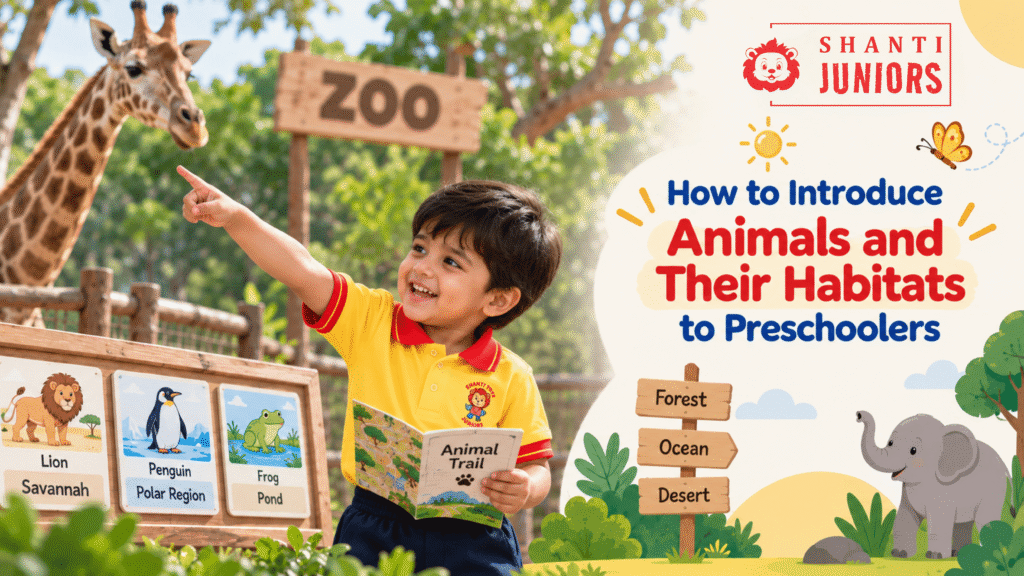
Ask a preschooler where a fish lives and you’ll probably hear:
“Water!”
Ask where a lion lives and the answer might be:
“Jungle!”
Young children are naturally fascinated by animals. That makes animals a wonderful starting point for introducing another idea — habitats.
But terms like ecosystem, adaptation and environment can quickly make a simple topic unnecessarily complicated.
For preschoolers, begin with one basic idea:
Different animals live in different kinds of places.
Here’s how parents can introduce animals and their habitats to preschoolers through simple, playful activities.
Keep the explanation simple:
“A habitat is the place where an animal naturally lives and gets what it needs.”
Start with a few environments children can easily distinguish:
Once the basic idea makes sense, gradually introduce more.
Start with familiar animals.
Dog.
Cow.
Lion.
Fish.
Elephant.
Ask:
“Where have you seen a cow?”
“Where does a fish live?”
“Where might we find a lion?”
Connecting new information with something children already recognise makes concepts easier to understand.
A collection of animal figurines is enough.
A blue cloth can become water.
Leaves and twigs can become a forest.
Sand can represent a desert.
A small fence can become a farm.
Now ask:
“Where should the fish go?”
“What about the camel?”
The child isn’t simply memorising an answer anymore. They’re actively thinking and placing the animal themselves.
Show pictures of a farm, forest, ocean and desert.
Then give your child animal pictures or figurines to match.
Fish → Water/ocean
Camel → Desert
Cow → Farm
Use the activity to start conversations rather than expecting perfect classification immediately.
Use household and craft materials to build tiny habitats.
For a forest, use leaves, twigs and stones.
For an ocean, use blue paper, shells and sea-animal toys.
For a farm, use blocks, toy fences and farm animals.
Ask your child to help build the environment.
Questions such as “What does our fish need?” encourage children to think beyond simply remembering names.
While reading animal stories, occasionally ask:
“Where is the bear?”
“Why do you think the fish is in water?”
“What animals can you see here?”
Don’t turn every page into a quiz.
Let the story remain enjoyable.
Ask your child to:
Hop like a rabbit.
Stomp like an elephant.
Slither like a snake.
Swim like a fish.
Then connect each animal with where it lives.
Combining movement, imagination and conversation can make concepts memorable.
A walk outside can become a mini habitat lesson.
Look for birds in trees, ants near the ground or butterflies around plants.
Ask:
“Why do you think the bird likes the tree?”
“What do you think the ant finds here?”
The objective isn’t to give a science lecture.
It’s to encourage observation.
Name an animal and ask your child to choose its home.
“I’m a fish. Where do I live?”
“I’m a camel. Where might I live?”
“I’m a cow. Where might you see me?”
Once your child understands the game, reverse the roles.
There’s no need for preschoolers to memorise complicated habitat classifications.
Begin with broad ideas:
Some animals live around farms.
Some live in forests or grasslands.
Some live in water.
Some live in hot environments.
Some live in cold environments.
If your child is still learning the distinction between farm and wild animals, start with our guide to farm animals vs wild animals for preschoolers.
Why can’t a fish live on land?
Why does a camel live in the desert?
Why does a polar bear have thick fur?
You don’t always need to answer immediately.
Try asking:
“What do you think?”
Encouraging children to observe, predict and ask questions is an important part of learning.
A fish can lead to a conversation about water.
A camel can introduce the desert.
A polar bear can introduce cold environments.
A bird can begin a conversation about trees, nests and the sky.
This kind of curiosity-led exploration fits naturally with Shanti Juniors’ approaches to early learning, where children are encouraged to learn through interaction and meaningful experiences.
Parents interested in understanding why experiences like these matter can also explore the importance of early childhood education.
Your preschooler doesn’t need to remember every habitat.
They need to become interested enough to ask:
“Where does this animal live?”
That’s where learning begins.
Use toys. Read stories. Go outside. Make habitats. Pretend to be animals.
And whenever possible, allow curiosity to lead the conversation
A simple explanation is: a habitat is the place where an animal naturally lives and gets what it needs.
Start with easily distinguishable environments such as farms, forests, oceans, deserts and polar regions.
Use animal toys, picture matching, mini habitats, storybooks, nature walks and simple sorting games.
Farm animals are raised and cared for by people, while wild animals live naturally in the wild

Comments are closed