
- Email info@shantijuniors.com
- Phone +91 99796 66660
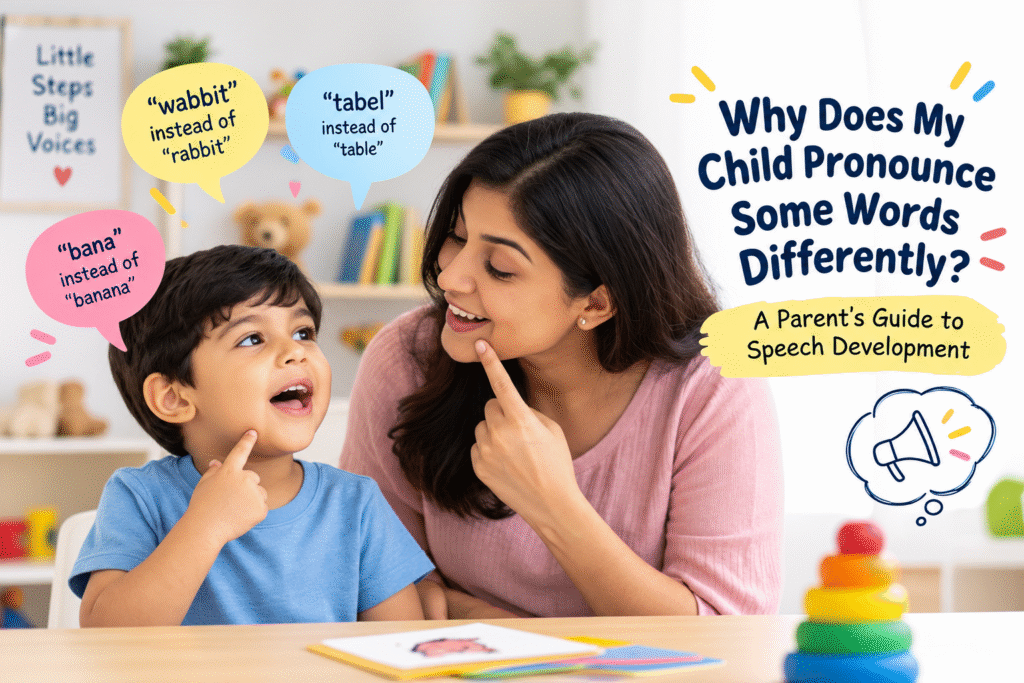
“Tat” for cat. “Wabbit” for rabbit. “Nana” for banana. “Poon” for spoon.
To family, it’s adorable. Then one day a relative says, “Shouldn’t she be saying that properly by now?” — and you start to wonder.
The reassuring truth: most mispronunciations in young children are a normal part of speech development, and they follow predictable patterns. This guide explains which sounds come when, the common “mistakes” that are perfectly normal at each age, what helps at home, and the signs that mean it’s worth a check-up.
Important: this guide is general information, not a diagnosis. Every child is different. If you are worried, speak to your paediatrician or a qualified speech-language pathologist.
Speaking is one of the most complex physical skills a child learns. To say a single word, they must coordinate the lips, tongue, jaw, teeth, voice and breath — in the right order, in a fraction of a second.
Some sounds are simply harder than others. Sounds made with the lips (p, b, m) are easy to see and copy, so they come early. Sounds made at the back of the mouth (k, g) or that need fine tongue control (s, r, l, th) take longer. So young children simplify — they replace a hard sound with an easier one. Speech therapists call these patterns phonological processes, and most disappear on their own as the child matures.
Most English-speaking children master speech sounds in roughly this order. Indian languages have their own sounds and timelines, and individual children vary — use this as a general guide only.
By around age | Sounds usually clear |
3 years | p, b, m, n, h, w, t, d |
4 years | k, g, f, y, ng |
5 years | l, s, ch, sh, j, v, z |
6–7 years | r, th, and blends such as “str”, “spl” |
So yes: a four-year-old who says “wabbit” for rabbit, or a five-year-old who says “fank you” for thank you, is usually right on track. R and th are among the last sounds children master.
A commonly used guide is how much of a child’s speech an unfamiliar listener can understand:
Age | Roughly understood by strangers |
2 years | About half |
3 years | About three-quarters |
4 years | Almost all, even with some sound errors |
Parents and siblings understand far more because they know the child’s words. The real test is the aunty at the shop or the teacher on day one.
What your child does | Example | Usually fades by about |
Drops the end sound | “ca” for cat | 3 years |
Repeats a syllable | “baba” for bottle | 3 years |
Says t/d for k/g (fronting) | “tat” for cat, “doe” for go | 3.5 years |
Drops a weak syllable | “nana” for banana, “puter” for computer | 4 years |
Simplifies a blend | “poon” for spoon, “top” for stop | 4–4.5 years |
Says t/d for s/f (stopping) | “tun” for sun | 3–5 years |
Says w for r or y for l (gliding) | “wabbit”, “yeyo” for yellow | 5–6 years |
Tongue between the teeth on s (frontal lisp) | “thun” for sun | about 4.5 years |
If your child’s errors are in this table and they’re within the age range, the most useful thing you can do is model the correct word and keep talking.
Many Shanti Juniors families speak two or three languages at home — Gujarati, Hindi and English, Marathi and English, and so on. Parents often worry this is confusing the child.
Do:
Don’t:
Check the basics too: frequent ear infections, constant mouth breathing, or prolonged bottle or pacifier use can affect speech. Mention any of these to your paediatrician.
Consider a professional assessment if:
Around 2 years
Around 3 years
Around 4 years
At any age
Start with your paediatrician, who may refer you to an audiologist (hearing test) and a speech-language pathologist. In India, look for an RCI-registered professional (Rehabilitation Council of India). Early support is much more effective than “wait and see” — and assessment does not mean labelling.
Preschool teachers hear dozens of children of the same age every day, which makes them very good at noticing who is on track and who might need extra support. A good preschool will:
At Shanti Juniors, language development is a core part of the Kiddowitty curriculum, from Toddcare to Senior KG. Our teachers work with parents if they notice anything, and you can read about the whole-child approach in how Shanti Juniors supports holistic development.
Weighing daycare and preschool for a young talker? Group settings with lots of talk help most children — our guide to daycare vs preschool compares the two. If you’re working from home with a little one, a simple daily routine can build in short daily “talk time”.
Yes. Many sounds — including k, g, s, l, r and th — are still developing at three. By three, strangers should understand roughly three-quarters of what a child says.
R is one of the last sounds to develop. Many children say "w" for "r" until five or six, and mastering R by around six or seven is common.
This is called fronting and is normal until around three and a half. If it continues beyond four, consider a speech assessment.
No. Bilingualism does not cause speech or language disorders. Bilingual children may mix languages or show sound patterns from one language in another; this is normal.
Don't correct directly. Repeat the word back correctly and naturally ("Yes, a cat!"), face your child, and keep the conversation going.
If strangers understand very little by four, your child is very hard to understand at three, has fewer than about 50 words at two, has lost skills, or you're worried — speak to your paediatrician about a referral.
A frontal lisp (tongue between the teeth on s) is common and often resolves by about four and a half. A "slushy" lateral lisp is not part of typical development and is worth assessing.
When your child says “Look, a tat!”, they’re telling you something exciting. Respond to that — “A cat! Where?” — and the sounds will usually follow.
To see how Shanti Juniors builds language through conversation, rhymes and play, find your nearest centre or book an admission enquiry.
Read next: How to Teach WH Questions to Preschoolers · Daycare vs Preschool: What Is the Difference? · Nursery Rhymes for Kids

Comments are closed