
- Email info@shantijuniors.com
- Phone +91 99796 66660
“How was school?” — “Good.” “What did you do?” — “Nothing.”
If that is how most evenings go, you are not alone. And the answer is not more worksheets. It is better questions, asked in the right order, during the ordinary moments you already share with your child.
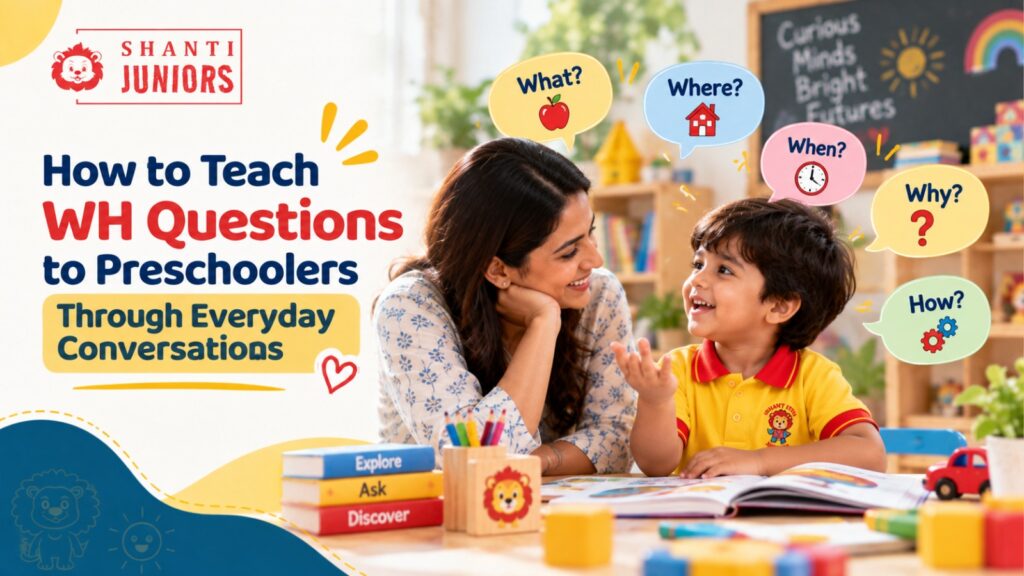
This guide shows you how to teach WH questions for preschoolers — what, where, who, when, why and how — through meals, baths, walks and bedtime stories, in the order children actually learn them.
WH questions are the question words that ask for information: what, where, who, when, why, how (and later, which and whose). Unlike yes/no questions, they need a real answer.
They matter because understanding and answering them is at the heart of:
Children do not learn all six at once. Most follow a rough developmental order, from concrete (things they can see) to abstract (time, reasons). Ages vary from child to child — treat these as guides, not deadlines.
Approx. age | Question word | Why it comes at this stage | Example |
~2 years | What | Names things a child can see and touch | “What is this?” — “Ball!” |
~2–2.5 years | Where | Places are visible and concrete | “Where is the cat?” — “Under the bed!” |
~2.5–3 years | Who | People they know | “Who is at the door?” — “Nani!” |
~3–3.5 years | What doing | Actions, not just objects | “What is the dog doing?” — “Running.” |
~3.5–4 years | Whose / Which | Ownership and choice | “Whose shoe is this?” — “Papa’s.” |
~4 years | When | Time is abstract and harder | “When do we brush teeth?” — “At night.” |
~4–5 years | Why | Needs reasoning and cause–effect | “Why is he crying?” — “Because he fell.” |
~4.5–5 years | How | Needs explaining a process | “How do we make tea?” — “Boil water, then…” |
The key rule: start where your child is. If your three-year-old answers “what” and “where” easily but freezes at “why”, that is completely normal. Spend more time on the ones they are ready for.
You don’t need extra time. You need to talk differently during time you already have.
Wait. Count silently to five after asking. Children need more processing time than adults. Filling the silence too soon is the most common mistake.
Offer choices when they’re stuck. “Where is the cat? Is it on the bed or under the bed?” A choice turns a hard question into a winnable one.
Model the answer. If your child doesn’t answer, answer it yourself, naturally: “Where is the cat? Oh, the cat is under the bed!” Then ask again later.
Expand what they say. Child: “Dog running.” You: “Yes! The big dog is running fast in the park.” Add two or three words to whatever they say.
Don’t quiz. Five questions in a row feels like a test. Mix questions with comments: “I see a red car. I wonder where it’s going?”
Use visuals for younger children. Point, use picture books, act things out.
Let them ask you, too. When your child starts asking “why?” twenty times a day, celebrate it — that’s exactly the skill growing.
Age 2–3: What is this? Where is your shoe? Who is that? What does a cow say? Age 3–4: What is the boy doing? Whose bag is this? Which one is bigger? Where do we keep the milk? Age 4–5: When do we sleep? Why do we need an umbrella? How do you wash your hands? What happened next in the story? Age 5–6: Why do you think he felt sad? How could we fix this? What would happen if…? What is the same and what is different?
Every child develops at their own pace, especially in bilingual and multilingual homes, where children may answer in one language before the other. Consider speaking to your paediatrician or a speech-language therapist if:
Early support works best, and asking early never hurts.
At Shanti Juniors, WH questions are woven through the day — circle time, story time, show-and-tell and theme weeks. Our Kiddowitty curriculum builds language step by step from Toddcare through Nursery and Junior KG, and our teachers are trained to wait, expand and ask open questions rather than test. Our GK questions for kids post has more question ideas you can use at home.
Working from home and short on time? You can fit most of these into your day — our simple daily routine for WFH parents shows where.
Most children start with "what" and "where" around age two, add "who" by around three, and "when", "why" and "how" between four and five. Children vary, and multilingual children may take a little longer in each language.
Start concrete and move to abstract: what → where → who → what-doing → whose/which → when → why → how.
Often, yes. "Why" requires reasoning about cause and effect, which develops gradually between four and five. Model answers ("He's crying because he fell"), offer choices, and keep it playful.
Be specific: Who did you play with? What did you eat? Which song did you sing? What made you laugh? Specific questions get real answers.
Use daily routines — meals, baths, dressing, walks and stories. Ask, wait five seconds, offer a choice if needed, and expand your child's answer.
No. Answering in your home language is still a real WH answer. Bilingual children develop both languages over time.
Tonight, swap “How was school?” for “Who did you play with today?”
Then wait five seconds.
To see how Shanti Juniors builds language through play, find your nearest centre or book an admission enquiry.
Read next: Why Does My Child Pronounce Some Words Differently? · Navratri for Kids: The Story of Maa Durga · Work-From-Home Parents: A Simple Daily Routine for Preschoolers

Comments are closed