
- Email info@shantijuniors.com
- Phone +91 99796 66660
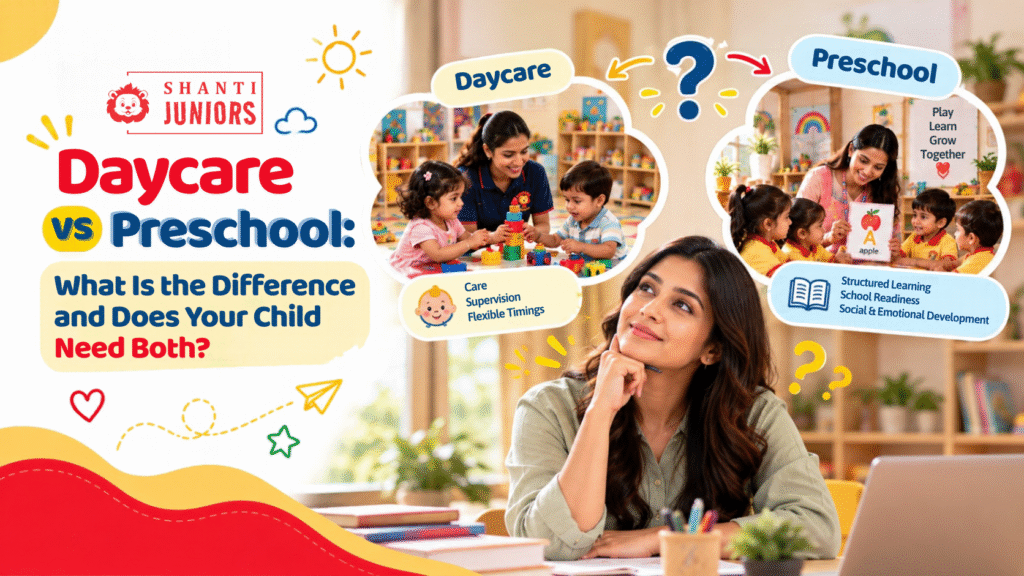
“Daycare”, “crèche”, “playschool”, “preschool”, “nursery” — in India the words are often used interchangeably, and centre signboards don’t always help.
But daycare vs preschool is a real distinction, and choosing the right one (or the right combination) depends on your child’s age, your working hours and what you want your child to get from their day.
Daycare / Crèche | Preschool / Playschool | |
Main purpose | Safe care during working hours | Early learning and school readiness |
Typical age | ~6 months to 5+ years | ~2 to 6 years |
Hours | Long — often 8–10 hours, flexible | Short — usually 3–4 hours |
Calendar | Most of the year, fewer holidays | Follows an academic year with vacations |
Daily structure | Care routine: meals, naps, play | Curriculum: themes, language, numbers, motor skills, social skills |
Staff | Caregivers (focus on care and safety) | Trained early-childhood teachers |
Groups | Often mixed ages | Grouped by age / class (Playgroup, Nursery, Jr KG, Sr KG) |
Meals and naps | Usually provided | Snack time; naps uncommon |
Progress tracking | Daily care updates | Learning observations, portfolios, PTMs |
Fees | Usually monthly, linked to hours | Usually term or annual, plus admission fee |
The line has blurred in recent years — good daycares now include learning activities, and many preschools offer extended hours. That’s why it’s worth asking any centre exactly what happens in each part of the day.
A typical daycare day (full day) Drop-off → breakfast → free play → snack → outdoor play → lunch → nap (1.5–2 hours) → snack → activities and stories → free play → pick-up.
A typical preschool day (half day) Arrival and free play → circle time (songs, calendar, theme talk) → learning activity (language, numbers, art) → snack → outdoor / movement → story → goodbye song.
Our post on what happens during a typical preschool day explains it in more detail.
Under 18 months → Daycare / Toddcare, if you need care while you work. Babies need consistent caregivers, safe sleep and responsive care — not a curriculum.
18 months – 2.5 years → Toddler programme or daycare, depending on your hours. A short toddler programme (2–3 hours) builds early social skills; full-day care covers working hours. At Shanti Juniors, Toddcare is designed for this age.
2.5 – 3.5 years → Preschool (Playgroup / Nursery) — this is usually the ideal time to start structured early learning. If you work full-time, add daycare / extended care after preschool hours.
3.5 – 6 years → Preschool (Junior KG / Senior KG) for school readiness — early literacy, numeracy and independence. Add extended care if needed.
Not sure about class and age? See Toddcare, Nursery, Jr KG or Sr KG — what’s the difference? and what age should a child start preschool.
Your situation | What usually works |
Both parents work full-time in offices | Preschool + daycare (extended care) at the same centre |
One parent at home or flexible | Preschool only (half day) |
Work-from-home parent(s) | Half-day preschool for focus hours; occasional extended care on heavy days |
Shift work or long commutes | Daycare with flexible hours; preschool built in for children over 2.5 |
Grandparents help part of the week | Preschool + a few days of extended care |
If you work from home, our guide to a simple daily routine for WFH parents shows how half-day preschool fits around your work.
For working parents with children over 2.5, preschool + daycare in the same place is often the best of both worlds:
When you might not need both: if one parent or a grandparent is home in the afternoons, half-day preschool alone is usually plenty. Long days in group care are tiring for young children, so don’t book more hours than you actually need.
“Daycare is just babysitting.” Good daycare is responsive, safe, stimulating care — and for babies, that is the most important learning.
“Preschool is too early for academics.” Good preschool isn’t about worksheets. It builds language, thinking, motor skills, independence and social confidence through play — the foundations that later academics rest on. Read why early childhood education matters.
“Children in daycare miss out on bonding with parents.” Research consistently shows that high-quality care does not weaken a child’s attachment to their parents. Quality and consistency matter most.
“Any centre that calls itself a preschool is a preschool.” Check for trained teachers, a real curriculum, age-wise classes and a sensible ratio.
Our full 25-point daycare checklist for working parents and how to choose the right preschool cover each in detail.
Shanti Juniors offers Toddcare for the youngest children, Nursery, Junior KG and Senior KG for structured early learning through the Kiddowitty and I-Cube approaches, and Active Care programmes for families who need longer hours. Daycare availability and timings vary by centre — check with your nearest Shanti Juniors centre.
Daycare focuses on safe care during working hours, often from infancy and for long hours. Preschool focuses on structured, play-based early learning for children aged about 2–6, usually for three to four hours a day.
No, though they often overlap. Daycare is care-led; preschool is learning-led. Many centres now offer both, with preschool in the morning and extended care in the afternoon.
f you need full-day care, daycare or a toddler programme with extended hours. If you only need a few hours, a toddler or playgroup programme is ideal. Most children are ready for structured preschool between 2.5 and
Yes. Many working families choose preschool in the morning and daycare in the afternoon, ideally at the same centre to reduce transitions.
A crèche is a care setting, usually for babies and toddlers during working hours. A playschool is an early-learning setting for children aged roughly 2–4.
Yes. Good daycares provide language, play, routines and social interaction. For under-twos, warm, responsive care is the most important learning. Preschool adds a structured curriculum for school readiness.
For children over 2.5, a preschool with daycare (extended care) at the same centre is often the best fit — learning plus full working-day coverage.
Start with your child’s age and what they need. Then match it to your working hours. Then visit.
To see Toddcare, preschool and extended care in action, find your nearest Shanti Juniors centre or book an admission enquiry.
Read next: Working Parents & Daycare: What to Check Before Choosing a Daycare · What Documents Are Required for Preschool Admission? · Work-From-Home Parents: A Simple Daily Routine

Comments are closed