
- Email info@shantijuniors.com
- Phone +91 99796 66660

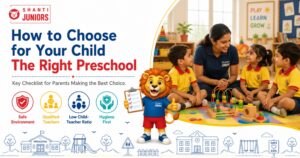
To choose the right preschool, check six things, safety, trained and warm teachers, a play-based approach, a fair child to teacher ratio, good hygiene, and a convenient location. The best way to judge these is a short in-person visit, which tells you far more than any brochure or website. Age and fees matter too, but these six factors decide whether your child will be safe, happy and learning well.
Choosing a preschool can feel overwhelming with so many options. This checklist breaks the decision into clear, practical steps, so you can compare a few nearby preschools with confidence and pick the one that fits your child.
Safety comes first, followed by the warmth and training of the teachers.
For a young child, nothing matters more than a safe, caring environment. Before looking at curriculum or fees, check that the space is secure and clean, and that the teachers are gentle, patient and trained in early childhood care. A child who feels safe and cared for will settle and learn. A fancy curriculum means little if the child is anxious or the space is unsafe.
Check safety, teachers, teaching approach, child to teacher ratio, hygiene, and location.
A short visit is the single best way to judge a preschool. Use this checklist while you are there.
| What to check | Why it matters |
| Safety | A secure, clean, child-friendly space keeps your child safe all day |
| Teachers | Trained, warm teachers shape how your child feels and learns |
| Approach | Play-based learning suits this age, as NEP 2020 recommends |
| Ratio | A fair child to teacher ratio means each child gets attention |
| Hygiene | Clean washrooms and eating areas protect young children |
| Location | A short, easy commute keeps a young child comfortable |
Important, but for this age it should be play-based, not heavy academics.
The teaching method matters, but the right one for a 2 to 5 year old is play-based and activity-based learning, which is what NEP 2020 recommends for the foundational stage. Look for a day built around stories, songs, art, movement and guided play, with gentle early learning woven in. Be cautious of any preschool pushing formal reading, writing and heavy homework too early, that is not developmentally suited to this age.
Yes. A convenient location and suitable hours make daily life easier and keep the child comfortable.
A preschool that is too far can make mornings stressful and tiring for a young child. A shorter, easier commute is usually better than a slightly better-rated school far away. Also check the hours, most preschools run a half-day, while some offer full-day or daycare options for working parents. Pick timing that fits your family’s routine, so drop-off and pick-up stay calm.
Visit each, score them on the same checklist, and trust what you see over what you are told.
The simplest method is to shortlist two or three nearby options and visit each one. Score every preschool on the same six points, safety, teachers, approach, ratio, hygiene, location. Notice how the children look, are they engaged, relaxed and happy? Trust what you observe on the visit more than marketing claims. After comparing, the right choice usually becomes clear.
Look for safety, trained and warm teachers, a play-based approach, a fair child to teacher ratio, good hygiene, and a convenient location.
Yes. A short in-person visit shows you the space, the teachers and how children behave, which tells you far more than a brochure.
A lower ratio means each child gets more attention. Ask the preschool their ratio and see whether teachers can attend to every child calmly.
For 2 to 5 year olds, play-based learning is recommended. NEP 2020 centres play-based and activity-based learning at the foundational stage.
Two or three nearby options is usually enough. Visit each, score them on the same checklist, and compare what you see.
Yes. A shorter, easier commute keeps a young child comfortable and mornings calm, and is often better than a distant higher-rated school.
Prepared by the Shanti Juniors early education team, referencing NEP 2020 and NAEYC guidance. General guidance for parents, not a substitute for advice from your paediatrician or educator.
Comments are closed