Blog Details

  • Home
  • Blog
  • Working Parents & Daycare: What Should You Check Before Choosing a Daycare?

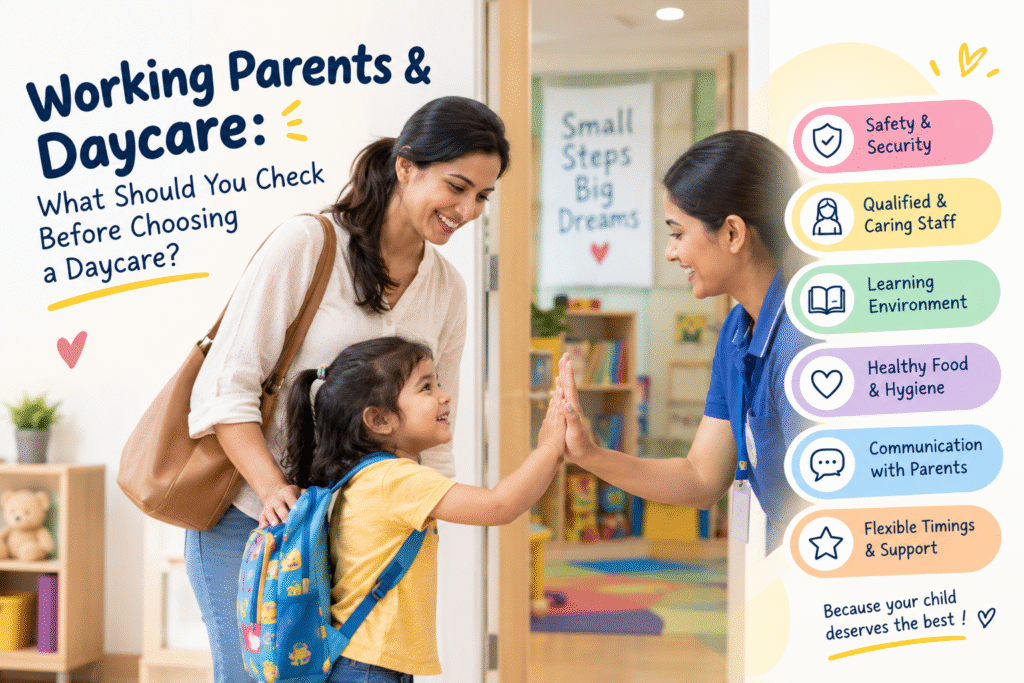
Working Parents & Daycare: What Should You Check Before Choosing a Daycare?

Choosing a daycare is one of the biggest decisions a working parent makes. You’re trusting strangers with your child for six, eight, sometimes ten hours a day.

A glossy brochure and a smiling receptionist tell you very little. This guide gives you a practical checklist for how to choose a daycare — what to look for, what to ask, the red flags to walk away from, and how to settle your child once you’ve decided.

First: know what kind of care you need

Before you visit anywhere, be clear on:

  • Your child’s age — infants (under 18 months), toddlers (18 months–3 years) and preschoolers (3–5) need very different care.
  • Hours — half day, full day, or extended hours for long commutes.
  • Location — near home or near work? (Near home is often easier if both parents may do pick-up.)
  • Learning — do you want care only, or care plus early learning?

If you’re unsure whether you need daycare, preschool or both, read Daycare vs Preschool: What Is the Difference? first.

Did you know? Under India’s Maternity Benefit (Amendment) Act, 2017, establishments with 50 or more employees are required to provide a crèche facility, either on-site or within a prescribed distance. If you work for a large employer, check your HR policy before paying for private daycare.

The daycare checklist: 25 things to check

A. Safety and security (non-negotiable)

  1. Secure entry and exit — controlled gate, visitor register, children can’t wander out.
  2. Authorised pick-up only — named, photographed adults; ID checked; what happens if someone else comes?
  3. CCTV — in play areas, and whether parents get access to a live feed or footage on request.
  4. Child-proofing — covered sockets, no sharp edges, furniture anchored, stair gates, no loose wires, window grills.
  5. Fire safety — extinguishers, clear exits, a known evacuation plan, a recent drill.
  6. First-aid trained staff on site — every shift, not just “someone”.
  7. Medical emergency plan — nearest hospital, how parents are called, what happens to the other children.
  8. Staff background checks — police verification for all staff, including drivers, cleaners and security.

B. Staff and care

  1. Adult-to-child ratio — count yourself in the room. Common practitioner norms: roughly 1:3–1:4 for infants, 1:5–1:6 for toddlers, 1:8–1:10 for 3–5 year olds. Ask what happens at lunch breaks and shift changes.
  2. Staff training — early childhood or childcare training, not just “experience”.
  3. Staff turnover — ask how long the caregivers have been there. Consistent faces matter deeply for babies and toddlers.
  4. Warmth — do caregivers get down to children’s level, speak gently, pick up crying children?
  5. Women caregivers for toileting and changing — and clear policies about who can be alone with a child.

C. Hygiene and health

  1. Clean toilets and changing area — child-sized toilets, handwashing before meals, diaper disposal.
  2. Kitchen and food — who cooks, menu shared in advance, allergies handled, safe drinking water (RO/filtered).
  3. Sick-child policy — when is a child sent home? This protects your child too.
  4. Medicine policy — written authorisation, dosage log.
  5. Toy and surface cleaning — daily, especially for mouthing babies.

D. Daily routine and environment

  1. A clear daily routine — meals, play, rest, outdoor time. Ask to see it.
  2. Separate nap area — clean bedding per child, supervised during sleep (babies on their backs).
  3. Indoor and outdoor play space — room to run, not just a TV room.
  4. Age-appropriate activities — stories, music, sensory play, art; for older children, early learning built in.
  5. Screen use — ideally minimal or none for under-twos; ask how often TV is on.

E. Communication and contract

  1. Daily updates — app, diary or message: meals eaten, nap time, nappy changes, mood.
  2. Clear fees in writing — monthly fee, admission fee, meals, late pick-up charges, holidays, notice period, refund policy.

12 questions to ask on your visit

  1. How many children are in my child’s group, and how many adults?
  2. How long have the current caregivers worked here?
  3. What training do staff have, and is anyone first-aid trained on every shift?
  4. Are all staff police-verified, including support staff?
  5. Who can pick up my child, and how do you verify it?
  6. Can I see the CCTV, and is there parent access?
  7. What does a typical day look like for my child’s age?
  8. What do children eat, and how do you handle allergies?
  9. What happens if my child gets sick or hurt?
  10. How will you update me during the day?
  11. Can I drop in unannounced?
  12. What is your settling-in process for new children?

The unannounced visit is the most revealing one. If a daycare discourages drop-in visits from parents, treat it as a serious warning sign.

More questions are in our posts on questions every parent should ask before admission and child safety: what parents should look for in a safe preschool.

Red flags — walk away if you see these

  • You’re not allowed to see the rooms where children spend the day.
  • Children look unattended, or many are crying with no one responding.
  • The TV is on for long stretches.
  • Strong smells from toilets or nappies.
  • Vague answers about ratios, staff verification or pick-up rules.
  • Fees not given in writing.
  • No clear sick-child or emergency policy.
  • High staff turnover, or caregivers who seem stressed and rushed.
  • Pressure to pay immediately.

Green flags — signs of a good daycare

  • Children seem relaxed, busy and happy.
  • Caregivers know every child’s name and routine.
  • The space is clean but lived-in, with children’s art on the walls.
  • They ask you lots of questions about your child — sleep, food, comfort objects.
  • They suggest a gradual settling-in period.
  • They welcome unannounced visits.

Daycare + early learning: why the combination helps

  1. For children over two, many working parents prefer a preschool with daycare (extended care) in the same centre. The child gets structured early learning in the morning and safe, play-based care in the afternoon — with the same familiar teachers and building, and only one drop-off and pick-up.

    At Shanti Juniors, Toddcare and our Active Care programmes are designed for working families, alongside our Nursery, Junior KG and Senior KG programmes. Timings and facilities vary by centre — check with your nearest centre.

    How to settle your child into daycare

    1. Visit together first — at least once, for 30 minutes.
    2. Start gradually — two to three hours on the first days, building to full days over one to two weeks.
    3. Share your child’s routine in writing — sleep times, food, comfort words, what calms them.
    4. Send a comfort object — a small soft toy or a cloth that smells of home.
    5. Keep goodbyes short and warm. Never sneak away.
    6. Be on time for pick-up in the early weeks — it builds trust.
    7. Expect some tears for the first one to three weeks. If it gets worse rather than better, talk to the caregivers.

    Our detailed guide on separation anxiety at preschool applies to daycare too. And if you work from home part of the week, our simple WFH daily routine for preschoolers helps keep days at home consistent with daycare days.

  Documents you’ll usually need

  Birth certificate, photographs of the child and authorised pick-up adults, parents’ ID and address proof, immunisation

 record, and     medical/allergy information. Our full preschool admission documents checklist applies to most daycares as well.


FAQs

Safety (secure entry, authorised pick-up, CCTV, child-proofing), a good adult-to-child ratio, trained and stable staff, hygiene, a clear daily routine, nap and play spaces, regular updates and transparent fees in writing

Common practitioner norms are about 1:3–1:4 for infants, 1:5–1:6 for toddlers and 1:8–1:10 for children aged 3–5. Rules vary by state, so count the adults and children in the room yourself.

A good-quality daycare with a low ratio, consistent caregivers, safe sleep practices and strong hygiene can be safe and positive for a one-year-old. Visit unannounced and check ratios carefully.

Ask about ratios, staff training and police verification, pick-up rules, CCTV access, the daily routine, food and allergies, sick-child policy, emergency plans, parent updates, drop-in visits and the settling-in process.

Not being allowed to see rooms, unattended or distressed children, TV on for long periods, poor hygiene, vague answers about staff or safety, no written fees, and discouraging unannounced visits.

Under the Maternity Benefit (Amendment) Act, 2017, establishments with 50 or more employees are required to provide a crèche facility. Check your company's HR policy for details.

Most children settle in one to three weeks with a gradual start, a consistent routine and short, warm goodbyes.

Visit, count, and trust your gut

Take this checklist on your next visit. Count the adults. Watch for ten minutes. Then trust your instinct — if something feels wrong, it usually is.

To see a Shanti Juniors centre for yourself, find your nearest centre, book an admission enquiry or contact us to ask about Toddcare and extended-care timings.

Read next: Daycare vs Preschool: What Is the Difference? · What Documents Are Required for Preschool Admission? · Work-From-Home Parents: A Simple Daily Routine

Comments are closed