
- Email info@shantijuniors.com
- Phone +91 99796 66660
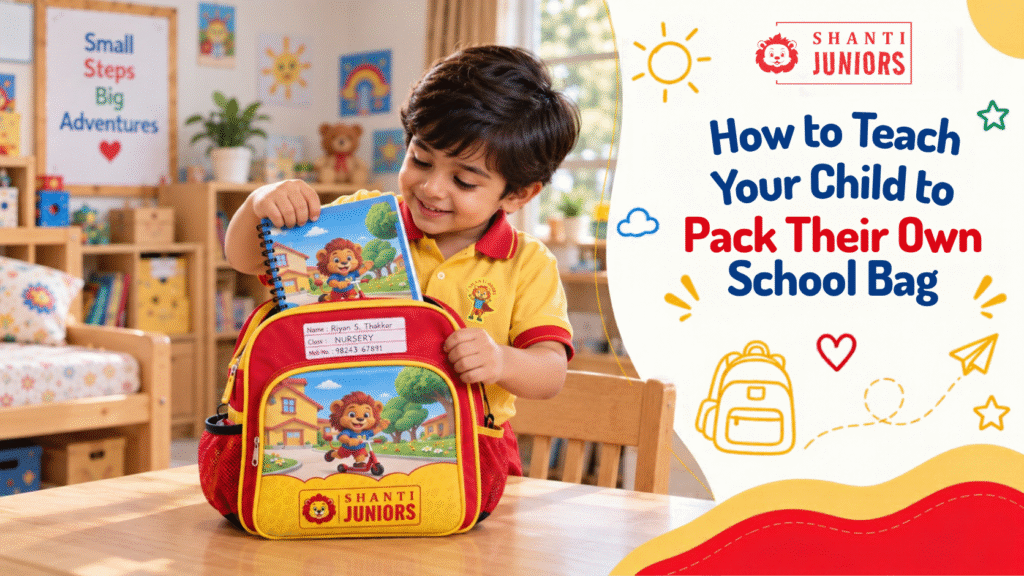
7:52 am. You’re holding a tiffin in one hand, a water bottle in the other, and a sock that may or may not belong to your child. Your child is watching cartoons.
It doesn’t have to be this way. Even a three-year-old can help pack their school bag, and by five or six most children can do it almost alone — with the right system. Here’s how to teach your child to pack their own school bag, step by step.
It’s faster to do it yourself — today. But teaching your child to pack their bag:
It’s one of the everyday things preschoolers can learn to do independently
Age | What your child can usually do |
2.5–3 | Put one or two items in the bag when handed to them; carry the bag; zip with help |
3–4 | Pack 3–4 items using a picture checklist with reminders; open and close the zip |
4–5 | Pack the full bag with the checklist and a quick check from you |
5–6 | Pack independently the night before; notice what’s missing; unpack after school |
A preschool bag should hold only a few things. Too many items overwhelm a small child. A typical preschool bag:
Choose a bag your child can open, close and carry — light, with a big zip pull or Velcro.
Preschoolers can’t read lists, but they can read pictures.
Level up for older children: add a tick box under each picture, or use clips your child moves from “to pack” to “packed”.
One fixed place, near the door: a hook for the bag, a low shelf for the tiffin and bottle, and the checklist on the wall above. The same place every day is what makes it a habit.
Mornings are rushed; evenings are calmer. After dinner or before bath:
In the morning, only the tiffin and water bottle go in — which your child can do.
Use the “I do, we do, you do” method:
Hardest part: don’t redo it. If the napkin is folded strangely, leave it. If they forget the napkin once and use their sleeve, that’s a natural lesson.
Problem | Try this |
“I don’t want to!” | Offer a choice: “Do you want to pack before or after bath?” |
Forgets items | Point to the checklist rather than telling them what’s missing |
Bag too heavy | Remove anything not needed; a preschooler’s bag should be light |
Can’t manage the zip | Add a big zip pull or ring; practise on a pencil pouch |
Tiffin won’t close | Choose a box with easy clips; practise opening and closing at home |
Packs toys instead | Agree that only checklist items go in; one small comfort item if school allows |
Bag-packing is a great start. The same picture-checklist method works for:
These routines build the planning and self-management skills that make school life smoother — and they free up your mornings. See our simple daily routine for preschoolers.
At Shanti Juniors, self-help skills are part of the daily routine: children hang their bags, open their tiffins, tidy materials and wash their hands independently. It’s part of the life-skills focus of the Kiddowitty curriculum across Nursery and Junior KG, inspired partly by Montessori practical-life activities. Opening a zip, a tiffin clip and a bottle lid also builds hand strength — the same skills in our fine motor activities for 3-year-olds.
From around three, children can put a few items in their bag using a picture checklist. By five to six, most can pack independently the night before, with a quick check from a parent.
Photograph your child's actual items — tiffin, bottle, napkin, spare clothes — stick the photos in a row on a card, laminate it, and hang it at eye level near the bag.
Use a picture checklist, pack the night before, and point to the checklist instead of reminding them. Occasional forgetting is normal and teaches natural consequences.
Yes, if the bag is light. A preschool bag should hold only the essentials. Carrying their own bag builds responsibility
Give small, regular, age-appropriate tasks — packing their bag, putting shoes away, tidying toys — use picture checklists, step back once they've learned, and praise effort.
One photo checklist. One hook by the door. Five minutes after dinner.
By next month, your 7:52 am might look very different.
To see how independence is built into the day at Shanti Juniors, find your nearest centre or book an admission enquiry.
Read next: Preschool Admission Checklist: Before the First Day · How to Teach Your Child Their Address and Emergency Information · Healthy Lunchbox Ideas for Preschoolers

Comments are closed