
- Email info@shantijuniors.com
- Phone +91 99796 66660
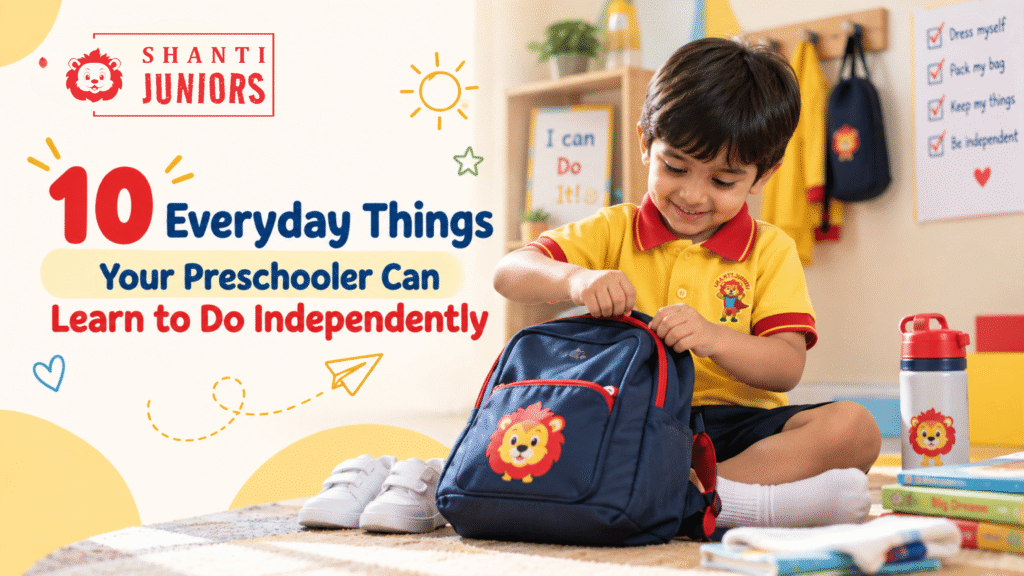
“Let me do it!”
It’s a sentence parents of preschoolers hear quite often.
Whether they’re trying to wear their shoes, pour water or carry something that’s almost as big as they are, young children have a natural desire to do things themselves.
Although stepping in is often quicker, allowing children to try age-appropriate tasks can help them develop independence, confidence and responsibility.
Being independent doesn’t mean a preschooler should manage everything alone. It means gradually discovering:
“I can try this myself.”
Here are 10 everyday things your preschooler can begin learning to do independently.
Start with one of the simplest responsibilities: tidying up after play.
Instead of cleaning everything once your child leaves the room, make putting toys back part of the activity itself.
Use simple instructions:
“Blocks go in this basket.”
“Books go back on this shelf.”
Clearly designated spaces make tidying easier for preschoolers to understand.
Yes, there may be spills.
And yes, dinner may take longer.
But allowing children to use a spoon, drink from their cup and manage age-appropriate foods independently helps develop valuable self-help skills.
Mealtimes can also introduce small responsibilities, such as carrying their plate or placing a napkin on the table.
If vegetables are the bigger challenge at your dining table, try these practical ways to encourage your child to eat vegetables.
Handwashing is one of the simplest routines children can gradually learn to manage.
Teach the sequence:
Wet hands.
Use soap.
Rub.
Rinse.
Dry.
Initially, they’ll need reminders and supervision. Over time, the sequence can become familiar.
Preschoolers don’t need to master complicated buttons and shoelaces immediately.
Start with easier clothing.
Let them try pulling up their shorts, putting their arms through sleeves or taking off a jacket.
These little tasks encourage independence while supporting coordination and fine motor development.
Parents can also try these fine motor skills activities for 3-year-olds to strengthen the small hand movements used in many everyday tasks.
Simple slip-on or Velcro shoes are a good place to start.
Instead of immediately putting your child’s shoes on, ask:
“Would you like to try first?”
Help only where needed.
Sometimes the most important part of teaching independence is knowing when not to take over.
A preschooler can begin taking responsibility for small personal belongings.
Their water bottle.
A light school bag.
Their lunchbox.
A favourite book.
Gradually show children where each item belongs and encourage them to remember their belongings themselves.
As this skill develops, parents can move to the next step: teaching children how to pack their own school bag.
Independence isn’t only physical.
Decision-making matters too.
Instead of making every small choice for your child, offer two suitable options:
“Would you like the red T-shirt or the blue one?”
“Would you like to colour or do a puzzle?”
“Would you like an apple or a banana?”
Small choices allow preschoolers to practise thinking, deciding and communicating their preferences.
Preschoolers can participate in the kitchen without handling anything unsafe.
Depending on their age, they can:
Kitchen activities combine responsibility with sensory learning and vocabulary.
They can also become an opportunity to teach fruit and vegetable names through fun activities.
Young children can begin learning that belongings need to be cared for.
Encourage them to:
Put crayons back after colouring.
Keep books on the shelf.
Place their bottle in its designated spot.
Put dirty clothes into a laundry basket.
These are tiny responsibilities, but together they create an understanding of ownership and organisation.
Independence does not mean doing everything without help.
Knowing when and how to ask for help is an important skill too.
A child who can say:
“I can’t open this.”
“Can you help me?”
“I don’t understand.”
is learning to recognise their own limits and communicate their needs.
That’s independence too.
Think about the difference between these two thoughts:
“Someone will always do it for me.”
and
“Maybe I can try.”
That second thought is powerful.
Every time a child successfully puts away a toy, wears their shoes or carries their own bottle, they experience a small sense of capability.
Shanti Juniors places emphasis on developing capable and empowered young learners through everyday experiences. Parents can learn more about this philosophy on the Shanti Juniors Childhood page and explore the different approaches to early learning.
If your child takes five minutes to put on a shoe you could put on in ten seconds, it’s tempting to step in.
Sometimes you will need to.
But when there’s time, let them struggle a little.
Let them try.
Let them get something slightly wrong.
Then guide them.
Independence isn’t created by expecting children to suddenly know how to do things.
It’s built through hundreds of small opportunities to practise.
Eating independently, washing hands, dressing, putting away toys, carrying belongings and making simple choices are useful places to start.
Give your child time to attempt the task first. Offer guidance when necessary rather than immediately completing the entire task for them.
Give them small, consistent responsibilities such as putting toys away, carrying their bottle or helping prepare the table.
Preschool provides opportunities to manage routines, make choices, interact with peers and participate in age-appropriate activities independently.

Comments are closed