
- Email info@shantijuniors.com
- Phone +91 99796 66660

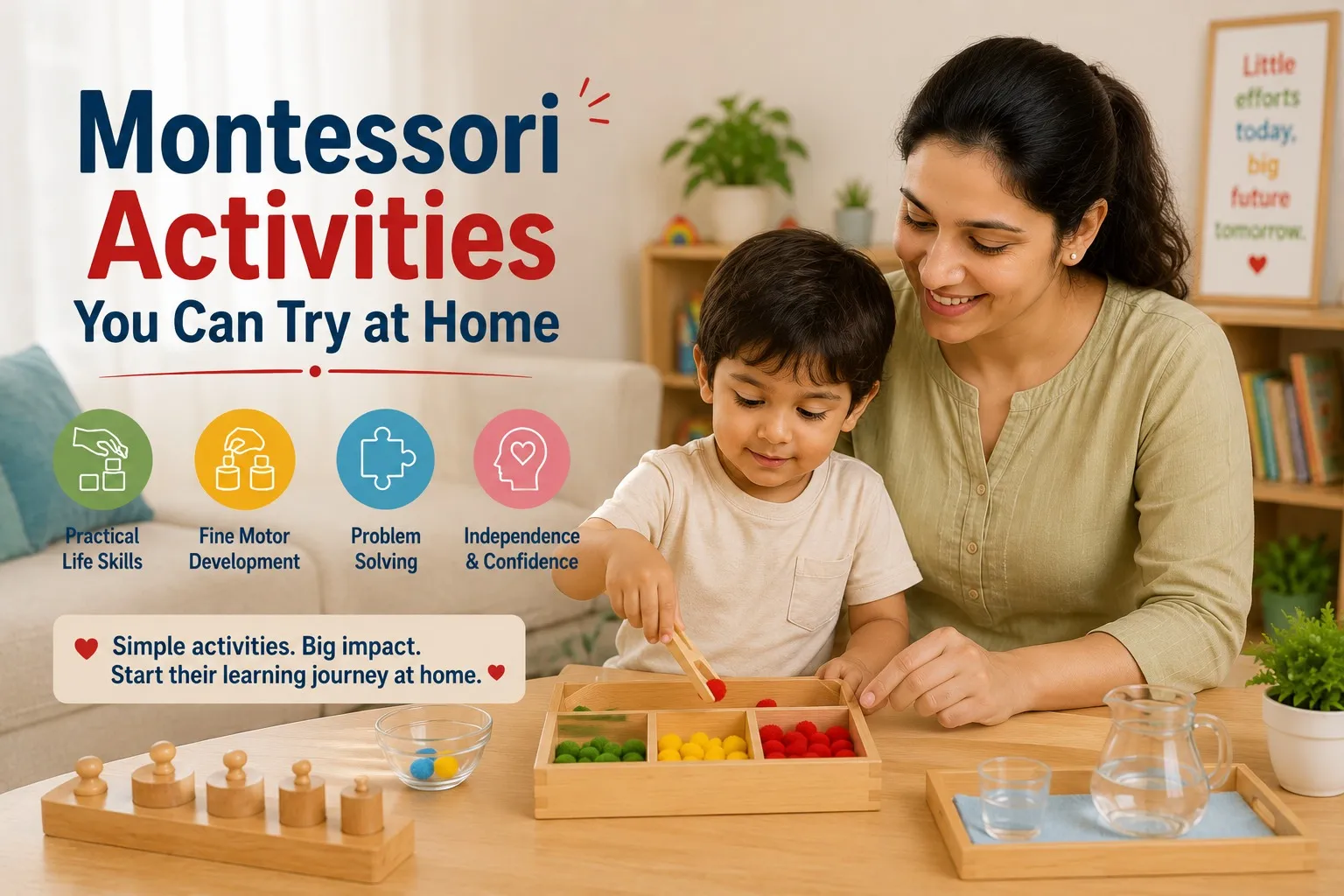
You don’t need a classroom full of specialized materials to introduce Montessori learning into your child’s daily routine. Many Montessori activities you can try at home use everyday household items while helping children build confidence, independence, and essential life skills.
The Montessori approach encourages hands-on learning, self-directed exploration, and practical experiences that allow children to learn at their own pace. Whether you have a toddler or a preschooler, these Montessori activities for toddlers and Montessori activities for kids can turn ordinary moments into meaningful learning opportunities.
Montessori activities are child-centered tasks designed to encourage independence, concentration, problem-solving, and fine motor development. Rather than focusing on worksheets or passive learning, children actively explore concepts through real-life experiences.
These activities are often simple, purposeful, and allow children to repeat tasks until they master them.
Creating a Montessori-inspired environment at home offers several developmental benefits.
Some of the key advantages include:
Parents don’t need expensive equipment—consistency and thoughtful activities are far more important.
Here are some fun and educational Montessori-inspired activities that are easy to set up using items you likely already have.
Pouring water, rice, beans, or lentils between two small containers helps children improve hand-eye coordination and control.
You’ll need:
Start with dry materials before introducing water to minimize spills.
This simple activity strengthens fine motor skills and concentration.
Provide:
Children transfer the objects from one bowl to another while practicing precision and patience.
Sorting activities introduce early math concepts while improving observation skills.
Use everyday objects such as:
Ask your child to group items based on color, size, shape, or type.
Practical life activities Montessori parents introduce at home are a core part of this educational approach.
Invite your child to fold:
This activity promotes independence while developing coordination.
Giving children responsibility for caring for plants teaches patience and responsibility.
Provide a small watering can and show them how much water each plant needs.
This also encourages a connection with nature.
Children love helping in the kitchen.
Ask them to:
This practical activity develops independence while teaching healthy habits.
Print or draw simple pictures of common household items.
Children can match:
This activity improves vocabulary and visual recognition.
Take a walk outdoors and ask your child to collect natural objects like:
Later, they can sort, compare, or create artwork using their collection.
Nature-based learning encourages observation and curiosity.
Children enjoy preparing their own snacks when given safe, age-appropriate tasks.
They can:
These activities improve coordination and build confidence.
Children naturally enjoy imitating adults.
Offer child-sized cleaning tools so they can:
These practical life activities help children take pride in caring for their environment.
A prepared environment encourages children to explore independently.
Some simple ideas include:
A calm, organized space helps children focus and make independent choices.
You don’t need to follow every Montessori principle perfectly. Small changes can make a big difference.
Keep these tips in mind:
Learning becomes more meaningful when children are allowed to discover solutions on their own.
When trying Montessori activities at home, avoid these common mistakes:
Montessori learning emphasizes patience, repetition, and independence rather than speed.
Trying Montessori activities at home doesn’t require expensive materials or a dedicated classroom. Everyday routines like folding clothes, watering plants, preparing snacks, and sorting household items can become valuable learning experiences.
By creating opportunities for hands-on exploration and independence, parents can support their child’s confidence, creativity, and lifelong love of learning. Start with one or two simple activities and gradually introduce more as your child grows and gains new skills.
Montessori activities can begin as early as infancy, with simple sensory experiences. Toddlers and preschoolers especially benefit from practical life and hands-on learning activities.
No. Many Montessori activities use everyday household items such as bowls, spoons, cloths, containers, and kitchen tools.
Let your child’s interest guide the session. Some activities may last 10–15 minutes, while others can keep children engaged for much longer.
Yes. Montessori learning encourages children to complete tasks on their own, helping them build confidence, responsibility, and problem-solving skills.
Start with one or two activities and rotate them regularly. Offering too many choices at once can overwhelm young children and reduce focus.
Comments are closed