
- Email info@shantijuniors.com
- Phone +91 99796 66660
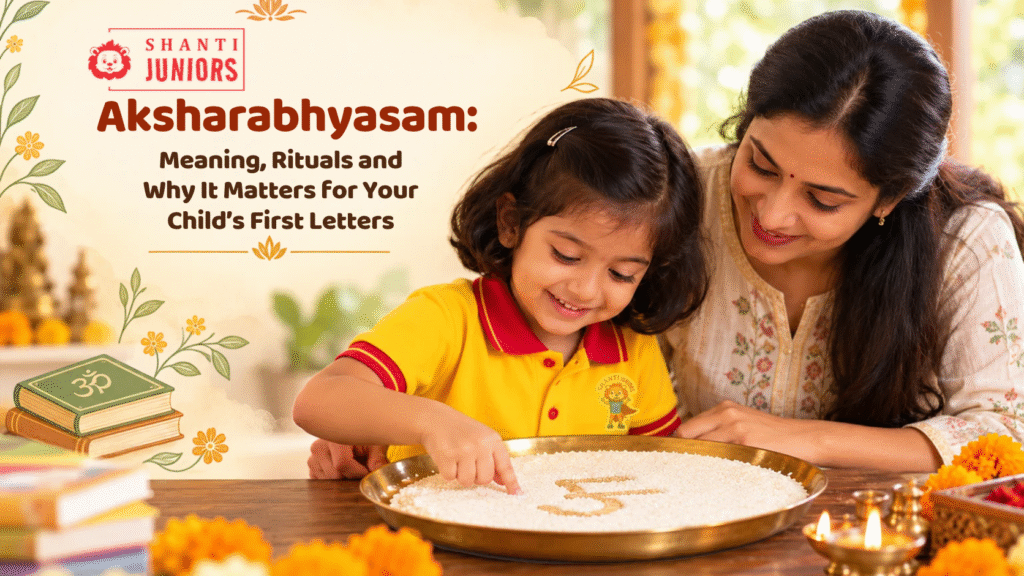
The Aksharabhyasam is done. The photos are on the family WhatsApp group. Your child traced “అ” or “अ” or “Om” in a plate of rice — and now there is a brand-new slate, a box of chalk and a question in your mind:
What do we do now?
Here is the short answer: don’t rush to the alphabet. Writing is built on hand strength, finger control and a handful of simple strokes, and all of these grow best through play. This guide gives you 10 playful pre-writing activities for preschoolers and a simple 30-day plan to keep the joy of the ceremony going — about 15 minutes a day, no worksheets.
(New to the ceremony? Read Aksharabhyasam: Meaning, Rituals and Why It Matters first.)
Pre-writing skills are everything a child needs before they can write letters comfortably:
Every letter in every Indian script and in English is built from a few basic strokes: lines, curves, circles and crosses. Learn the strokes, and letters become much easier later.
These ages are rough guides from child-development practice. Children vary, so use them to choose the next step, not to test your child.
Stroke | Typically copied around | Letters it leads to |
Vertical line | | 2–3 years | l, i, t, 1 |
Horizontal line — | 2.5–3 years | t, e, f, H |
Circle ○ | 3 years | o, a, d, g, 0 |
Cross + | 3.5–4 years | t, f, + |
Square □ | 4–4.5 years | boxes, E, F |
Diagonal lines / \ | 4–5 years | v, w, x, k, A |
X | 4.5–5 years | x, X |
Triangle △ | 5 years | A, v, letter shapes |
Important: most three-year-olds are working on lines and circles. Formal letter writing usually comes around age 5. If your child is 3, the plan below is about strength and strokes — and fun.
Families usually choose one of these:
Timings vary by panchang and by region, so confirm with your temple or family priest. (For the story behind Vijayadashami to share with your child, see our Dussehra story for kids.)
Most families perform it between ages 2 and 5, and very commonly around age 3, just before or as a child begins preschool. Some traditions prefer the child’s third or fifth year.
Developmentally, this timing makes sense. Around two and a half to three, most children:
There is no “too late.” A child who has Aksharabhyasam at four or five loses nothing. And there is no need to rush it for a two-year-old who is not ready to sit — the ceremony is meant to be a happy beginning, not a test.
If you’re also wondering when to start preschool itself, see what age should a child start preschool.
Spread rice (or semolina, sand or salt) in a flat tray. Let your child draw lines, circles and “rain” with one finger. Shake to erase and start again. Builds: finger control, stroke practice, and a lovely link back to the ceremony. Level up: draw a stroke yourself; your child copies it beside yours.
Roll snakes, squash balls, pinch “cookies”, poke holes with a finger, cut with plastic scissors. Builds: hand strength — the single biggest foundation for a comfortable pencil grip. Level up: roll dough snakes into lines and circles — “Let’s make a big O!”
Use kitchen tongs (or tweezers for older children) to move pom-poms, cotton balls or chana from one bowl to another. Builds: the pincer grip and finger coordination. Level up: sort by colour as you go — a great link to our Navratri colour activities.
Tape paper to a wall or use a chalkboard or easel. Draw big up-and-down lines, rainbows and circles. Builds: shoulder stability and the wrist position that writing needs. Working on a vertical surface naturally sets the wrist in a good writing position.
Clip clothes pegs around the edge of a paper plate or a box. Make a “sun” with pegs as rays. Builds: finger strength and the pinch needed to hold a pencil.
Tear coloured paper into small pieces, scrunch them into balls, and stick them inside a big outline — a mango, a fish, a letter of your language. Builds: finger strength, bilateral coordination, and an early feel for letter shapes.
Thread big beads, pasta or cut straws onto a shoelace or string. Builds: hand–eye coordination and two hands working together. Safety: use large pieces for children who still mouth objects.
Give your child a paintbrush and a cup of water. “Paint” lines and circles on a wall, a floor tile or a slate. They vanish as they dry, so there’s no pressure and no mess. Builds: brush control and stroke practice.
Draw wide “roads” on paper — straight, curved, zig-zag, round — and let your child drive a small toy car along them, then trace them with a crayon. Builds: following a path with the eyes and hand — the skill behind tracing and later writing. Level up: make the roads narrower over the weeks.
Snap crayons into short pieces (about 3–4 cm). Short crayons naturally encourage a tripod grip — thumb, index and middle finger. Then return to the Aksharabhyasam slate with chalk and practise the strokes your child has mastered in rice and paint. Builds: a healthy grip and confidence on the “real” slate.
About 15 minutes a day. Repeat freely — children love repetition, and repetition is how skills stick.
Week 1 (Days 1–7): Hands get strong Rice tray · play dough · tear and stick · wall chalk. Goal: happy hands, big movements, vertical lines in rice.
Week 2 (Days 8–14): Fingers get clever Tongs and pom-poms · pegs · threading · play dough snakes. Goal: pincer grip, horizontal lines, first circles.
Week 3 (Days 15–21): Lines and circles Water painting · road tracing · easel painting · rice tray copying. Goal: copy a vertical line, a horizontal line and a circle.
Week 4 (Days 22–30): Back to the slate Broken crayons · slate and chalk · road tracing (narrower) · the first letter from the ceremony, traced in rice, then on the slate. Goal: draw strokes on the slate; trace the Aksharabhyasam letter with a finger — and, if ready, with chalk.
Day 30 celebration: put the slate next to a photo of the ceremony. Ask your child to “show Nani” what they can do now. Celebrate the effort, not the neatness.
Most children move through these stages:
Approx. age | Typical grip |
1–2 years | Fist grip — whole hand wrapped around the crayon |
2–3 years | Fingers pointing down, palm facing the paper |
3–4 years | Developing a four-finger or early tripod grip |
4–6 years | Mature tripod grip — thumb, index and middle finger |
Tips:
When you see these — often around age four to five — your child is moving towards letters. Until then, keep it playful.
Every child develops at their own pace. Consider speaking to your paediatrician or an occupational therapist if, by around age 4 to 4.5, your child:
Early support is easy, effective and nothing to worry about.
Writing is talking on paper. While hands get ready, keep building words: read every day, sing nursery rhymes, and ask open questions — see how to teach WH questions through everyday conversations. If you notice your child mixing up some sounds, that is common at this age; our guide why does my child pronounce some words differently? explains what’s typical.
At Shanti Juniors, we follow the same order as this plan: hands first, strokes next, letters last. Through the Kiddowitty curriculum, children in Nursery build strength through sensory and Montessori-style activities, pre-writing strokes and letter sounds come in Junior KG, and formal letter formation follows in Senior KG. You’ll find more home ideas in our fine motor activities for kids, fine motor activities for 3-year-olds and homework for preschoolers posts. And everyday self-help tasks — buttoning, opening a tiffin, pouring water — build the same hand skills; see 10 things your preschooler can learn to do independently.
Keep learning playful and hands-on. Focus on hand strength, finger control and pre-writing strokes — lines and circles — through activities like rice trays, play dough, tongs, wall chalk and threading, for about 15 minutes a day. Formal letter writing usually begins around age 5
Play-based activities that build the skills needed for writing: play dough, tearing paper, using tongs and pegs, threading beads, drawing on vertical surfaces, tracing in rice or sand, water painting and following "roads" with a toy car or crayon.
Usually vertical line, horizontal line, circle, cross, square, diagonal lines, X and triangle, developing roughly between ages 2 and 5.
Most children are ready for formal letter writing around age 5, once they can copy basic strokes and hold a crayon with a developing tripod grip. Before that, play-based pre-writing activities are more effective than worksheets.
Usually not. Most three-year-olds are still developing their grip. Build hand strength with play dough, pegs and tongs, and use short crayons. If by 4 to 4.5 your child still can't copy a line or circle or avoids all hand activities, ask your paediatrician or an occupational therapist.
Generally not as a main activity. Tracing letters before the hand is ready can create a tight, awkward grip. Sensory, hands-on play builds writing readiness much better at this age.
About 10–15 minutes for a three- or four-year-old, stopping while your child is still enjoying it.
Keep the rice plate photo. Keep the slate. And remember that the real gift of Aksharabhyasam is the feeling it gives your child — that learning is joyful, blessed and theirs.
To see how Shanti Juniors builds on that first letter, day by day and through play, find your nearest Shanti Juniors centre or book an admission enquiry. Planning ahead for admission season? Our preschool admission documents checklist will help.
Read next: After Aksharabhyasam: 10 Pre-Writing Activities for the Next 30 Days · Dussehra Story for Kids · Fine Motor Activities for Kids

Comments are closed