
- Email info@shantijuniors.com
- Phone +91 99796 66660
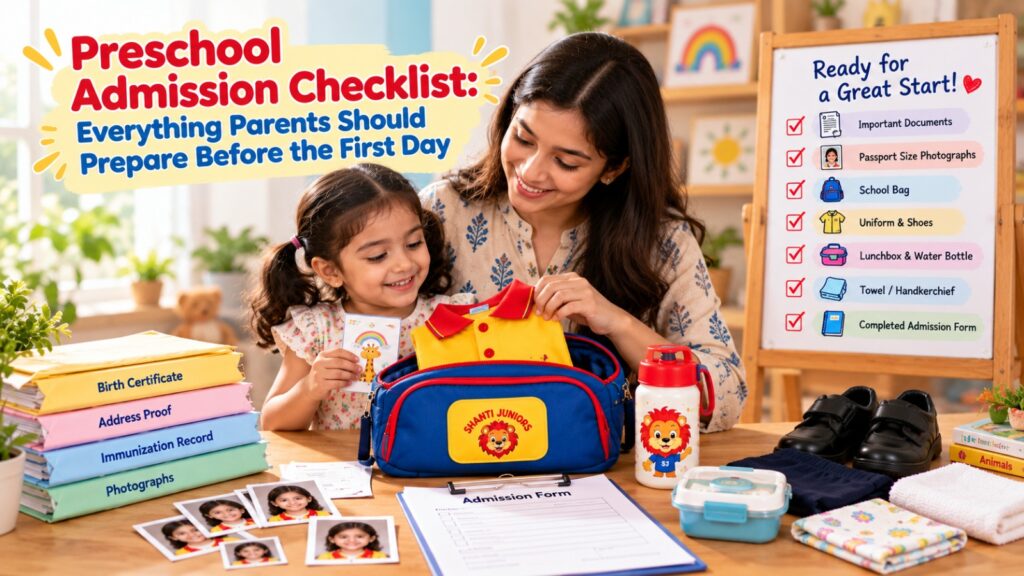
The admission is confirmed. The fees are paid. And now there is a strange gap of a few weeks where nothing is happening — except, in your head, everything.
What do they need to bring? Should you start waking them earlier? What if they cry? What if you cry?
This preschool admission checklist covers everything to prepare between “admission confirmed” and “first day”, in the order you’ll actually need it: paperwork, health, the bag, labelling, routine, skills, and the emotional prep that makes the biggest difference of all.
Print it, tick it, relax. A printable version is at the end.
Most of this is done at admission, but check nothing is pending.
Ask the school for: the term calendar, daily timings, the first-week schedule (many preschools start with short days), uniform and supply list, and how they’ll update you during the day.
Starting preschool often means a few more colds in the first months as children meet new germs. That’s normal — our guide on season change, coughs and colds explains when to keep your child home.
Keep it simple and light. A preschool bag should be small enough for your child to carry.
Daily bag checklist:
Avoid: expensive toys, sharp items, anything with small detachable parts, and heavy books.
Want your child to pack it themselves? Here’s how to teach your child to pack their own school bag — a great independence skill.
Preschoolers have identical water bottles, identical tiffins and identical sweaters. Label:
Tip: add a small picture sticker as well as the name — your child can recognise their own things before they can read.
The biggest first-day struggles are often about sleep, not school.
A predictable home routine helps enormously — see our simple daily routine for preschoolers.
Your child doesn’t need to know letters or numbers. These everyday skills matter far more:
More ideas: 10 everyday things your preschooler can learn to do independently.
Talk about it positively — but not too much. A few mentions a day is plenty. Over-talking can increase anxiety.
Visit the school together at least once before the first day. Meet the teacher. See the toilet and the play area.
Read books about starting school, and play “school” at home with toys.
Use the teacher’s name at home. “Riya ma’am will be there.”
Plan a short, confident goodbye. A hug, a kiss, “I’ll pick you up after lunch,” and leave. Never sneak away — it breaks trust.
Expect tears — and know they pass. Most children settle within 2–3 weeks. Our guides on separation anxiety at preschool and preparing for the first day of school go deeper.
Look after yourself too. If you’re anxious, your child will notice. Have a plan for the first morning — maybe coffee with a friend — so you’re not sitting outside the gate.
To know what your child’s day will look like, read what happens during a typical preschool day.
Paperwork: ☐ Admission form ☐ Documents ☐ Fee receipt ☐ Pick-up list ☐ Emergency contacts ☐ Medical/allergy form ☐ Consent forms Health: ☐ Vaccinations ☐ Check-up ☐ Allergies in writing ☐ Sick-day plan Bag: ☐ Backpack ☐ Tiffin ☐ Water bottle ☐ Napkin ☐ Spare clothes ×1–2 ☐ Diapers/wipes if needed ☐ Comfort item Labels: ☐ Bag ☐ Tiffin ☐ Bottle ☐ Clothes ☐ Sweater/cap ☐ Shoes Routine: ☐ Sleep shifted ☐ Morning practised ☐ Trial journey Skills: ☐ Toilet request ☐ Handwashing ☐ Tiffin/bottle ☐ Shoes ☐ Name ☐ Asking for help Emotional: ☐ School visit ☐ Teacher’s name ☐ Books/role play ☐ Goodbye plan
Shanti Juniors centres share a joining kit and a first-week plan with families, and many run a gentle settling-in period with shorter days at the start. [CONFIRM: parent orientation / settling-in policy]. Our FAQs answer common first-week questions, and our Nursery and Toddcare pages explain each programme’s routine.
Complete all forms and documents, update vaccinations, pack a light bag with tiffin, water bottle and spare clothes, label everything, shift the sleep routine to school timings, practise self-help skills like handwashing and asking for the toilet, and visit the school together.
A small backpack, an easy-to-open tiffin, a water bottle, a napkin, one or two full sets of spare clothes in a zip bag, diapers and wipes if needed, and a small comfort item if allowed. Label everything.
One full set daily, and two if your child is still potty training. Include inner wear and socks.
Not letters or numbers — but how to tell an adult they need the toilet, wash their hands, open their tiffin, eat independently, put on shoes and ask for help.
Most children settle within two to three weeks. Short, confident goodbyes and a consistent routine help most.
Follow the school's settling-in policy. Many preschools allow a short stay on day one, then encourage a brief goodbye. Sneaking away tends to make separation harder.
Tick the list over three or four weeks, not the night before. Then on day one, all that’s left is a hug.
Haven’t chosen a preschool yet? Find your nearest Shanti Juniors centre or book an admission enquiry.
Read next: What Documents Are Required for Preschool Admission? · How to Teach Your Child to Pack Their Own School Bag · Separation Anxiety at Preschool

Comments are closed