
- Email info@shantijuniors.com
- Phone +91 99796 66660
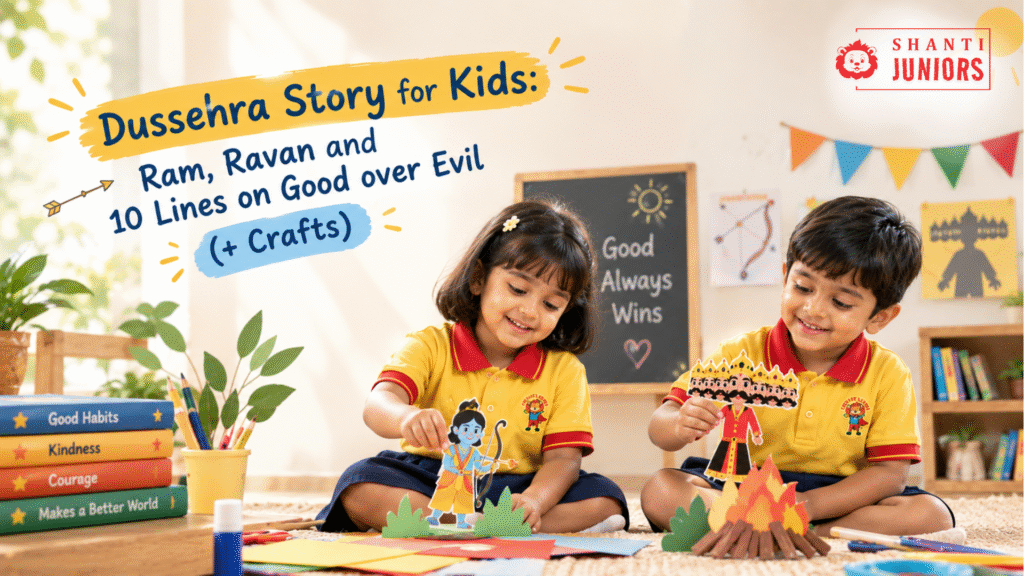
Dussehra 2026 falls on Tuesday, 20 October 2026 — the day after nine nights of Navratri. Across India, effigies of Ravan will burn, families will exchange sweets, and somewhere a five-year-old will ask: “Why did Ravan have ten heads? And why are we burning him?”
This guide gives you the Dussehra story for kids in simple words, 10 lines on Dussehra for school, a much-loved “burn ten bad habits” activity, easy crafts, and a gentle way to explain Ravan Dahan.
Dussehra (also called Vijayadashami — “the tenth day of victory”) is celebrated for two connected reasons:
Both stories share one message, which is the only thing a preschooler needs to take away: good wins over bad.
For ages 2–3 (three sentences) Ram was a kind and brave prince. A bad king called Ravan took away his wife, Sita. Ram and his friends rescued her, and everyone was happy again.
For ages 3–5 (the short story) Long ago, in a kingdom called Ayodhya, lived a kind prince called Ram, his wife Sita and his brother Lakshman. They went to live in the forest for many years.
One day, a king called Ravan, who lived far away in Lanka, took Sita away in his flying chariot. Ravan was very clever and very strong — he had ten heads! But he was also proud and unkind.
Ram and Lakshman searched everywhere. They made friends with a monkey army, led by the brave Hanuman. Hanuman jumped all the way across the sea to find Sita. Then the monkeys built a bridge of stones over the water so everyone could cross.
Ram and Ravan had a big battle. In the end, Ram won, Sita was safe, and they all went home. That day of victory is Dussehra. Twenty days later, when they reached home, the people lit lamps everywhere — and that is Diwali!
For ages 5–6 (add the meaning)
The squirrel is worth its own moment. In the popular telling, a tiny squirrel rolled in the sand and shook it onto the bridge to help. Ram stroked its back gratefully — and that, the story goes, is why squirrels have stripes. Small children love this, and it is the perfect lesson for the smallest person in the family: your help counts too.
Linking it to Diwali is one of the easiest ways to make the festival season make sense to a child: Dussehra is the victory, Diwali is the homecoming.
Shorter version for 3–4 year olds (5 lines): Dussehra is a festival. Lord Ram was good and brave. Ravan was bad and had ten heads. Ram won the battle. Good always wins!
Practise standing up, looking at the listener, speaking slowly. Confidence matters more than perfect words.
This is the most meaningful Dussehra activity you can do with a young child, and it takes 20 minutes.
You need: a big sheet of paper, ten small paper circles or plates for heads, crayons, glue.
Why tearing, not burning: it is safer, and the physical act of tearing gives a young child a satisfying, concrete ending. Adults should model a habit too — children love seeing a parent tear off “using phone at dinner”.
Follow-up: for the next ten days, give a small sticker whenever your child notices themselves not doing one of the habits. Positive noticing works far better than reminders.
Big effigies, loud crackers and fire can frighten young children.
What to say: “This is a big model of Ravan. When it burns, it means all the bad things are going away, and good wins. Nobody is hurt — it is just paper and bamboo.”
Safety at Ravan Dahan:
What they do | What it builds |
Hear and retell the Ram–Ravan story | Language, sequencing, memory |
Name ten bad habits | Self-awareness and emotional vocabulary |
Tear off the Ravan heads | Concrete understanding of change and goodbye |
Make the bow, gada and crown | Fine motor skills and pretend play |
Cross the “stone bridge” | Balance and gross motor skills |
Hear about the squirrel’s help | Empathy and the value of small contributions |
At Shanti Juniors, Dussehra closes the Navratri theme week — the nine colours, garba and dandiya and the Ram–Ravan story woven into language, art and movement. That is the Kiddowitty curriculum at work, and you can see the rhythm of a school day in what happens during a typical preschool day.
Ravan, the ten-headed king of Lanka, took Sita away. Lord Ram, with his brother Lakshman, Hanuman and an army of monkeys, built a bridge to Lanka, defeated Ravan and rescued Sita. The day of victory is Dussehra; their homecoming twenty days later is celebrated as Diwali.
Dussehra (Vijayadashami) 2026 is on Tuesday, 20 October 2026. Muhurat timings vary by city, so check your local panchang.
In the stories, the ten heads show how clever and powerful Ravan was. Many families explain them to children as ten bad habits — like pride, anger and greed — which is why burning or tearing them up means saying goodbye to those habits.
Dussehra is a Hindu festival also called Vijayadashami; it comes the day after Navratri; Lord Ram defeated Ravan, who had ten heads; Maa Durga defeated Mahishasura; people watch Ramlila and burn Ravan effigies; families share sweets; and the festival teaches that good wins over evil. The full ten lines are above.
Only from a safe distance with ear protection — effigies contain firecrackers. For children under three, watching at home and doing a paper Ravan activity is often a better choice.
In the popular telling, Ram defeated Ravan on Dussehra and returned home to Ayodhya around twenty days later. The people lit lamps to welcome him — the origin of Diwali, which falls on 8 November in 2026.
The "ten bad habits" Ravan activity, paper-plate Ravan, bow and arrow craft, a stone-bridge balance game, a squirrel craft and role-play with a crown and gada.
Make the paper Ravan this evening. Let your child pick the habit to say goodbye to. Tear it off together.
That’s the whole festival in one moment: good wins, and we get to start again.
To see how festival weeks build real learning at Shanti Juniors, find your nearest centre or book an admission enquiry. If you’re planning for next year’s admission season, our preschool admission documents checklist will save you a scramble in December.
Read next: Navratri for Kids: The Story of Maa Durga · How to Teach WH Questions to Preschoolers · Garba & Dandiya with Little Ones

Comments are closed