
- Email info@shantijuniors.com
- Phone +91 99796 66660
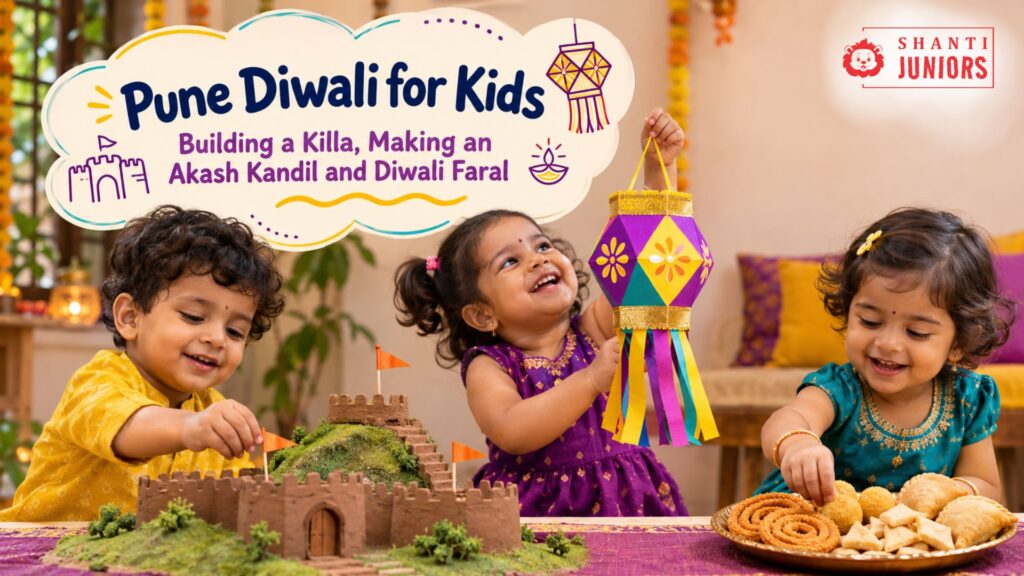
Walk through any Pune society in the week before Diwali and you’ll see it: a heap of mud in a corner of the compound, a group of children with sticks and buckets, and a fort slowly taking shape, complete with a tiny Shivaji Maharaj on the ramparts.
The Diwali killa is one of Maharashtra’s most loved children’s traditions. This guide shows Diwali killa making for kids step by step, how to make a simple akash kandil, how little ones can help with Diwali faral, and what Vasu Baras, Padwa and Bhau Beej mean, in words a preschooler can follow.
Maharashtra Diwali 2026: Vasu Baras Thu 5 Nov (confirm locally) · Dhanteras Fri 6 Nov · Narak Chaturdashi and Lakshmi Puja Sun 8 Nov · Diwali Padwa Tue 10 Nov · Bhau Beej Wed 11 Nov. Based on Drik Panchang; local calendars can differ by a day.
Maharashtra is the land of forts: Sinhagad, Rajgad, Raigad, Shivneri, Pratapgad. Many were built or captured by Chhatrapati Shivaji Maharaj, and they’re a big part of Maharashtrian pride and history.
During the Diwali holidays, children recreate these forts with mud and stones, decorate them with toy soldiers, animals and Shivaji Maharaj’s figure, and show them off to visitors. Many societies and neighbourhoods in Pune hold killa competitions.
For a preschooler, the simple version: “Long ago, a brave king called Shivaji Maharaj built strong forts on the hills to keep his people safe. At Diwali, we build our own little fort to remember him.”
You need:
– Mud or garden soil (a bucket or two), or clay
– Stones and bricks for the base
– Water in a mug
– Small branches, grass, mustard or methi seeds (to grow “grass” on the fort)
– Toy soldiers, animals and a Shivaji Maharaj figure (sold in Pune markets before Diwali)
– Paper flags, a small diya (unlit, or battery) and coloured paper
Steps:
1. Pick a spot: a corner of the balcony, terrace or society compound. Lay an old sheet or a tray if you’re on a balcony.
2. Build the base: pile stones and bricks into a hill shape. This is the hill your fort will sit on. (Adult job for heavy stones.)
3. Cover with mud: your child mixes mud with a little water until it’s like thick dough, then pats it over the stones. Little hands love this part.
4. Shape the fort: press walls along the top, a gate at the front, a winding path up the hill and a flat top for the king.
5. Add details: a “lake” from a small steel bowl of water, steps cut with a spoon, towers made from paper cups covered in mud.
6. Sprinkle seeds on the slopes and water them gently each day. In 4–5 days, green shoots appear: your fort is “growing a forest.”
7. Decorate: place the soldiers, animals, flags and Shivaji Maharaj figure. Add a battery diya at the gate.
8. Show it off: invite neighbours and grandparents for a “fort tour” led by your child.
Age guide:
– 2–3 years: patting mud, placing stones and toys, watering seeds
– 3–4 years: shaping walls and the path, placing soldiers
– 4–6 years: planning the layout, building towers, naming the fort, giving the tour
What your child learns: building a killa is a real STEM activity: balance, structure, cause and effect (what happens if the mud is too wet?), and patience as the seeds grow. It’s also wonderful gross and fine motor play. Carrying buckets, patting and shaping all count (see why fitness matters for preschoolers).
Hygiene: wash hands well afterwards, and keep mud away from mouths.
The akash kandil (sky lantern) is the big star-shaped or box-shaped lantern hung outside Maharashtrian homes at Diwali. Traditional ones are bamboo and paper. Here’s an easy version for preschoolers.
Easy box kandil (age 3–6)
You need: an empty cereal or tissue box, coloured paper or old greeting cards, glue, child-safe scissors, crepe paper strips, string, an LED bulb or battery tealight.
Star kandil (age 5–6, with lots of help): two paper stars joined with paper strips. Your child decorates; you assemble.
More lantern and paper craft ideas are in easy Diwali crafts and rangoli for preschoolers.
Faral is the tray of Diwali snacks every Maharashtrian home makes and shares: chakli, karanji, shankarpali, chivda, besan ladoo, rava ladoo, anarse and shev.
Faral | Child job (age 3–6) | Adult only |
Besan / rava ladoo | Rolling small ladoos once the mixture has cooled | Roasting besan, handling hot ghee |
Karanji | Pressing the edges with a fork, or using a karanji mould | Frying |
Shankarpali | Cutting diamond shapes with a pastry cutter or blunt knife | Frying |
Chivda | Mixing cooled ingredients in a big bowl | Roasting and tempering |
Chakli | Watching the chakli press; laying out shapes on a plate | Pressing hot dough, frying |
Faral box | Arranging faral in boxes and decorating them | — |
Kitchen safety: children stay well away from the stove and hot oil, always. Give them their own station at the dining table.
Sharing faral: let your child carry a faral plate to a neighbour. It’s one of the best ways to teach sharing. For healthier, lower-sugar ideas, see a safe, eco-friendly Diwali with small children.
Vasu Baras (Thu 5 Nov, confirm): we thank the cow and her calf for giving us milk. Draw a cow and calf, or feed a cow with an adult.
Dhanteras (Fri 6 Nov): a day for health and good fortune. Help polish the family’s brass or steel vessels.
Narak Chaturdashi (Sun 8 Nov): an early abhyanga snan (oil bath) with utane (a fragrant herbal paste), new clothes, and the first faral of the day. Many families crush a small bitter fruit (karit) under the foot, a symbol of Krishna defeating Narakasura.
Lakshmi Puja (Sun 8 Nov): diyas, rangoli and prayers to Goddess Lakshmi in the evening. The main story is in Diwali for kids.
Diwali Padwa (Tue 10 Nov): a day for husbands and wives, and in many families the start of the new business year. It’s also Govardhan Puja; see Govardhan Puja story for kids.
Bhau Beej (Wed 11 Nov): sisters do aukshan (an aarti) for their brothers and pray for them; brothers give a gift. Ideas for only children and cousins are in Bhai Dooj story for kids.
Shanti Juniors centres in Pune celebrate the Maharashtrian Diwali season with stories, crafts and hands-on activities like mini forts and lanterns, which fit naturally with our I-Cube approach of imagining, investigating and creating. See more in our culture and celebrations. [CONFIRM: number of Shanti Juniors centres in Pune and Diwali break dates]
Pile stones into a hill shape, cover with mud mixed with water, shape walls, a gate and a path, sprinkle seeds on the slopes, water daily, and decorate with toy soldiers, flags and a Shivaji Maharaj figure.
To remember Chhatrapati Shivaji Maharaj and the forts he built and protected. Building killas during the Diwali holidays is a much-loved Maharashtrian tradition, and many Pune societies hold competitions.
Cut windows in a cardboard box, cover it with coloured paper, glue butter paper over the windows, add a crepe paper tail, and hang it with an LED light inside, never a candle.
Rolling cooled ladoos, pressing karanji edges, cutting shankarpali shapes, mixing cooled chivda and decorating faral boxes. Frying and roasting stay with adults.
Bhau Beej is on Wednesday 11 November 2026.
Diwali Padwa is on Tuesday 10 November 2026.
A heap of mud, a box lantern and a plate of faral for the neighbours. That’s a Pune Diwali your child will remember.
To see hands-on learning at a Shanti Juniors centre in Pune, find your nearest centre or book an admission enquiry.
Read next: Easy Diwali Crafts and Rangoli for Preschoolers · Bhai Dooj Story for Kids · Diwali for Kids: The Story and 10 Lines

Comments are closed