
- Email info@shantijuniors.com
- Phone +91 99796 66660
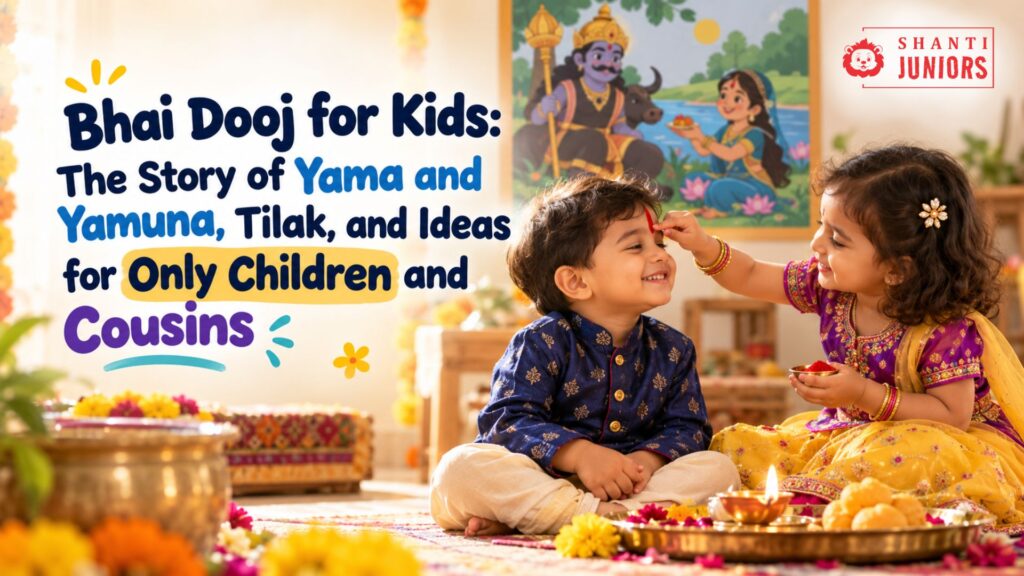
Bhai Dooj closes the Diwali week. A sister puts a tilak on her brother’s forehead, does a small aarti, feeds him a sweet, and prays for his long and happy life. He promises to look after her, and (very importantly, to most children) gives her a gift.
But what’s the story behind it? And what do you do if your child has no brother, no sister, or two sisters? This guide tells the Bhai Dooj story for kids, gives the Bhai Dooj 2026 date, and shares activities that include every kind of family.
Bhai Dooj 2026: Wednesday 11 November 2026 (Drik Panchang, New Delhi). It’s Bhau Beej in Maharashtra, Bhai Beej in Gujarat and Bhai Phonta in Bengal.
Read aloud. It takes about two minutes.
Long ago, there lived a brother and sister: Yama and Yamuna. Yama was a very important god with a very busy job. Yamuna was a beautiful river goddess who loved her brother very much.
Yamuna kept inviting her brother to visit her. “Please come to my home, Bhaiya! I’ll cook your favourite food.” But Yama was always too busy.
One day, two days after Diwali, Yama finally came. Yamuna was so happy! She cleaned her home, decorated it with flowers, and made all his favourite dishes. When he arrived, she put a tilak on his forehead, did an aarti, and fed him lovingly.
Yama was so touched that he said, “Dear sister, ask me for anything you wish.”
Yamuna smiled and said, “Just promise that you’ll visit me every year on this day. And bless every brother whose sister puts a tilak on his forehead today with a long and happy life.”
Yama happily agreed. And so, every year, two days after Diwali, sisters put a tilak on their brothers’ foreheads and pray for them. That’s Bhai Dooj!
Another story some families tell: after defeating the demon Narakasura, Lord Krishna visited his sister Subhadra, who welcomed him with a tilak, flowers and sweets.
The lesson: brothers and sisters love and look after each other, and it’s lovely to make time for the people we love.
| Raksha Bandhan | Bhai Dooj |
When | Shravan Purnima (July–August) | Two days after Diwali (October–November) |
What the sister does | Ties a rakhi on the brother’s wrist | Puts a tilak on the brother’s forehead, does aarti, feeds him |
What the brother does | Promises to protect his sister; gives a gift | Visits his sister; gives a gift; promises to look after her |
Simple way to explain | “The thread day” | “The tilak day” |
You need: a small thali, roli or kumkum, a few grains of rice (akshat), a diya, a sweet, and a small gift.
Steps:
1. The brother sits facing the sister (often facing north or east, if your family follows this).
2. The sister puts a dot of roli with her ring finger, then presses a few rice grains on it. (Help a toddler gently. A small dot is enough.)
3. She circles the diya in front of him in a small aarti. (An adult holds the thali with the lit diya; the child places their hands on top.)
4. She feeds him a small piece of sweet.
5. The brother gives a gift and a hug.
For children under 3: keep it short and playful. If your toddler wants to put tilak on everyone, including the dog and the teddy, that’s part of the fun.
Only child?
– Cousins: the most common answer. A video call works if they live far away.
– A close family friend’s child who feels like a sibling.
– Grandparents and parents: your child can put a tilak on Dada, Papa or Mama, which many families do.
– “Self-love Bhai Dooj”: your child puts a tilak on a parent, then a parent does one for them.
Two sisters, no brother?
Sisters can do tilak for each other. Many families now celebrate it as a day for siblings, whatever their gender.
Two brothers, no sister?
Brothers can do tilak for each other, or for a cousin sister.
New baby in the house?
Let the older child do a tiny tilak for the baby (with help) and receive a gift “from the baby.” It can help with jealousy. See sibling rivalry and the new baby.
Siblings who fight?
Totally normal. Bhai Dooj is a nice moment to notice the good: “Remember when your brother shared his biscuits?” Naming warm feelings builds emotional skills (see naming feelings in 2–5 year olds). If the day itself ends in a meltdown over gifts, our guide to toddler tantrums can help.
The full five days of Diwali are in Diwali for kids: the story, the 5 days and 10 lines, and the day before Bhai Dooj (with a gap this year) is Govardhan Puja.
Shanti Juniors celebrates festivals in ways that include every child, whatever their family looks like. Children hear the story, make cards for someone they love, and talk about kindness and caring, as part of our culture and celebrations and the Kiddowitty curriculum
Bhai Dooj is on Wednesday 11 November 2026. It’s called Bhau Beej in Maharashtra and Bhai Beej in Gujarat.
Yama visited his sister Yamuna two days after Diwali. She welcomed him with a tilak, aarti and his favourite food. Touched, Yama blessed all brothers who receive a tilak from their sister on this day with a long life.
With cousins (in person or on a video call), a close family friend’s child, or by doing tilak for parents and grandparents.
Yes. Many families now celebrate Bhai Dooj as a day for siblings, so sisters can do tilak for each other.
On Raksha Bandhan (July–August), the sister ties a rakhi. On Bhai Dooj (two days after Diwali), she puts a tilak on her brother’s forehead, does aarti and feeds him a sweet.
Books, colouring sets, play dough, puzzles, a plant, or a handmade coupon for a game together.
Whether it’s a brother, a sister, a cousin or a grandparent, Bhai Dooj is a chance for your child to say “you matter to me.”
To see how Shanti Juniors celebrates festivals with every child, find your nearest centre or book an admission enquiry.
Read next: Diwali for Kids: The Story and 10 Lines · Sibling Rivalry and the New Baby · Naming Feelings: Emotional Intelligence in 2–5 Year Olds

Comments are closed