
- Email info@shantijuniors.com
- Phone +91 99796 66660
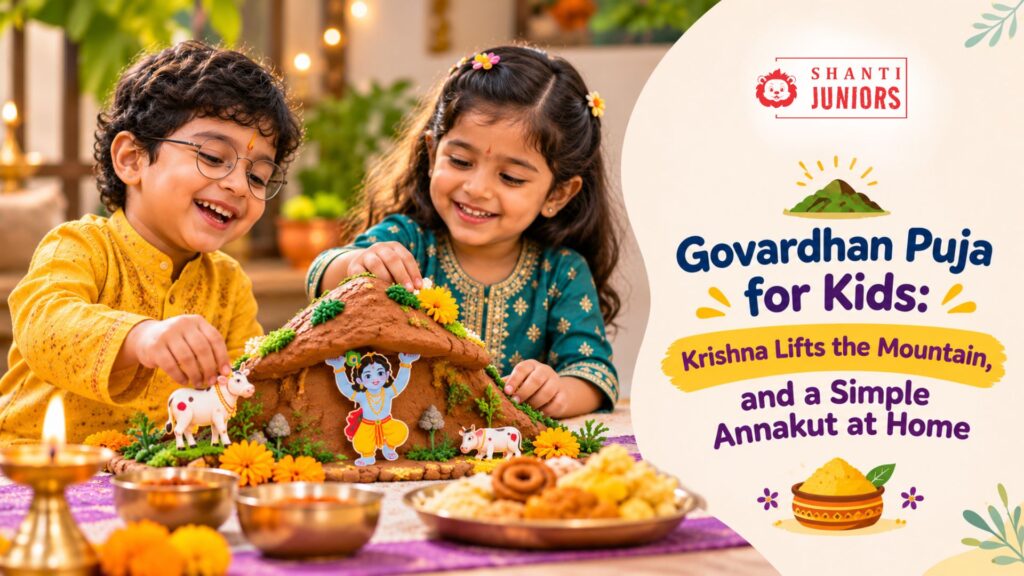
The day after Diwali’s lights, many families in Delhi, Lucknow, Jaipur and across North India make a small mountain, sometimes of cow dung, sometimes of food, and surround it with offerings. Children often ask, “Why are we making a mountain?”
The answer is one of the best Krishna stories there is. This guide tells the Govardhan Puja story for kids simply, explains Annakut for kids, gives the Govardhan Puja 2026 date, and shows how to make a small Annakut at home together.
Govardhan Puja 2026: Tuesday 10 November 2026 (Drik Panchang, New Delhi). In 2026 there’s a gap day between Diwali (8 Nov) and Govardhan Puja. The same day is Gujarati New Year, Diwali Padwa in Maharashtra and Bali Padyami in Karnataka.
Read aloud. It takes about three minutes.
Long ago, in a village called Gokul, lived a little boy called Krishna. Krishna loved his cows, his friends, butter, and playing his flute.
Every year, the villagers held a big puja for Indra, the king of the sky and the rain. They cooked lots of food for him and hoped he would send rain for their fields.
One year, little Krishna asked, “Why do we pray to Indra? It’s Govardhan, the mountain, that gives our cows grass to eat and gives us water and fruit. Let’s thank the mountain instead!”
The villagers agreed. They cooked all their food and offered it to Govardhan mountain.
Indra was very angry. “How dare they forget me!” he roared. He sent huge black clouds, thunder and lightning, and rain, rain, rain. It rained so hard that the village began to flood. The people and cows were scared and had nowhere to go.
Then Krishna walked to Govardhan mountain, and with just his little finger, he lifted the whole mountain up into the air like a giant umbrella!
“Come under the mountain!” he called. All the people, all the cows, all the calves and all the animals came and stayed safe and dry underneath.
For seven days and seven nights it rained. And for seven days and seven nights, Krishna held up the mountain on his little finger.
At last, Indra understood that he had been proud and unkind. He stopped the rain and said sorry to Krishna. Krishna gently put the mountain back down, and everyone cheered.
Ever since then, people make a little Govardhan mountain and offer it lots of food to say thank you. That’s Govardhan Puja.
The lessons for children:
– Say thank you to what looks after us: nature, animals, the people who grow our food.
– Helping others is what heroes do. Krishna used his strength to protect everyone.
– It’s okay to say sorry, even if you’re a king like Indra.
The 30-second version for a 2- or 3-year-old: “Big rain came. Everyone was scared. Little Krishna lifted a big mountain like an umbrella, and everyone stayed dry. Thank you, Krishna! Thank you, mountain!”
Anna means food and kut means a mountain. Annakut means “a mountain of food.” On Govardhan Puja, families and temples cook many different dishes and arrange them like a mountain as an offering to Krishna, to say thank you, just like the villagers of Gokul. Temples often prepare 56 dishes (chhappan bhog).
For children: “Annakut is a big thank-you party with lots of food for Krishna. Afterwards, we share it with everyone.”
You don’t need 56 dishes. Five or six is plenty for little ones.
You need:
– A large plate or thali
– Something for the “mountain”: a mound of cooked rice, or a heap of puffed rice (murmura), or a small clay mound
– 5–6 small foods already at home: poha, roasted chana, fruit pieces, a few sweets, kadhi or a dry sabzi, makhana
– A small Krishna idol or picture, flowers and a diya
Steps:
1. Make the mountain in the centre of the plate. Your child can pat the rice or murmura into shape.
2. Arrange the foods around it. Count them together: “One, two, three, four, five foods!”
3. Add flowers and leaves for “trees” on the mountain.
4. Place small toy cows or paper cows around it if you have them.
5. Light the diya (adult holds the flame) and say a simple thank-you together.
6. Share the food with family and a neighbour.
Why this works for preschoolers: counting, sorting, describing colours and textures, and practising gratitude, all in one activity. Food play like this also helps picky eaters warm up to new foods. See our healthy lunchbox ideas for more.
A note on cow dung Govardhan: many families traditionally make the Govardhan figure from cow dung in the courtyard. If you’d rather not have little hands in it, a clay, mud or rice mound works just as well for children.
Where | What it’s called | What happens |
Delhi, UP, Rajasthan, Mathura–Vrindavan | Govardhan Puja / Annakut | Govardhan figure, Annakut, parikrama of Govardhan hill in Mathura |
Gujarat | Bestu Varas (Gujarati New Year) | Annakut displayed at temples; see Gujarati Diwali for kids |
Maharashtra | Diwali Padwa | |
Karnataka | Bali Padyami |
The full five days of Diwali are explained in Diwali for kids: the story, the 5 days and 10 lines. Next comes Bhai Dooj.
At Shanti Juniors, festival stories like Govardhan are told at circle time and brought to life through crafts and role play, as part of our culture and celebrations and the Kiddowitty curriculum. [CONFIRM: Shanti Juniors centres in Delhi NCR, Lucknow and Jaipur]
Indra, the king of rain, was angry that the villagers thanked Govardhan mountain instead of him, so he sent a terrible storm. Krishna lifted the mountain on his little finger to shelter all the people and cows for seven days until Indra stopped the rain.
Govardhan Puja is on Tuesday 10 November 2026, according to Drik Panchang for New Delhi.
Annakut means “mountain of food.” Families and temples arrange many dishes like a mountain as an offering to Krishna, then share the food with everyone.
Make a small mound of rice or puffed rice on a plate, arrange 5–6 foods around it, add flowers and toy cows, light a diya, say thank you together, and share the food.
Be thankful to nature and the people who look after us, use your strength to help others, and say sorry when you’re wrong.
A little rice mountain, five foods and one story about a boy and his little finger. That’s enough to teach your child gratitude this Diwali.
To see how Shanti Juniors brings festival stories to life, find your nearest centre or book an admission enquiry.
Read next: Bhai Dooj Story for Kids · Diwali for Kids: The Story and 10 Lines · A Safe, Eco-Friendly Diwali

Comments are closed