
- Email info@shantijuniors.com
- Phone +91 99796 66660
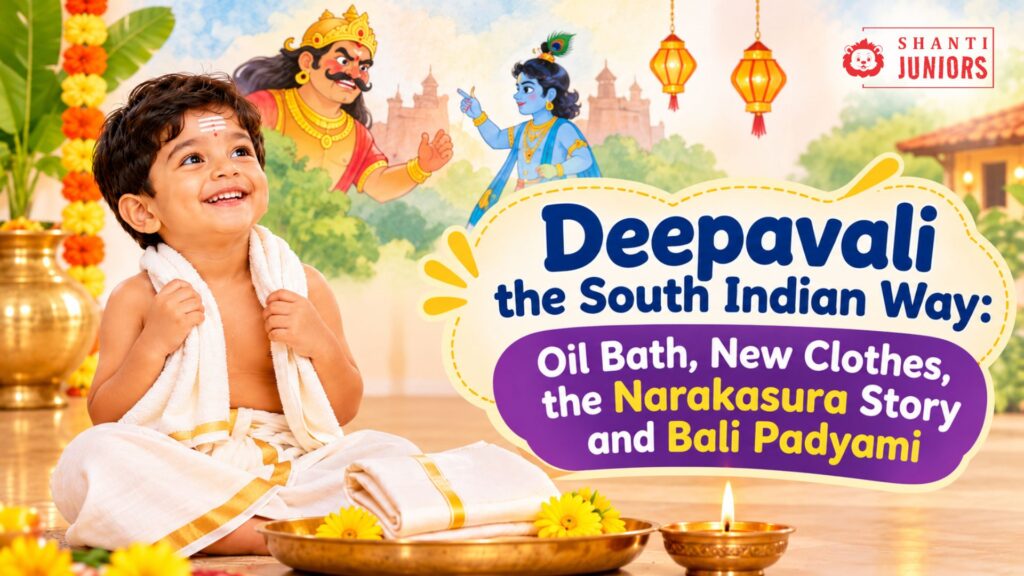
In North India, Diwali is an evening festival. In Chennai, Bangalore and Hyderabad, the biggest moment often comes before sunrise: a grandmother warming sesame oil, children half-asleep being led to an early bath, new clothes laid out, and the first crackers of the day at dawn.
This guide explains Deepavali for kids the South Indian way: the oil bath, the Narakasura story, new clothes, sweets, and Bali Padyami, with simple words for children aged 2–6 and safety tips for little ones.
Deepavali 2026: Naraka Chaturdashi, the main Deepavali morning in Tamil Nadu, Karnataka, Telangana and Andhra Pradesh, falls on Sunday 8 November 2026, the same day as North India’s Lakshmi Puja. Bali Padyami (Karnataka) is on Tuesday 10 November. Regional calendars can differ by a day; check yours.
Read aloud. It takes about two minutes.
Long ago, there was a demon king called Narakasura. He was very strong, and he became proud and unkind. He took away things that didn’t belong to him, and he made the people and the gods very unhappy. Everyone was afraid.
The people asked Lord Krishna for help. Krishna set off in his chariot with his brave wife, Satyabhama. There was a great battle. Narakasura was so strong that the fight went on and on.
At last, just as the sun was about to rise, Narakasura was defeated. The people were free again. Before the battle ended, Narakasura asked one thing: that people remember this day with lights and happiness.
So, early in the morning, everyone took a bath, wore new clothes, lit lamps and shared sweets. And that’s what we still do on Deepavali morning.
The lesson for little ones: being strong is not the same as being good. Kindness and courage win.
Telling it to a 2- or 3-year-old: “A long time ago, a mean king made everyone sad. Krishna and Satyabhama stopped him. Everyone was so happy that they woke up early, took a bath, wore new clothes and lit lamps. That’s Deepavali!”
The pre-dawn oil bath is at the heart of South Indian Deepavali. Elders apply warm oil (usually sesame/gingelly oil) to the head and body, sometimes with a little pepper or betel leaf warmed in it, followed by a bath with shikakai or herbal powder. In Tamil homes the bath is called Ganga snanam, because the water on this morning is said to be as pure as the Ganga, and people greet each other with “Ganga snanam aachaa?” (“Have you had your Ganga bath?”).
Why children love it: it’s special, it’s early, and it ends with new clothes.
New clothes: after the bath, children wear new clothes, often silk pavadai for girls and veshti or kurta for boys. Many families place the new clothes before the deity first.
Kolam / rangoli: a fresh kolam at the door, made with rice flour, often with diyas placed in the pattern. Children can help fill shapes or place flowers. See easy rangoli for kids.
Deepavali marundhu / lehiyam: a traditional ginger-and-spice paste many families take on Deepavali morning to help digest the rich festival food. Give young children only a very small taste, if any, and check ingredients for anything they’re sensitive to.
Sweets and snacks: murukku, ribbon pakoda, adhirasam, mysore pak, laddu, badusha and more. Children can help arrange sweets on plates for neighbours, which is a lovely way to teach sharing. For healthier options, see the sweets section in a safe, eco-friendly Diwali.
Crackers at dawn: if your family bursts crackers, keep children at a safe distance, never let under-5s hold anything lit, and keep a bucket of water nearby. Cracker-free alternatives are in the eco-friendly Diwali post.
City | How Deepavali is often celebrated | One local detail for kids |
Chennai | Pre-dawn Ganga snanam, new clothes, crackers and sweets in the morning; thalai Deepavali for newly married couples | Say “Ganga snanam aachaa?” to grandparents |
Bangalore | Naraka Chaturdashi oil bath, Lakshmi Puja, and Bali Padyami on Tue 10 Nov | Tell the King Bali story (below) |
Hyderabad | Naraka Chaturdashi morning, evening diyas; Karthika Masam begins after Deepavali, with lamps lit through the month | Light one lamp each evening in Karthika Masam |
Long ago, there was a king called Bali. He was very generous and his people loved him. But he became a little too proud, and he wanted to rule over everything, even the heavens.
One day, a small boy-priest called Vamana came to his court. “What would you like?” asked the king. “Just three steps of land,” said Vamana.
King Bali laughed. “Only three steps? Of course!”
Then Vamana grew bigger and bigger, until he was as tall as the sky. With one step he covered the earth. With the second, he covered the heavens. “Where shall I put my third step?” he asked.
King Bali bowed his head and said, “Put it here.” Vamana, who was really Lord Vishnu, was pleased by Bali’s humility. He sent Bali to rule a kingdom under the earth, and promised that Bali could visit his people once every year.
That visit is Bali Padyami. Families make a small figure of King Bali and welcome him with lamps and prayers.
The lesson: keep your promises, and be humble even when you’re strong.
Bali Padyami falls on the same day as Govardhan Puja in North India; you can read the Krishna and the mountain story in our Govardhan Puja story for kids. Two days later is Bhai Dooj; see Bhai Dooj story for kids.
Shanti Juniors centres in South India celebrate Deepavali with stories, kolam, diya painting and conversations about kindness and courage, as part of our culture and celebrations and the Kiddowitty curriculum. [CONFIRM: Shanti Juniors centres in Chennai, Bangalore and Hyderabad, and their Deepavali break dates]
If your child feels unwell after the festival week, see when to keep your child home from preschool.
In much of South India, Deepavali celebrates Krishna’s victory over Narakasura, which happened at dawn. So families celebrate early with an oil bath, new clothes, prayers, sweets and crackers.
Narakasura was a proud, unkind demon king who made everyone unhappy. Lord Krishna and Satyabhama defeated him at dawn, and people celebrated with a bath, new clothes and lamps. That’s why Deepavali is celebrated in the morning.
It’s the pre-dawn oil bath on Deepavali in Tamil homes. The water that morning is said to be as pure as the Ganga, so people greet each other with “Ganga snanam aachaa?”
Generally yes, with care: use warm (not hot) oil, patch test new oils, keep oil and shikakai out of eyes, and watch for slippery floors. For babies under 1, follow your paediatrician’s advice.
Bali Padyami is on Tuesday 10 November 2026 in Karnataka, the same day as Govardhan Puja.
King Bali promised the boy-priest Vamana three steps of land. Vamana, who was Lord Vishnu, grew giant and covered the earth and sky in two steps. Bali humbly offered his own head for the third. Pleased, Vishnu let Bali visit his people once a year, on Bali Padyami.
An early bath, new clothes and a story told by a grandparent: that’s what your child will remember.
To see how Shanti Juniors celebrates festivals across India, find your nearest centre or book an admission enquiry.
Read next: Diwali for Kids: The Story and 10 Lines · Govardhan Puja Story for Kids · Easy Diwali Crafts and Rangoli

Comments are closed