
- Email info@shantijuniors.com
- Phone +91 99796 66660
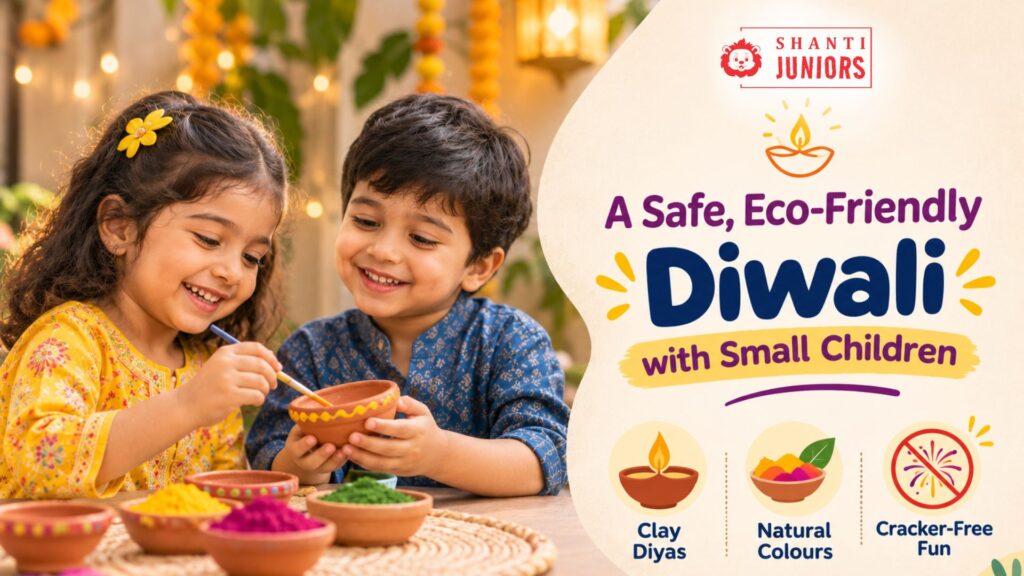
Diwali with a toddler can feel like a balancing act. You want the lights, the colour, the sweets and the joy, without the smoke, the 11 pm bangs and the sugar crash.
The good news: small children don’t need firecrackers or a box of mithai to love Diwali. They need light, colour, people and something to do with their hands. This guide covers an eco-friendly Diwali for kids: clay diyas, natural colours, cracker-free activities, and a sensible approach to sweets, including how much sugar is okay for a toddler and healthier homemade ladoo you can make together.
Local rules: firecracker rules vary by state and district, and Delhi-NCR rules for 2026 are set by court and government orders. Check your local order before buying anything. [CONFIRM: add the 2026 Delhi-NCR order once published, for the Delhi version of this post]
Child job: putting the (unlit) wicks into each diya, counting as they go.
Store-bought rangoli powders can contain synthetic dyes. For small hands (and mouths), try:
Colour | Natural source |
Yellow | Turmeric mixed with rice flour or besan |
Red / pink | Kumkum, rose petals, beetroot powder |
Orange | Marigold petals |
Green | Leaves, dried mehndi powder |
White | Rice flour |
Brown | Coffee or tea powder |
Flower-petal rangoli is the easiest of all: marigold, rose, chrysanthemum and leaves. When Diwali is over, it all goes in the compost.
Tell children what you will do, not just what you won’t. “This year we’re having a light party!” lands better than “No crackers.”
How to explain it to a 4- to 6-year-old: “Crackers make smoke that makes the air dirty and hard for birds, animals and little lungs to breathe. We make our Diwali bright with diyas and colours instead.”
Diwali is about sharing sweets, and an occasional ladoo is part of the joy. The trouble is quantity: over the week, the boxes keep coming.
Health bodies broadly agree on a few points:
– Under 2 years: avoid added sugar altogether where you can.
– Over 2 years: keep added sugar low. WHO recommends that “free sugars” be less than 10% of daily energy intake, and ideally under 5%, for adults and children alike.
– In everyday terms, one small piece of mithai a day during the festival week is a reasonable limit for a preschooler, ideally after a meal rather than on an empty stomach.
This is general guidance. If your child has diabetes, an allergy or a medical condition, follow your paediatrician’s advice.
Dates and nut ladoo (age 2+ with nuts finely ground)
– 1 cup soft, pitted dates
– ½ cup nuts (almonds, cashews), ground to a fine powder
– 2 tbsp desiccated coconut
1. Blend the dates into a paste.
2. Mix in the ground nuts.
3. Roll into small balls (your child can do this part) and coat in coconut.
Ragi and jaggery ladoo
– 1 cup ragi flour, roasted in 2 tbsp ghee until fragrant
– ½ cup powdered jaggery
– 2 tbsp ghee, warmed
Mix, cool slightly, and roll small balls. Jaggery is still sugar, so keep portions small, but these ladoos also add fibre and minerals.
Coconut and banana ladoo (age 2+)
– 1 ripe banana, mashed
– 1 cup desiccated coconut
– 2 tbsp milk powder
Mix and roll. Refrigerate and eat within two days.
Child jobs: washing hands, measuring, mashing banana, rolling balls, coating in coconut. Adult jobs: anything on the stove, and grinding nuts.
More everyday ideas are in our healthy lunchbox ideas for preschoolers.
If your child seems unwell after Diwali (cough, cold, upset stomach), it’s often a mix of late nights, rich food, smoke and the season change. Our guide on when to keep your child home from preschool explains which symptoms need rest and which need a doctor.
Shanti Juniors celebrates festivals with stories, crafts, clay diyas and flower rangoli, so children experience the joy of Diwali in a calm, safe way. You can see more in our culture section and in how we approach learning on our approaches page. [CONFIRM: any centre-wide green Diwali initiative this year]
Use clay diyas, natural or flower-petal rangoli, LED lights, cracker-free activities such as shadow puppets and lantern parades, homemade sweets, and gifts that aren’t plastic.
Keep added sugar low. WHO recommends keeping free sugars under 10% of daily energy, ideally under 5%. During Diwali, one small piece of mithai a day after a meal is a reasonable limit. Avoid added sugar for under-2s where possible.
Dates and nut ladoos (nuts finely ground), ragi-jaggery ladoos, roasted makhana, baked mathri or chakli, dhokla, fruit chaat and besan chilla rolls.
Keep windows closed during peak hours, play calm music or white noise, stay close and name the sound calmly, protect the bedtime routine, and consider child-sized earmuffs. Don’t force your child to watch.
Keep it simple: crackers make smoke that makes the air dirty and hard for birds, animals and little lungs to breathe, so we make Diwali bright with diyas and colours instead. Then offer a fun alternative.
Turmeric with rice flour (yellow), kumkum or rose petals (red), marigold petals (orange), leaves or mehndi powder (green), rice flour (white) and coffee powder (brown).
Your child won’t remember how many crackers you burst. They’ll remember painting the diyas, rolling ladoos and walking through a glowing house holding your hand.
To see how Shanti Juniors celebrates festivals with children, find your nearest centre or book an admission enquiry.
Read next: Winter Air Pollution and Preschoolers · Easy Diwali Crafts for Preschoolers · Diwali for Kids: The Story and 10 Lines

Comments are closed