
- Email info@shantijuniors.com
- Phone +91 99796 66660
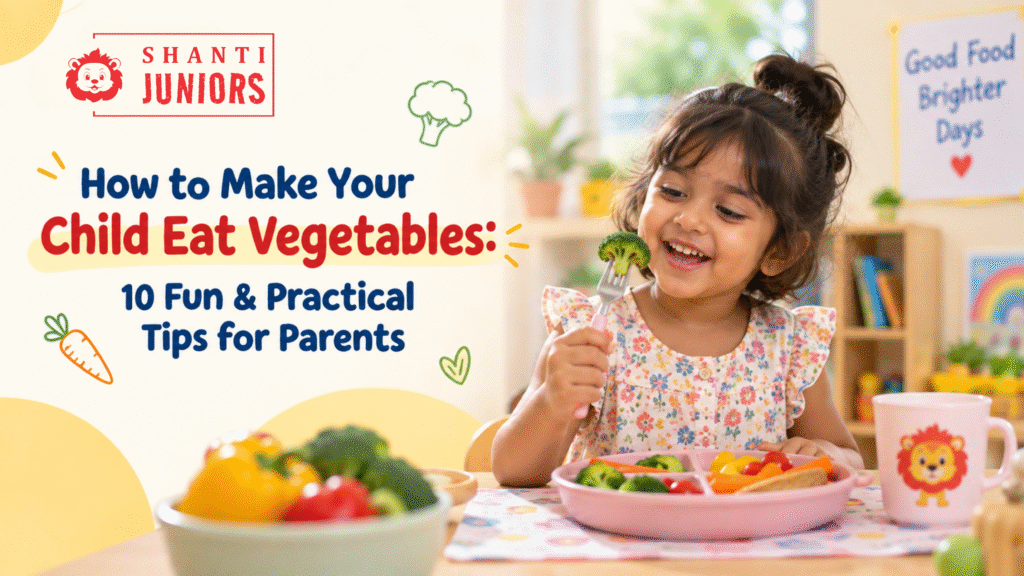
You put carrots on the plate. Your child moves them aside.
You try peas. Somehow, they find every single one and leave them behind.
Then comes the familiar question: “How do I get my child to eat vegetables without turning every meal into a battle?”
If you have a preschooler who refuses vegetables, you are certainly not alone. Young children are still getting used to different tastes, smells, colours and textures. What looks perfectly normal to an adult can feel completely unfamiliar to them.
Instead of forcing another bite, the goal can be much simpler: help vegetables become familiar.
Here are 10 practical ways to encourage healthy eating habits in preschoolers
A large serving of an unfamiliar vegetable can immediately make a child say, “No!”
Start with something much smaller — one piece of carrot, a slice of cucumber or a spoonful of peas.
Your child doesn’t have to finish it.
Seeing, touching, smelling and eventually tasting a food are all part of becoming familiar with it.
Preschoolers notice colours, shapes and interesting arrangements.
Use that curiosity.
Carrot sticks, cucumber circles, tomato slices, beetroot and corn can make a plate visually interesting.
You can occasionally arrange them into a rainbow, face or simple shape.
It doesn’t need to look perfect. The idea is simply to make vegetables feel interesting rather than intimidating.
Instead of asking:
“Will you eat vegetables?”
Try:
“Would you like cucumber or carrots today?”
Both answers work.
Giving preschoolers small, age-appropriate choices allows them to feel involved without removing the healthy options.
You can do the same while grocery shopping. Let your child choose one vegetable to bring home.
Young children love doing things that adults do.
With appropriate supervision, let your preschooler wash tomatoes, separate peas, tear lettuce, mix ingredients or arrange vegetables on a plate.
They might not eat everything they prepare, but they’re touching, smelling and becoming familiar with the food.
Simple kitchen responsibilities are also a great way of encouraging the independence that children gradually develop through real-life learning experiences.
Vegetables don’t have to appear only when it’s time to eat.
Use them for everyday conversations:
“Can you find something green?”
“Which one is the carrot?”
“Which vegetable is round?”
“Which one feels smooth?”
Once children recognise foods and know their names, they may feel less unfamiliar when those foods appear on their plate.
You can take this further with our guide on how to teach fruit and vegetable names to preschoolers through fun activities.
If everything on the plate feels unfamiliar, children may be less willing to experiment.
Instead, introduce a new vegetable alongside something your child already enjoys.
For example:
The familiar food provides comfort while the new food gets another opportunity to be explored.
“My child doesn’t like carrots.”
Maybe.
Or perhaps your child simply didn’t like carrots that way.
Texture matters to preschoolers.
A vegetable may taste and feel very different when it is grated, steamed, roasted, mashed or incorporated into another dish.
Keep experimenting with age-appropriate preparations rather than writing off a vegetable after one attempt.
Preschoolers learn a lot by watching.
If they regularly see parents and other family members eating vegetables naturally, vegetables begin to look like an ordinary part of a meal.
You don’t always need to announce:
“Look! Mummy is eating broccoli!”
Just eat together.
Modelling healthy eating habits can sometimes communicate more than repeated instructions.
For more ideas around food and nutrition during the early years, parents can also explore Shanti Juniors’ guide to nutrition and meal plans for early childhood.
“Finish your vegetables and then you’ll get dessert.”
Think about what that sentence can unintentionally communicate.
Vegetables become the unpleasant task.
Dessert becomes the reward.
Similarly, repeatedly forcing “just one more bite” can turn the dining table into a negotiation.
Parents can continue offering nutritious options while giving children reasonable space to explore their appetite and preferences.
The aim isn’t to win tonight’s dinner.
It’s to build a healthier relationship with food over time.
One refusal doesn’t necessarily mean permanent dislike.
Young children are continuously developing their preferences.
Something they wouldn’t touch last month may suddenly become interesting this month.
Continue offering vegetables calmly in small amounts and different forms.
Patience matters.
A vegetable market can become a vocabulary lesson.
Sorting vegetables can become a colour activity.
Counting peas can become an early numeracy activity.
Helping prepare dinner can build independence.
At Shanti Juniors, children are encouraged to learn through exploration, interaction and meaningful experiences. Parents can discover more about these ideas through the Shanti Juniors learning approaches.
The same principle can continue at home through ordinary moments.
Some days your preschooler may surprise you and taste something completely new.
Other days, that lonely carrot may remain exactly where you put it.
That’s okay.
Healthy eating habits don’t develop because a child was persuaded to finish one serving of vegetables.
They develop through repeated, positive experiences with food.
Let children see vegetables. Touch them. Name them. Help prepare them. Watch you eat them. And gradually, taste them.
Start with small portions, serve vegetables alongside familiar foods, experiment with different textures and avoid pressuring your child to eat.
Adding vegetables to familiar dishes can increase variety, but children should also have opportunities to see and recognise vegetables so they gradually become familiar with them
Use colourful plates, involve children in food preparation, let them choose vegetables and try sorting, naming and matching activities
Learning their names, colours and textures can make vegetables more familiar and encourage curiosity around them.
Quality early childhood experiences can help children develop routines, independence, social habits and awareness of everyday choices through age-appropriate activities.

Comments are closed