
- Email info@shantijuniors.com
- Phone +91 99796 66660
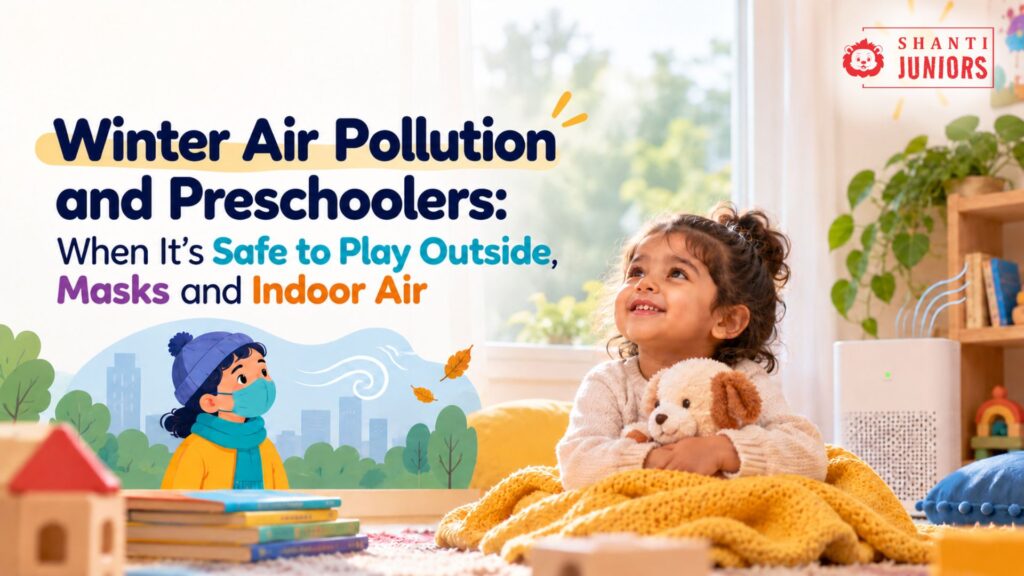
Every November, parents in Delhi, Lucknow and much of North India start their mornings the same way: check the AQI, look out of the window at the grey haze, and wonder whether it’s safe to take the children out.
This guide explains air pollution and kids in practical terms: what the AQI numbers mean for outdoor play, whether toddlers should wear masks, how to choose an air purifier for a child’s room, and the signs that mean it’s time to see a doctor.
This is general information, not medical advice. If your child has asthma, allergies, a heart or lung condition, or you’re worried about symptoms, follow your paediatrician’s guidance.
Winter makes it worse in North India: cooler, still air traps pollutants near the ground, and crop burning, vehicle traffic, construction dust and festival smoke add to it. AQI is typically worst from November to January.
ndia’s National Air Quality Index (published by CPCB) has six categories. Here’s a practical guide for preschoolers.
AQI | Category | Outdoor play for preschoolers |
0–50 | Good | Play freely |
51–100 | Satisfactory | Play freely; children with asthma may notice symptoms |
101–200 | Moderate | Fine for most children; shorten long, vigorous play if your child has asthma or a cough |
201–300 | Poor | Keep outdoor time short and gentle; move running games indoors |
301–400 | Very poor | Keep active play indoors; go out only when needed |
401–500 | Severe | Stay indoors as much as possible; keep windows closed |
Use the reading for your area, not the city average. AQI can vary a lot between neighbourhoods. Check a nearby monitoring station on the SAMEER app (CPCB) or a reliable AQI app.
In winter, pollution often builds up overnight and in the early morning, and again in the evening as temperatures drop and traffic peaks. Late morning to mid-afternoon is usually the better window, when sunshine helps the air mix. Check the hourly reading; patterns vary by day.
Avoid busy roads. A park away from traffic is better than a playground next to a main road, even at the same AQI.
Under 2 years: no. Masks are not recommended for babies and toddlers under 2. They can’t remove a mask if they struggle to breathe, and there’s a suffocation risk.
2–6 years: sometimes, with limits.
– A well-fitting, child-sized N95/KN95-type mask can reduce exposure to fine particles if it seals well. Most children’s faces are hard to fit, and a gap around the edges lets air in.
– Cloth and surgical masks offer little protection against fine pollution particles.
– Children often won’t keep a mask on for long, and shouldn’t wear one while running.
– Never use a mask on a child who can’t tell you or remove it if they feel unwell.
The bottom line: a mask is a backup for short, necessary trips (the school run, a car-to-door walk), not a reason to play outside on a “very poor” day. Reducing exposure matters more than masking.
Children spend most of the day indoors, so indoor air matters most.
What to check | Why it matters |
True HEPA filter | Captures fine particles (PM2.5), the main concern |
CADR matched to room size | A higher Clean Air Delivery Rate cleans the air faster. Check the room size the maker rates it for, and choose one rated for a slightly bigger room than yours |
Activated carbon layer | Helps with smells and some gases |
Low noise on night mode | For sleep |
No ozone-generating “ionisers” | Ozone irritates lungs. Choose purifiers that don’t produce it |
Filter replacement cost | Filters need changing; budget for it |
Child lock and stable base | Small hands, curious fingers |
Use it properly: keep doors and windows closed while it runs, place it where air can flow around it, run it before bedtime as well as during sleep, and change filters on schedule.
Children still need to move every day. Indoors, try:
– Yoga: see our 10-minute yoga routine for kids
– Dance parties, animal walks, obstacle courses with cushions
– Balloon volleyball, hopscotch with tape on the floor
– Indoor scavenger hunts
More on why daily movement matters: why fitness is important in preschoolers.
Call your paediatrician if your child has:
– A cough that won’t settle, especially at night or after play
– Wheezing or a whistling sound when breathing
– Fast breathing, chest pulling in, or breathlessness
– Frequent nosebleeds, sore throat or burning eyes that don’t improve indoors
– An asthma flare that needs more reliever medicine than usual
Seek urgent care for any breathing difficulty, blue lips, or a child who is unusually drowsy.
Children with asthma: ask your doctor for a written action plan for high-pollution days, and keep reliever medicine with you and at preschool.
For coughs and colds that come with the season change, see when to keep your child home from preschool.
Our guide on child safety in a preschool covers other things to check.
Shanti Juniors centres follow local government directions on school timings and closures during pollution emergencies, and move physical activity indoors when air quality is poor. [CONFIRM: AQI threshold for indoor play, air purifiers in classrooms, Delhi and Lucknow centre policies]. See our FAQs and our approaches for how we plan the day.
Up to 100 (Good or Satisfactory), children can play freely. At 101–200 (Moderate), most children are fine but those with asthma should do less vigorous play. Above 200 (Poor), keep outdoor time short; above 300 (Very poor), keep active play indoors.
Not under 2 years, because of the suffocation risk. For 2–6-year-olds, a well-fitting child-sized N95/KN95-type mask may help on short trips, but it’s hard to get a good seal, and it doesn’t make outdoor play safe on very poor days.
Often late morning to mid-afternoon, when the air mixes better. Check the hourly reading for your area and avoid busy roads.
Choose a true HEPA purifier with a CADR rated for a room slightly larger than your child’s room. Keep doors and windows closed while it runs and change filters on time.
Persistent cough, wheezing, breathlessness, sore throat, burning eyes, nosebleeds, and asthma flares. See a doctor if symptoms don’t settle or if breathing is difficult.
Usually yes, if the preschool keeps children indoors with clean air and follows government directions. Ask about their AQI policy. Keep your child home if they’re unwell.
You can’t fix the city’s air alone. But closed windows at peak hours, a purifier in the bedroom, active play indoors and a watchful eye on symptoms make a real difference for your child this winter.
To ask how your nearest Shanti Juniors centre handles pollution days, find your nearest centre or book an admission enquiry.
Read next: Yoga for Kids: 12 Easy Poses · Season Change: When to Keep Your Child Home · A Safe, Eco-Friendly Diwali

Comments are closed