
- Email info@shantijuniors.com
- Phone +91 99796 66660
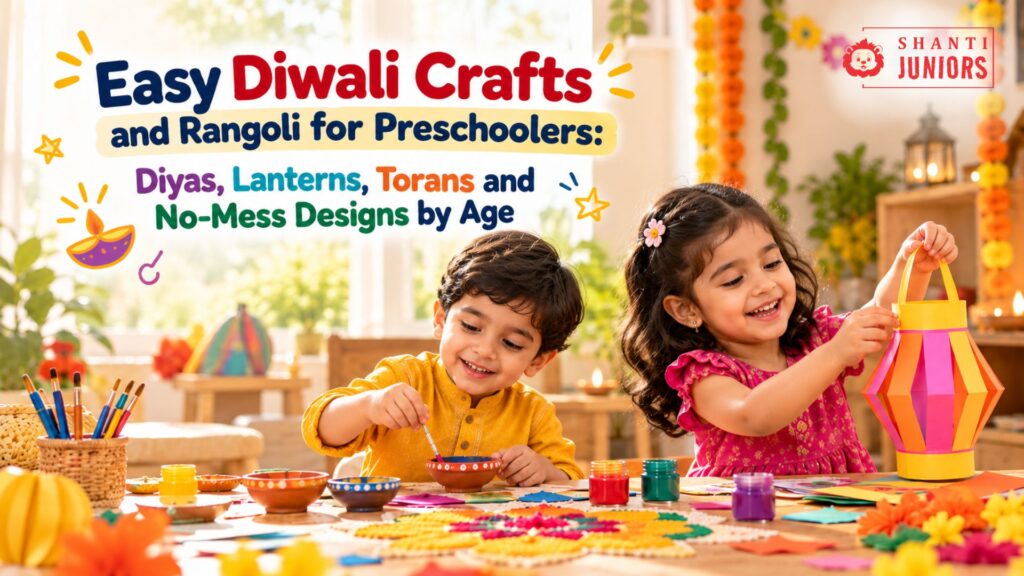
Every Diwali craft list online seems to be written for ten-year-olds with steady hands and a glue gun. This one isn’t.
These Diwali crafts for kids are chosen for ages 2 to 6, sorted by what little hands can actually do. Each one needs things you probably have at home, takes 15–30 minutes, and builds a real skill: grip, colour recognition, pattern-making or patience.
The golden rule: the craft doesn’t need to look like Pinterest. A lopsided diya your child painted alone is worth more than a perfect one you fixed.
Craft | Age 2–3 | Age 3–4 | Age 4–6 | Skill it builds |
Diya painting | ✓ (sponge) | ✓ | ✓ (patterns) | Grip, colour |
No-mess rangoli in a tray | ✓ | ✓ | — | Sensory, pouring |
Dot rangoli | — | ✓ | ✓ | Pattern, counting |
Paper plate diya | ✓ | ✓ | — | Gluing, shapes |
Paper lantern | — | ✓ (with help) | ✓ | Cutting, folding |
Toran | — | ✓ | ✓ | Threading, sequencing |
Greeting card | ✓ (handprint) | ✓ | ✓ (writing name) | Pre-writing |
You need: plain clay diyas, washable poster paint, cotton buds or small sponges, a paintbrush.
Steps:
1. Soak the diyas in water for 10 minutes and let them dry. This helps the paint stick.
2. Age 2–3: dab paint on with a sponge. Any colour, anywhere.
3. Age 3–4: paint the whole diya one colour, then add dots with a cotton bud.
4. Age 4–6: make patterns: dots in a row, stripes, alternating colours. Count the dots together.
5. Dry overnight.
Learning link: holding a cotton bud uses the same pincer grip as holding a pencil. More ideas in fine motor activities for kids.
Note: painted diyas are best kept as decorations. If you’ll light them, paint only the outside and let an adult handle the flame.
Pour coloured rice or coloured salt into a baking tray or a large plate. Your child draws with a finger, makes patterns with a spoon, or places diyas and flowers. Shake to erase and start again.
To colour rice: put 1 cup of rice, a few drops of food colour and 1 teaspoon of vinegar in a zip bag, shake, and dry on newspaper for an hour.
Draw a simple flower outline with chalk on the floor or a chart paper. Your child fills each petal with coloured rice, flower petals or round stickers. Ready-made rangoli stencils work well for this age too.
Dot rangoli is early maths in disguise: rows, symmetry, counting and shapes.
Eco tip: flower-petal rangoli (marigold, rose and leaves) needs no colours and goes straight to the compost afterwards. More green ideas in a safe, eco-friendly Diwali with small children.
You need: a paper plate cut in half, yellow and orange paper, glue, crayons.
Tearing paper strengthens finger muscles, which is great for under-3s who aren’t ready for scissors.
You need: an A4 sheet of coloured paper, child-safe scissors, glue or tape, a strip of paper for the handle.
Age 3–4: you cut, they decorate with crayons and stickers before folding.
Age 4–6: they cut along the lines with help.
In Maharashtra, the big hanging lantern is the akash kandil. If you’re in Pune, our Pune Diwali for kids guide has a simple version.
A toran is the decorative hanging over the door.
Option A, paper toran: cut mango-leaf shapes from green paper (you cut, your child decorates). Punch a hole in each and thread onto string or ribbon. Add a paper marigold every few leaves.
Option B, pattern toran (age 4–6): thread large pasta, paper flowers and leaves in a pattern: leaf, flower, leaf, flower. Ask, “What comes next?”
Threading is one of the best activities for hand–eye coordination. See more in fun fine motor activities for 3-year-olds.
Give the cards to grandparents, neighbours and teachers. It turns a craft into a lesson in sharing.
Fill a tub with coloured rice, a few unlit clay diyas, spoons, small bowls and a funnel. Let your toddler scoop, pour and fill. This is the same idea as Montessori practical-life activities: simple materials, real concentration.
If you enjoyed the Navratri colour activities, these crafts continue the same colour learning.
In the run-up to Diwali, Shanti Juniors classrooms fill with painted diyas, paper lanterns and rangoli made by small hands. Crafts are chosen by age, and every one has a learning goal behind it, as part of the Kiddowitty curriculum. You can see examples in our activities, and our Nursery page explains how creative play fits into the day.
Sponge-painting a clay diya, a paper plate diya with torn-paper flames, a handprint diya card, and a no-mess rangoli in a tray with coloured rice.
Draw a simple outline with chalk and let your child fill it with coloured rice, flower petals or stickers. For ages 4–6, try dot rangoli: make a grid of dots and join them into shapes.
Put a cup of rice, a few drops of food colour and a teaspoon of vinegar in a zip bag, shake well, and spread on newspaper to dry for about an hour.
Fold an A4 sheet lengthways, cut lines from the fold (stopping 2 cm from the edge), open it, roll it into a tube, glue the edges and add a paper handle.
Diya painting, dot rangoli, paper lanterns, toran threading, greeting cards and storytelling about Ram’s return to Ayodhya.
It’s best avoided for under-3s, as it can get into eyes and mouths. Use stickers, coloured rice or flower petals instead.
Pick one craft from the list, spread out the newspaper, and let your child lead. Then hang the result somewhere everyone can see it.
For the story behind the festival, read Diwali for kids: the story, the 5 days and 10 lines. To see crafts and creative learning at a Shanti Juniors centre, find your nearest centre or book an admission enquiry.
Read next: Diwali for Kids: The Story and 10 Lines · A Safe, Eco-Friendly Diwali · Gujarati Diwali for Kids

Comments are closed