
- Email info@shantijuniors.com
- Phone +91 99796 66660
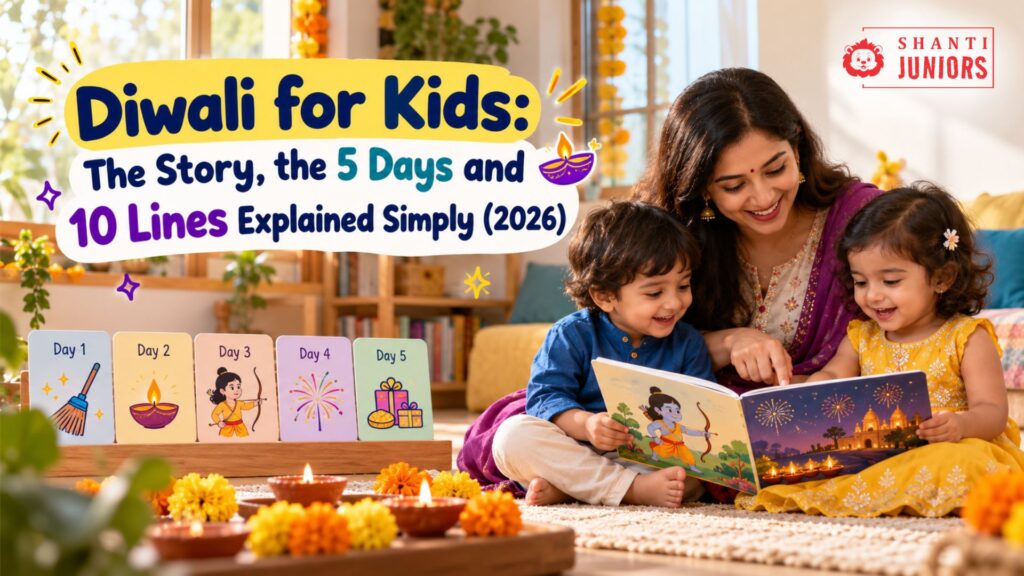
“Why are we putting lights everywhere?” If your child is asking, Diwali has arrived in your home.
This guide explains Diwali for kids in words a two- to six-year-old can follow: the story behind the festival, what happens on each of the five days, ten easy lines for school, and the Diwali 2026 date. There’s also a short version for toddlers and a slightly longer one for five- and six-year-olds.
Diwali 2026 at a glance: Diwali (Lakshmi Puja) is on Sunday 8 November 2026. This year Choti Diwali falls on the same day, so the festival has no separate “small Diwali” the day before. Dates are from Drik Panchang (New Delhi); regional calendars can shift a day.
Diwali is the festival of lights. We light diyas to say that light wins over darkness and good wins over bad. Families clean their homes, wear new clothes, share sweets, make rangoli and pray for a happy, healthy year.
Different families tell different stories, and all of them carry the same idea.
And that’s why, every Diwali, we light diyas too: to welcome goodness home.
If you told the Dussehra story last month, this is a natural sequel. Our Dussehra story for kids covers the first half.
Other Diwali stories families tell:
– Goddess Lakshmi, who brings good fortune, visits clean and well-lit homes. That’s why we clean and light lamps.
– Krishna and Narakasura: in much of South India, Deepavali celebrates Krishna defeating the demon Narakasura. See Deepavali the South Indian way.
– Jain families remember Lord Mahavira, and Sikh families celebrate Bandi Chhor Divas, the day Guru Hargobind Ji was freed from prison.
Young children don’t need the whole Ramayana. Keep it to three sentences:
“Diwali is the festival of lights. A long time ago, a kind prince called Ram came home, and everyone lit lamps to say welcome. We light lamps too, to make our home happy and bright.”
Then let them do something with their hands: put a diya on a plate (unlit), stick a paper flame on a drawing, or help sprinkle rangoli colour. At this age, doing builds understanding far more than listening. Ask simple questions afterwards: “Who came home? What did people light?” Our guide to teaching WH questions shows how.
For 5- and 6-year-olds, add the forest, Ravan and the bridge. They’ll enjoy acting it out with soft toys.
Day | Date (2026) | What it means, simply | One thing to do with your child |
1. Dhanteras | Fri 6 Nov | A day for good health and new beginnings; families often buy a small steel or silver item | Help polish a steel bowl or the family’s diyas |
2. Choti Diwali / Naraka Chaturdashi | Sun 8 Nov (same day as Diwali this year) | Krishna defeats Narakasura; in the South, families take an early oil bath | Wake up early for a special bath and new clothes |
3. Diwali / Lakshmi Puja | Sun 8 Nov | The main festival night: diyas, rangoli, prayers, sweets | Light diyas together (adult holds the flame) |
4. Govardhan Puja / Padwa / Gujarati New Year | Tue 10 Nov | Krishna lifts a mountain to protect the villagers; in Gujarat, Bestu Varas (New Year) | Make a tiny “mountain” of food for Annakut |
5. Bhai Dooj / Bhau Beej / Bhai Beej | Wed 11 Nov | Brothers and sisters celebrate their bond with tilak and gifts | Draw a card for a sibling or cousin |
Why only “five days” when the dates run from the 6th to the 11th? In 2026, two of the days fall together on the 8th, and the lunar calendar leaves a gap day on the 9th in many places. Kids don’t need this detail; just tell them Diwali is a “week of happy days”.
Each day has its own post in this series:
– Gujarati Diwali for kids: Vagh Baras to Labh Pancham
– Deepavali the South Indian way
– Pune Diwali for kids: killa, akash kandil and faral
– Govardhan Puja story for kids
– Bhai Dooj story for kids
Perfect for Nursery, Junior KG and Senior KG show-and-tell. Younger children can learn the first three.
5 lines for toddlers (2–3 years): Diwali is the festival of lights. We light diyas. We make rangoli. We eat sweets. We say “Happy Diwali!”
Tip: Turn the lines into a simple chant with claps. Rhythm helps memory, which is why nursery rhymes work so well.
“Good morning, everyone. My name is ___. Diwali is the festival of lights. We celebrate it because Lord Ram came home after fourteen years, and everyone lit lamps to welcome him. On Diwali, we clean our homes, make rangoli, light diyas and share sweets. Diwali teaches us to be kind and to choose good over bad. Happy Diwali! Thank you.”
Let your child decorate their own clay diya. The steps are in easy Diwali crafts for preschoolers.
At Shanti Juniors, festivals are part of how children learn: stories at circle time, rangoli with fingers and stencils, diya painting, sharing sweets, and talking about kindness and light. It’s all part of the Kiddowitty curriculum and our culture and celebrations. [CONFIRM: Diwali celebration date and activities at centres this year]
Diwali (Lakshmi Puja) is on Sunday 8 November 2026. Choti Diwali falls on the same day this year. Dhanteras is on Friday 6 November, Govardhan Puja on Tuesday 10 November and Bhai Dooj on Wednesday 11 November.
Keep it to three sentences: Diwali is the festival of lights; a kind prince called Ram came home and everyone lit lamps to welcome him; we light lamps too, to make our home happy. Then let your child decorate a diya or make a rangoli.
Dhanteras, Choti Diwali (Naraka Chaturdashi), Diwali (Lakshmi Puja), Govardhan Puja (Padwa or Gujarati New Year in some regions) and Bhai Dooj.
Most families celebrate Lord Ram’s return to Ayodhya after defeating Ravan. Others celebrate Goddess Lakshmi or Krishna’s victory over Narakasura. All the stories celebrate light over darkness and good over bad.
See the list above: Diwali is the festival of lights; it comes in October or November; we celebrate Ram’s return; we light diyas, make rangoli, wear new clothes, pray to Lakshmi and Ganesha, and share sweets; and Diwali teaches us that good wins over bad.
Yes. In 2026, both fall on Sunday 8 November, according to Drik Panchang for New Delhi.
You don’t need a big celebration for your child to understand Diwali. One story, one diya and one plate of sweets shared with a neighbour is enough.
To see how festivals come alive in a Shanti Juniors classroom, find your nearest centre or book an admission enquiry.
Read next: Easy Diwali Crafts and Rangoli for Preschoolers · A Safe, Eco-Friendly Diwali with Small Children · Bhai Dooj Story for Kids

Comments are closed