
- Email info@shantijuniors.com
- Phone +91 99796 66660
For a preschooler, Navratri’s nine colours are not just a dress code. They are a nine-day colour lesson that arrives with music, sweets and new clothes — the best learning package a three-year-old could ask for.
This guide gives you the Navratri colours 2026 list, one simple activity for each colour, and the learning behind it, so the “what to wear tomorrow” question turns into nine days of colour recognition, counting, sorting and talking.
Sharad Navratri 2026 began on Sunday 11 October, so the sequence opened with orange.
Day | Date | Colour | Form of Durga | Preschool activity (below) |
1 | Sun 11 Oct | Orange | Shailputri | Orange treasure hunt |
2 | Mon 12 Oct | White | Brahmacharini | Cotton-wool clouds |
3 | Tue 13 Oct | Red | Chandraghanta | Red bead threading |
4 | Wed 14 Oct | Royal Blue | Kushmanda | Blue water play |
5 | Thu 15 Oct | Yellow | Skandamata | Turmeric sunshine painting |
6 | Fri 16 Oct | Green | Katyayani | Leaf printing |
7 | Sat 17 Oct | Grey | Kalaratri | Shadow and pebble play |
8 | Sun 18 Oct | Purple | Mahagauri | Mixing red + blue |
9 | Mon 19 Oct | Peacock Green | Siddhidatri | Peacock feather craft |
Why the colours change every year. The sequence follows the weekday on which Navratri begins, so the starting colour shifts each year. Different communities, offices and temples sometimes follow slightly different lists — if your child’s school has shared one, follow the school’s list so your child matches their friends. (Editor: update this table each August with the next year’s dates and colours.)
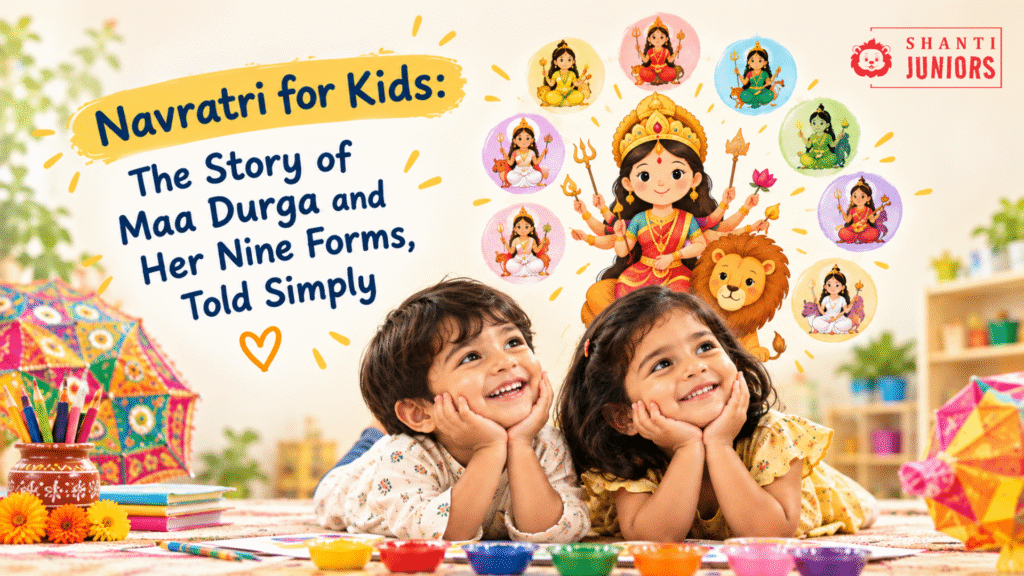
To pair each colour with the story of that day’s form of the Goddess, read Navratri for Kids: The Story of Maa Durga and Her Nine Forms.
Most children can match colours before they can name them, and name them before they can sort by shade. Colour days take a child through all three stages naturally:
Add counting, shape-spotting and conversation, and nine colour days become a complete early-learning unit. That is how theme weeks are built in the I-Cube approach: children explore one idea by looking, doing, making and talking about it.
Every activity uses things already in an Indian home. Each takes 15–20 minutes.
Day 1 — Orange: The orange treasure hunt (ages 2–5) Hide ten orange things around the room — a carrot, a marigold, an orange crayon, a ball. Your child finds them and puts them in a basket. Count together at the end. Learning: colour matching, counting to ten, movement.
Day 2 — White: Cotton-wool clouds (ages 2–4) Draw a blue sky; let your child pull cotton wool apart and stick it on as clouds. Talk about other white things — milk, rice, the moon. Learning: pincer grip, sensory exploration, vocabulary.
Day 3 — Red: Red bead threading (ages 3–6) Thread red beads, or red-painted pasta, on a shoelace to make a bracelet for Durga Maa. For older children, make a red-white pattern. Learning: hand–eye coordination and early patterning — see more ideas in our fine motor activities for 3-year-olds.
Day 4 — Royal Blue: Blue water play (ages 2–5) A tub of water with a drop of blue food colour, cups, a spoon and a sieve. Pour, fill, empty. Learning: early measurement words — full, empty, more, less. Supervise water play at all times.
Day 5 — Yellow: Turmeric sunshine painting (ages 2–5) Mix a little haldi with water to make natural yellow paint. Paint a big sun. Talk about why Kushmanda’s smile is said to make the sun shine. Learning: brush control and storytelling.
Day 6 — Green: Leaf printing (ages 3–6) Collect leaves on a walk. Paint one side green and press it on paper. Compare big and small, smooth and rough leaves. Learning: nature observation and size comparison — a natural follow-on from our post on teaching fruit and vegetable names.
Day 7 — Grey: Shadow and pebble play (ages 3–6) Grey is the hardest colour for children to love, so make it fun. Collect grey pebbles and sort them big to small. In the evening, make shadow animals on the wall with a torch — Kalaratri is the form who chases away fear of the dark. Learning: seriation (ordering by size) and gently building comfort with the dark.
Day 8 — Purple: The magic colour mix (ages 3–6) Give your child red and blue paint and let them discover that mixing makes purple. Let them predict first: “What do you think will happen?” Learning: cause and effect, prediction, early science thinking.
Day 9 — Peacock Green: Peacock feather craft (ages 3–6) Paper-plate peacock with fingerprint “eyes” in green and blue on the tail. Count the feathers. Learning: fine motor control, counting, finishing a project — a lovely way to close the nine days.
Skill | How Navratri colours build it |
Colour recognition | Nine colours named, matched and sorted |
Early maths | Counting objects, comparing sizes, making patterns |
Fine motor | Threading, tearing, pressing, painting |
Language | Describing words, WH questions, retelling |
Science thinking | Colour mixing, nature walks, light and shadow |
Independence | Choosing and putting on their own colour |
This is the thinking behind theme weeks across our Nursery and Junior KG classrooms at Shanti Juniors, and you can see examples in our activities.
Orange (11 Oct), white (12 Oct), red (13 Oct), royal blue (14 Oct), yellow (15 Oct), green (16 Oct), grey (17 Oct), purple (18 Oct) and peacock green (19 Oct). Some communities follow a slightly different list, so match your school's or society's list if one is shared.
The commonly followed sequence is linked to the weekday on which Navratri begins, so the starting colour — and the order — shifts each year. The colour tradition is a popular custom rather than a religious requirement.
A colour treasure hunt, bead threading, leaf printing, colour-mixing with paint, sorting objects into colour bowls and a simple peacock craft. Each takes 15–20 minutes and builds colour recognition plus counting and fine motor skills.
Most children can match colours around age two, start naming a few common colours between two and three, and name most basic colours by around four. Children vary, so treat these as rough guides rather than deadlines.
Not at all. A ribbon, a bindi or a hair clip works, and talking about the colour teaches just as much as wearing it.
Most are, with supervision. Use large objects for sorting, skip small beads, use haldi or food-safe colours, and never leave a toddler alone with water.
Nine pages, nine colours, one book your child made themselves. Bring it out next Navratri and watch how much more they can tell you.
To see colour weeks, festival themes and hands-on learning in a real classroom, find your nearest Shanti Juniors centre or enquire about admission.
Read next: Navratri for Kids: The Story of Maa Durga and Her Nine Forms · Dussehra Story for Kids · Garba & Dandiya with Little Ones

Comments are closed