
- Email info@shantijuniors.com
- Phone +91 99796 66660
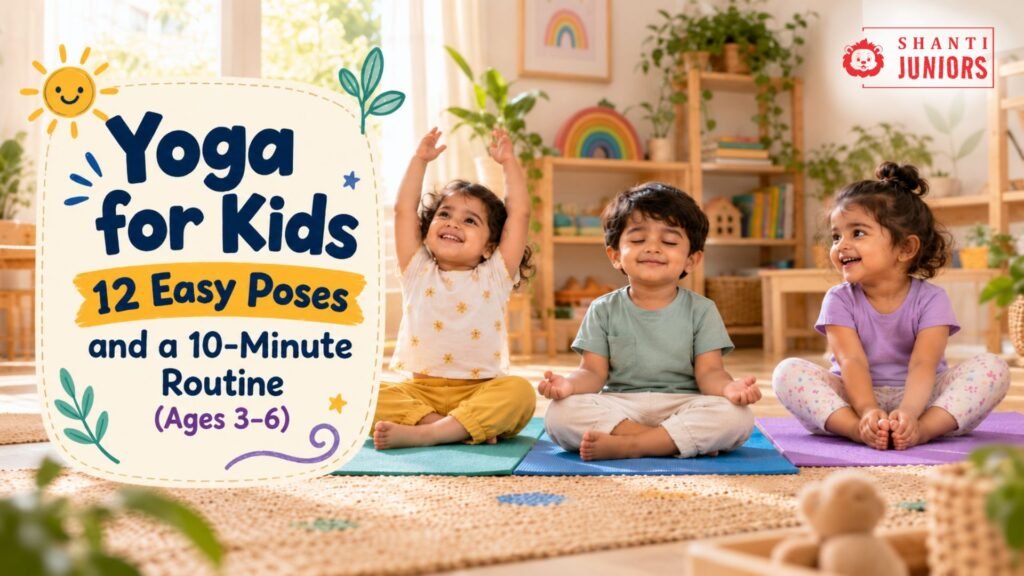
Ask a four-year-old to “sit still and breathe deeply” and you’ll get a puzzled look. Ask them to be a lion and roar out all their breath, and they’ll do it ten times in a row.
That’s the secret of yoga for kids: turn poses into animals, stories and games. This guide has 12 easy yoga poses for kids, a 10-minute kids yoga routine at home, breathing games, benefits and safety tips for ages 3–6.
Children can enjoy simple, playful yoga from about 2–3 years, copying animal poses with a parent. Holding poses and following short sequences comes more easily from 4–6 years. There’s no need for perfect form; the aim is fun and movement.
# | Pose (kid name) | Yoga name | How to do it | Hold |
1 | Mountain | Tadasana | Stand tall, feet together, arms by sides. “Be a strong, still mountain.” | 5 breaths |
2 | Tree | Vrikshasana | Stand on one leg, place the other foot on the ankle or calf (never the knee), hands together. Wobbling is fine! | 3–5 breaths each side |
3 | Butterfly | Baddha Konasana | Sit, soles of feet together, knees out. Flap knees gently like wings | 10 flaps |
4 | Cat and Cow | Marjaryasana–Bitilasana | On hands and knees: arch back up like a scared cat (“meow”), then dip tummy down and look up like a cow (“moo”) | 5 rounds |
5 | Cobra (Snake) | Bhujangasana | Lie on tummy, hands under shoulders, gently lift head and chest. “Hiss!” | 3 breaths |
6 | Dog | Adho Mukha Svanasana | Hands and feet on floor, hips high like an upside-down V. Wag your “tail” | 3 breaths |
7 | Lion | Simhasana | Kneel, hands on knees, breathe in, then open mouth wide, stick out tongue and ROAR | 3 roars |
8 | Frog | Malasana (squat) | Feet apart, squat low, hands together. Hop up and squat again | 5 hops |
9 | Bridge | Setu Bandhasana | Lie on back, knees bent, feet flat, lift hips. “Cars drive under the bridge!” | 3 breaths |
10 | Star | — | Stand with feet wide and arms stretched out like a big star | 5 breaths |
11 | Boat (age 4+) | Navasana | Sit, lean back a little, lift feet, balance on bottom. Hold knees if needed. “Row, row, row your boat” | 3 breaths |
12 | Sleeping child | Balasana | Kneel, sit back on heels, fold forward, forehead on the floor, arms by sides | 5 slow breaths |
Easy poses for 3-year-olds: Mountain, Butterfly, Cat and Cow, Lion, Star, Frog and Sleeping child. Add Tree, Dog, Cobra and Bridge as they grow; save Boat for 4+.
Read it like a story while your child does the poses.
Make it your own: a sea adventure (fish, boat, star), a farm visit (cat, cow, dog, frog), or a trip to the zoo.
Game | How to play | Good for |
Balloon breath | Hands on tummy, breathe in to fill the “balloon,” breathe out slowly to let it go | Calming down |
Smell the flower, blow the candle | In through the nose, out through the mouth | Big feelings |
Bunny breaths | Three quick sniffs in, one long breath out | Energy after sitting |
Bumblebee breath | Breathe in, then hum “mmmm” on the way out | Bedtime |
Feather or tissue blow | Blow a feather across the table slowly | Breath control |
Breathing games are one of the simplest calm-down tools for children. See naming feelings in 2–5 year olds and toddler tantrums for how to use them when feelings get big.
A calm version for the end of the day: Cat and Cow (slowly), Butterfly (still, not flapping), Sleeping child, then lie on your back for three bumblebee breaths. It fits neatly into a bedtime routine for 2–5 year olds.
Family yoga also makes a great Children’s Day activity.
Movement, music and simple yoga are part of the daily rhythm at Shanti Juniors, building strength, balance and calm. It fits our I-Cube approach of learning through doing, and you’ll find examples in our activities. Extended-day children get more active time through our Active Care Programs. [CONFIRM: yoga sessions per week at centres]
Children can enjoy playful yoga from about 2–3 years, copying animal poses with a parent. Holding poses and short sequences come more easily from 4–6.
Mountain, Butterfly, Cat and Cow, Lion, Star, Frog and Sleeping child (Balasana).
Better strength, balance and flexibility, body awareness, concentration, calm, confidence, and a fun way to stay active indoors.
Five to ten minutes is plenty for preschoolers. Stop while they’re still enjoying it.
Yes, when it’s gentle and playful. Never force stretches, avoid headstands and inversions, and keep breathing normal. Check with your doctor if your child has a medical condition.
A few slow poses and humming breaths at bedtime can help children wind down.
Ten minutes, a mat and a story. Start with the lion; your child will probably ask for it again.
To see how movement and play fit into a Shanti Juniors day, find your nearest centre or book an admission enquiry.
Read next: Winter Air Pollution and Preschoolers · A Bedtime Routine That Works · Why Fitness Is Important in Preschoolers

Comments are closed