
- Email info@shantijuniors.com
- Phone +91 99796 66660
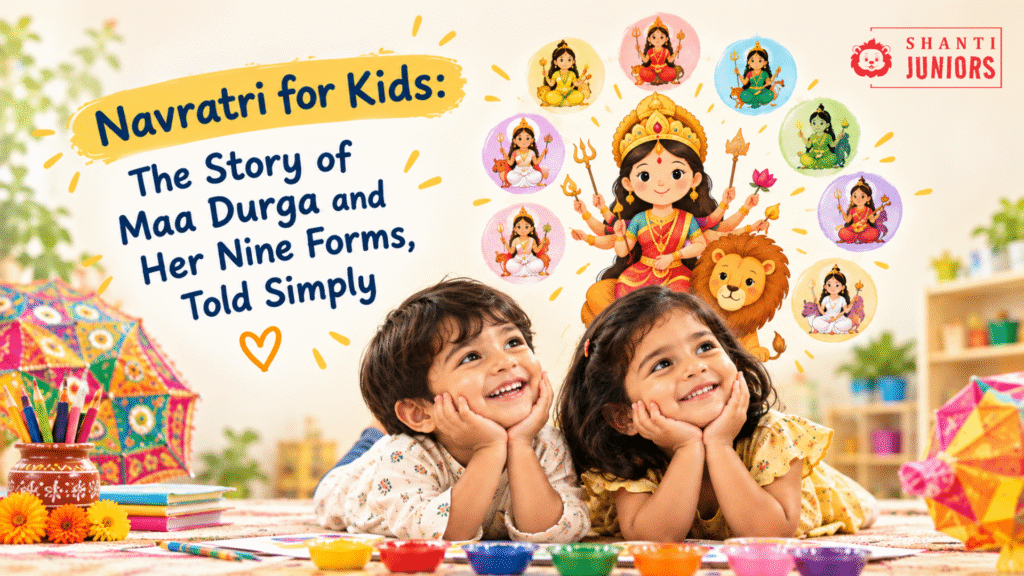
Somewhere in the middle of nine nights of garba, aarti and new clothes, your child will ask the question every parent half-expects: “Mumma, who is Durga Maa, and why does she have so many hands?”
This guide gives you the Navratri story for kids in words a preschooler can hold — three versions, by age — plus the nine forms of Maa Durga with one simple lesson for each day, and gentle ways to tell the scarier parts without frightening a small child.
Sharad Navratri 2026 ran from Sunday 11 October to Monday 19 October, with Dussehra (Vijayadashami) on Tuesday 20 October 2026. Navratri also comes in spring as Chaitra Navratri, ending on Ram Navami. The stories below work for both — and for the rest of the year
Preschoolers learn through repetition, rhythm and things they can see and touch. Navratri gives them all three: the same aarti every evening, a new colour every day, a new form of the Goddess to meet, music and dance at night.
Nine days is also the perfect length for a young child — long enough to build a routine, short enough to stay exciting. That is why at Shanti Juniors, Navratri is taught as a themed learning week inside the Kiddowitty curriculum rather than a single costume day. You can see how festivals sit inside the year on our culture page.
Match the version to your child’s age. A two-year-old does not need a plot; they need a picture and a feeling.
For ages 2–3 (three sentences) Durga Maa is a strong and kind mother who rides a big lion. She has many hands so she can help many people at once. For nine nights we sing and dance to say thank you to her.
For ages 3–5 (the short story) Long ago, there was a buffalo-demon called Mahishasura. He was big and proud, and he was troubling everyone — the people, the animals, even the gods. Nobody could stop him.
So all the gods came together. Each of them gave a little of their light and strength, and from all that light, a beautiful Goddess appeared — Maa Durga. Each god gave her a gift: one gave a trident, one a bow, one a lotus, one a conch. The mountains gave her a lion to ride.
Maa Durga went to meet Mahishasura. He kept changing shape — a buffalo, a lion, an elephant — trying to trick her. For nine days and nine nights she did not give up. On the tenth day, she won, and everyone was safe and happy again. That is why we celebrate for nine nights, and the tenth day is a day of victory.
For ages 5–6 (add the meaning) Once a child can follow the story, add the why:
A note on the battle. You do not need to describe the fight. “She won and everyone was safe” is complete for an under-five. Children handle a difficult moment in a story well when the ending is safe — so keep the focus on the courage, not the conflict.
Each night of Navratri honours one form of the Goddess. For children, give each form one picture and one value. That is enough to make nine days meaningful.
Day | Form | What to tell your child | Value of the day |
1 | Shailputri | The daughter of the mountains, riding a bull | Being strong and steady, like a mountain |
2 | Brahmacharini | She walks barefoot, holding prayer beads, learning patiently | Patience and practice |
3 | Chandraghanta | A half-moon shaped like a bell on her forehead | Being brave and calm together |
4 | Kushmanda | Her smile is said to have made the sun shine | Smiling and spreading happiness |
5 | Skandamata | A mother holding her baby on her lap | Love and caring for others |
6 | Katyayani | A warrior Goddess who stands up for what is right | Standing up for others |
7 | Kalaratri | Dark like the night, and she chases away fear | Not being afraid of the dark |
8 | Mahagauri | Dressed in white, calm and peaceful | Being kind and gentle |
9 | Siddhidatri | She sits on a lotus and gives gifts of wisdom | Sharing what we know |
Day 7 is a gift for parents of children who are afraid of the dark. Kalaratri looks fierce, but she is fierce for us — she chases fear away. A child who meets her on Day 7 often goes to bed a little braver.
If you want to pair each form with that day’s colour and an activity, our companion
Practise it three times, standing up. A child who speaks clearly and looks at the audience has already done what matters — the words do not need to be perfect.
On Ashtami or Navami, many families invite young girls home, wash their feet, offer them food — puri, chana and halwa — and give small gifts. The girls are honoured as forms of the Goddess.
To a child: “Today we are saying that every little girl is special and strong, like Durga Maa.” If your son asks why he is not invited, many families include a boy as Langur (a form of Bhairav, the Goddess’s protector). Either way, it is a lovely day to talk about respecting everyone.
What they do | What it builds |
Hear the same story each evening | Vocabulary, memory, narrative |
Meet a new form of Durga daily | Sequencing and anticipation |
Wear the colour of the day | Colour recognition and planning |
Dance garba in a circle | Rhythm, balance, gross motor skills |
Fill the brave jar | Emotional vocabulary and confidence |
Retell the story to a grandparent | Language production — the strongest form of learning |
This is how Navratri week is planned at Shanti Juniors — language, motor skills, early maths and social confidence woven into one theme. It reflects the approach behind the whole programme, and you can see festival weeks in our activities and gallery.
n three sentences: Durga Maa is a strong, kind mother who rides a lion; she has many hands to help many people; for nine nights we sing and dance to thank her. The demon and the meaning can wait until four or five
A buffalo-demon, Mahishasura, was troubling everyone. The gods combined their strength to create Maa Durga, who battled him for nine days and nights and won on the tenth. Navratri celebrates those nine nights; the tenth day is Vijayadashami, the day of victory.
Shailputri, Brahmacharini, Chandraghanta, Kushmanda
Sharad Navratri 2026 was observed from 11 to 19 October, with Dussehra on Tuesday, 20 October 2026. Ashtami and Navami timings vary slightly by region, so check your local panchang.
Because, in the traditional story, Maa Durga fought Mahishasura for nine days and nights. Each night also honours one of her nine forms, which is why the festival has nine parts.
Not if you tell it at the right level. Skip the details of the battle, keep the focus on courage and teamwork, and end on safety: "she won and everyone was happy again." Children aged 2–3 only need the lion and the many hands.
No. Preschoolers have small energy reserves and cannot judge their hunger well. Include them through decorating, singing and serving prasad instead.
Tonight, tell the three-sentence or the short version. Tomorrow, ask your child to tell it to you — or to a grandparent.
That retelling is where the learning happens.
To see how Shanti Juniors turns festivals into real learning weeks, find your nearest Shanti Juniors centre or book an admission enquiry. Planning ahead for admission season? Keep our preschool admission documents checklist handy.
Read next: Dussehra Story for Kids: Ram, Ravan and 10 Lines on Good over Evil · 9 Days, 9 Colours: Navratri Activities for Preschoolers · Garba & Dandiya with Little Ones

Comments are closed