
- Email info@shantijuniors.com
- Phone +91 99796 66660
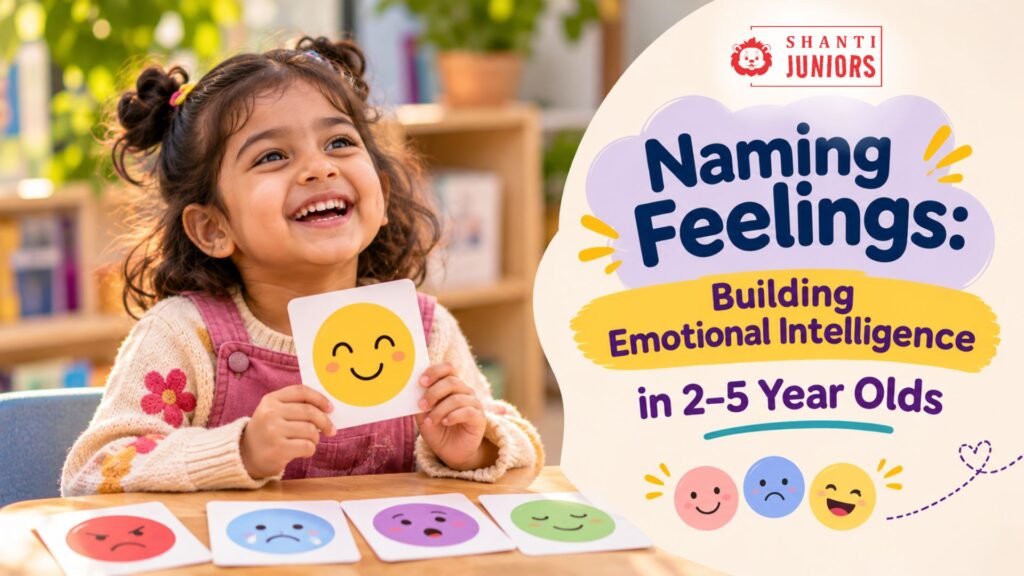
“I’m not hungry, I’m angry!” When your four-year-old says something like this, celebrate a little. They’ve just done one of the hardest things a young child can do: noticed a big feeling and put a word to it.
Emotional development in preschoolers is about exactly this: recognising feelings, naming them, and slowly learning what to do with them. It’s the foundation for friendships, focus, behaviour and confidence. This guide covers what to expect at each age, practical ways of teaching emotions to toddlers, how to make a feelings chart for kids, and the everyday games that build these skills.
When children can name a feeling, they can begin to manage it. “I feel frustrated” is the first step to “I need help” rather than throwing the puzzle across the room.
Children who learn emotional skills early tend to:
– Have fewer and shorter meltdowns
– Make and keep friends more easily
– Concentrate better in class
– Bounce back faster from disappointment
– Show more empathy for others
This is what preschools mean by social-emotional learning (SEL): teaching children to understand themselves, understand others and get along.
Every child is different. These are broad guides, not tests.
Age | What many children can do |
2–3 years | Show clear emotions but rarely name them; begin to use “happy”, “sad”, “scared”, “cross”; big feelings often come out as tantrums |
3–4 years | Name basic feelings in themselves and others (“He’s sad because he fell”); start to wait a little; enjoy playing with friends but still struggle with sharing |
4–5 years | Use more feeling words (frustrated, worried, excited, proud, embarrassed, jealous); begin to calm themselves with help; show empathy and comfort others |
5–6 years | Talk about why they feel something; use simple strategies (deep breaths, asking for help); understand that two people can feel differently about the same thing |
Tantrums at 2–3 are normal; they’re a sign the feelings are bigger than the words. Our guide to toddler tantrums explains what to do in the moment.
Narrate what you see, without judging: “You’re laughing, you look happy.” “You threw the block. I think you’re frustrated because the tower fell.” Name your own feelings too: “I’m feeling a bit tired, so I’m going to sit down for a minute.”
“It’s okay to feel angry. It’s not okay to hit.” All feelings are allowed; not all actions are.
Start with four: happy, sad, angry, scared. Then add: excited, frustrated, worried, proud, lonely, surprised, disappointed, jealous, calm. The more words a child has, the more precisely they can tell you what’s wrong.
“How did you feel when Riya took your crayon?” “What could you do next time?” Open questions build thinking. See how to teach WH questions.
Picture books where characters feel big things (a lost toy, a new baby, a first day at school) give you a safe way to talk. Pause and ask, “How do you think she feels?”
Dolls and soft toys can act out feelings your child finds hard to talk about: “Teddy is scared of the doctor. What can we do?” See benefits of pretend play.
You need: chart paper, a marker, photos or drawings.
How to use it: at breakfast, after preschool and at bedtime, ask, “Where’s your peg?” Your child moves it to the face that fits. Then ask one gentle question: “What made you feel that way?”
Level up for 5-year-olds: add a “what can I do?” strip below: take deep breaths, hug a toy, ask for help, go to the calm corner, draw it.
Tool | How to teach it |
Balloon breathing | Breathe in slowly through the nose like filling a balloon, out slowly through the mouth. Do 3 |
Smell the flower, blow the candle | In through the nose (flower), out through the mouth (candle) |
Squeeze and let go | Squeeze hands into tight fists, count to 5, then let go |
Calm corner | A cosy spot with cushions, a soft toy, a few books and the feelings chart. Not a punishment; a place to feel better |
Count to 10 | With fingers, slowly |
Hug or ask for help | “I need a hug” is a strategy too |
Practise these when your child is calm, so they’re ready when feelings are big. Slow, gentle movement helps too; a few calm poses from yoga for kids work well at bedtime (see bedtime routine for 2–5 year olds).
Talk to your paediatrician or a child psychologist if your child:
– Has very frequent, intense outbursts well past age 4–5
– Seems persistently sad, withdrawn or anxious for weeks
– Rarely shows emotion or interest in others
– Hurts themselves or others often
Early support helps, and asking for it is a sign of good parenting.
At Shanti Juniors, emotional skills are taught every day through circle time, stories, role play and the way our teachers respond to children’s feelings. It’s part of the Kiddowitty curriculum and of how Shanti Juniors supports holistic development. [CONFIRM: any named SEL programme or feelings routine used in classrooms]
Name feelings out loud throughout the day, accept the feeling while limiting the behaviour, start with four words (happy, sad, angry, scared), read picture books about feelings, and use soft toys to act out situations.
Many 3-year-olds can name basic feelings in themselves and others, begin to wait briefly, and enjoy playing with friends, though sharing and big feelings are still hard.
Draw or photograph 4–8 feeling faces, write the word under each, stick the chart at your child’s eye level, and use a named clothes peg your child moves to show how they feel.
Teaching children to understand and manage their feelings, understand others, make friends and solve problems. It’s taught through play, stories, routines and how teachers respond to children.
Model naming your own feelings, use books and pretend play to talk indirectly, offer a feelings chart, and stay calm and accepting when they do share.
Practise simple tools when they’re calm (balloon breathing, squeezing fists, a calm corner), then guide them through one when feelings are big.
You don’t need a curriculum. You need to notice, name and accept, every day. “You look proud of that drawing” might be the most useful sentence you say this week.
To see how Shanti Juniors teachers support children’s emotional growth, find your nearest centre or book an admission enquiry.
Read next: Toddler Tantrums: What to Do in the Moment · A Bedtime Routine That Works · Pretend Play: Why It Builds Real Skills

Comments are closed