
- Email info@shantijuniors.com
- Phone +91 99796 66660

By Vishal Chiripal, Shanti Juniors
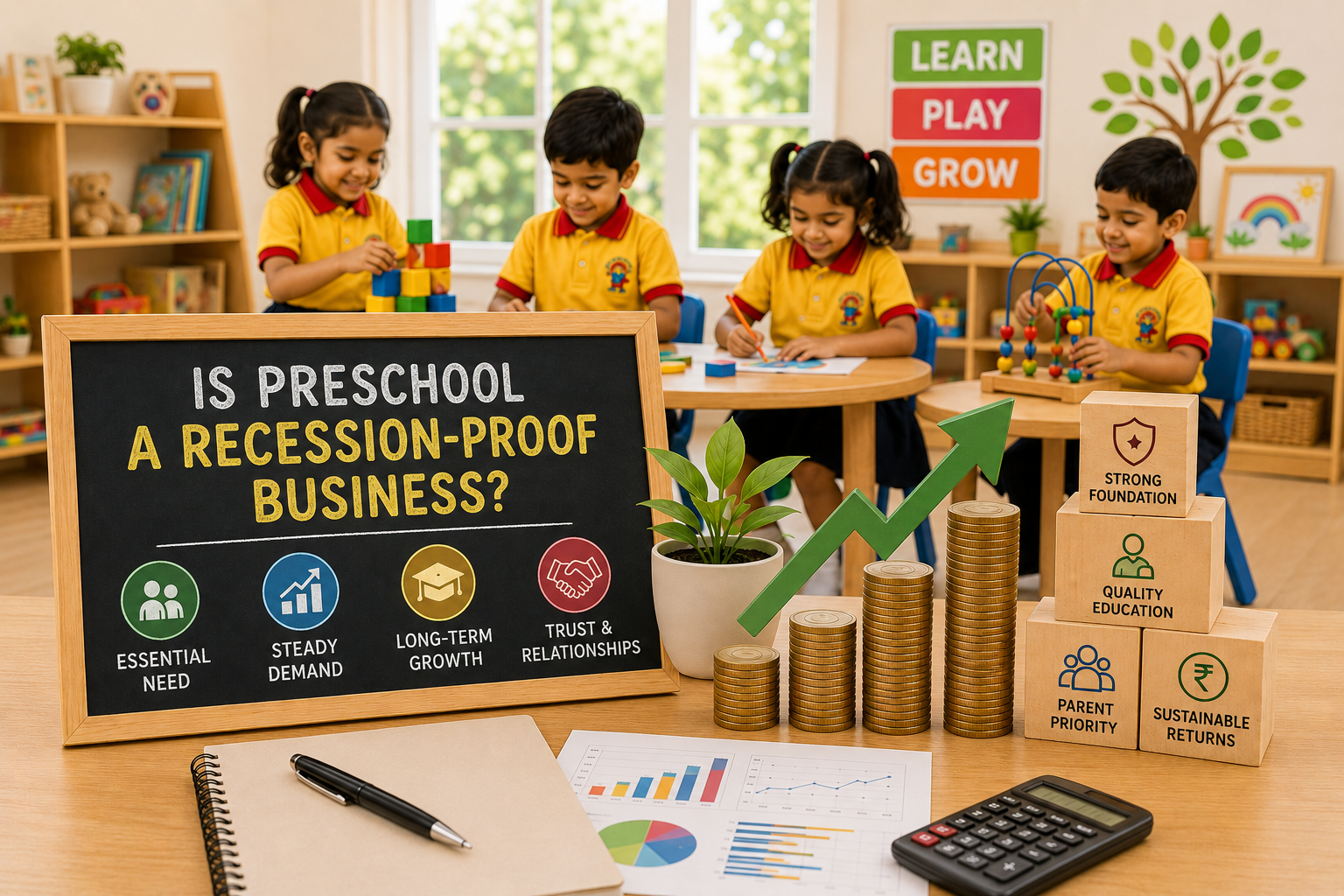
As economic fluctuations often influence business viability, many investors are turning their attention to sectors that demonstrate resilience during recessions. The preschool industry, particularly through franchise models, stands out as a potential opportunity for those seeking to invest in a recession-proof business. In this article, we will delve into the recession-resistant nature of preschool franchises, focusing on investment opportunities, profitability metrics, and market trends that support the stability of early childhood education.
The preschool business offers unique advantages that can provide reliable revenue streams, even in economic downturns. We’ll explore the operational dynamics of this industry, examining how recurring admissions cycles and a focus on quality education contribute to its resilience. Additionally, we’ll consider specific benefits of investing in a preschool franchise, with a focus on the Shanti Juniors franchise, known for its robust support systems and proven business frameworks.
Investing in a preschool franchise involves several financial commitments that can vary significantly depending on the location and specific business model chosen. Understanding these costs is crucial for potential investors eager to tap into this growing market.
This financial overview highlights the various aspects of funding a preschool franchise, making it an accessible option for many investors looking for stable undertakings in education.
To evaluate the profitability of a preschool franchise, key performance indicators must be considered. These metrics provide insights into financial health and potential returns, enabling savvy business decisions.
These indicators emphasize the attractive profitability landscape that preschool franchise investors can benefit from, promoting the viability of such businesses even in challenging economic climates.
The perception of preschools as recession-proof rests on several foundational attributes.
This understanding of the recession-resistant nature of preschools highlights their essential role in society, irrespective of external economic pressures.
Several current trends are driving growth within the preschool market, contributing to its durability during economic downturns.
Understanding these trends is crucial for stakeholders looking to enhance their position within the preschool industry.
The preschool business exhibits unique characteristics that underscore its resilience in the face of economic uncertainty.
Exploring these elements can help investors understand why the preschool model is becoming increasingly favorable during economic fluctuations.
It is important to compare the investment and profitability potential of preschool franchises with other business sectors.
This comparative approach reveals the distinctive advantages that preschool franchises hold over alternative business models.
Economic conditions can influence preschool enrollments, but generally show stable performance even during recessions.
Assessing these dynamics further emphasizes the preschool industry’s resilience during tough financial times.
Several key trends bolster the stability of the preschool market in the face of economic uncertainty.
These trends highlight the ongoing evolution of the preschool sector, supporting its growth potential.
Investing in a preschool franchise in India offers several unique advantages:
By analyzing these benefits, potential investors can make informed decisions regarding their involvement in this sector.
Investing in a preschool franchise presents numerous advantages over independent startups.
Understanding these benefits places franchise offerings in a distinct position compared to independent startups.
Support services offered by preschool franchises enhance growth and operational efficiency.
These support mechanisms are integral to the growth and sustainability of preschool franchises.
Shanti Juniors is recognized for its robust franchise model that fosters investor confidence through various key aspects.
Understanding the Shanti Juniors model provides insight into the factors that contribute to its success in the preschool franchise sector.
Franchisees of Shanti Juniors benefit from several proven systems that streamline operations and enhance profitability.
By leveraging these systems, franchisees can enjoy a streamlined approach to running their businesses while increasing the likelihood of success.
Building community trust and brand strength is vital for preschool franchises.
These strategies exemplify how Shanti Juniors fosters its reputation as a trusted provider of preschool education.
Several factors play a critical role in determining the profitability of preschool businesses in India.
By considering these aspects, investors can adopt practices that optimize profitability in the preschool sector.
Recurring admission cycles are foundational to the financial performance of preschool franchises.
The role of these recurring cycles is crucial in ensuring the stability of income for preschool franchises.
Understanding the cost drivers and return on investment expectations for preschool franchises can guide prospective investors’ decisions.
Evaluating these financial parameters empowers investors to make informed choices regarding their preschool franchise endeavors.
The demand for early childhood education is a stabilizing force for preschool businesses, particularly during economic downturns.
This demand underscores the durability of the preschool model even in challenging times, ensuring ongoing opportunities for enrollment and growth.
Despite economic constraints, parents continue to prioritize their children’s educational needs, highlighting the preschool sector’s resilience.
This steadfast commitment to quality education creates stability for preschool franchises by continuing to attract families even in uncertain economic climates.
Several demographic and social trends contribute to increasing preschool enrollment rates in India, creating vast opportunities for investors.
These trends indicate fertile ground for preschool franchises, paving the way for sustained interest and investment in early childhood education.
Understanding the differences between preschool franchises and independent startup models can inform investment decisions.
By comparing these models, investors can make more strategic choices regarding their entrepreneurship journeys in the preschool sector.
Franchises often hold operational advantages that make them a favorable choice compared to independent preschools.
These operational aspects underscore the tactical benefits of investing in franchises over independent models.
Effective franchise training is crucial for long-term business sustainability in the preschool industry.
These training elements play an important role in ensuring the brand’s success and the sustainability of the investment involved.
Increasing online visibility is essential for preschool franchises aiming to attract new clientele.
Investing in these digital enhancements can greatly support preschool franchises in reaching a broader audience and strengthening market presence.
Employing structured data methodologies such as FAQ and organization schema can enhance visibility and communication.
Utilizing these techniques is essential for preschool franchises aiming to maintain a competitive edge in digital marketing.
Comments are closed