
- Email info@shantijuniors.com
- Phone +91 99796 66660
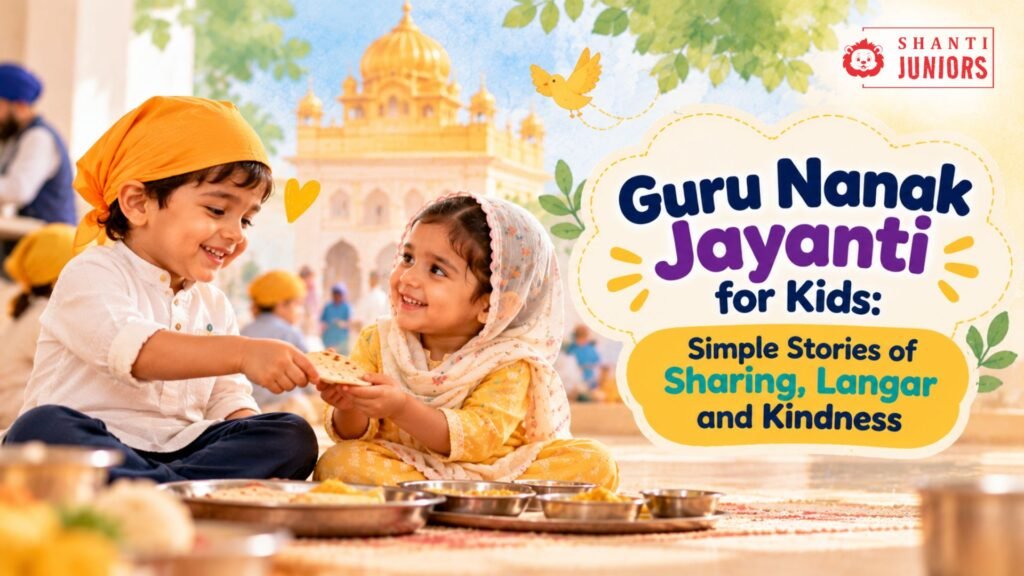
On Guru Nanak Jayanti, gurdwaras glow with lights, early-morning processions sing through the streets, and thousands of people of every background sit side by side on the floor to share a meal. For children, it’s a beautiful festival to learn from, because its message is one even a toddler can understand: share, be honest, and treat everyone as equal.
This guide explains Guru Nanak Jayanti for kids: who Guru Nanak Dev Ji was, three simple stories, what langar means, the 2026 date, and gentle Gurpurab activities for kids aged 2–6.
Guru Nanak Jayanti 2026: Tuesday 24 November 2026, on Kartik Purnima (full moon), per Drik Panchang. It marks the 557th birth anniversary of Guru Nanak Dev Ji. It’s also called Gurpurab or Prakash Purab.
Simple version for 2–4 year olds:
> “Guru Nanak was a kind and wise teacher who lived a long time ago. He taught everyone to share, to be honest, to work hard and to love all people the same. He is the first Guru of the Sikhs. His birthday is Guru Nanak Jayanti.”
A little more for 5–6 year olds:
Guru Nanak Dev Ji was born in 1469 in a village called Talwandi, now known as Nankana Sahib (in present-day Pakistan). Even as a boy, he was thoughtful and kind and asked big questions. When he grew up, he travelled very far on foot, meeting people of all religions and backgrounds, singing songs of love for God and teaching that all people are equal. He became the first of the ten Sikh Gurus.
When Nanak was a young man, his father gave him twenty rupees. “Go to the market and make a good bargain,” he said. “Buy something and sell it for more.”
On the way, Nanak met a group of holy men who had not eaten for days. They were tired and hungry.
Nanak thought, “What is the best bargain I can make?” He used all twenty rupees to buy food and fed every one of them.
When he came home with no money, his father was upset. But Nanak said gently, “Father, I made the truest bargain of all. I fed the hungry.”
The lesson: helping someone in need is worth more than money.
Once, Guru Nanak visited a town where a rich man called Malik Bhago held a great feast. He invited Guru Nanak, but Guru Nanak chose instead to eat simple roti at the home of a poor carpenter called Bhai Lalo.
Malik Bhago was offended. “Why would you eat dry bread at a poor man’s house instead of my grand feast?”
Guru Nanak explained that Bhai Lalo’s roti was made with honest, hard work and given with love, and that made it more precious than the richest food.
The lesson: honest work and kindness matter more than how much you have.
(Some retellings include a dramatic miracle in this story. For young children, the simple version above works well.)
Guru Nanak taught that everyone is equal: rich or poor, man or woman, any religion, any caste. To show this, a free community kitchen was started, where everyone could eat together.
Kings and farmers, children and grandparents, all sat on the same floor, in the same rows, and ate the same simple food.
The lesson: no one is more important than anyone else. We all eat together.
Langar is the free community meal served at every gurdwara, every day, to anyone who comes, whoever they are. Volunteers (called sevadars) cook, serve and clean. People sit together on the floor in rows, called pangat, so everyone is at the same level.
For a 3-year-old: “Langar is a big free lunch at the gurdwara. Everyone sits together on the floor and shares the same food. People help cook and serve because helping makes everyone happy.”
What children learn from langar:
– Sharing food with everyone
– Helping without being asked (seva)
– Waiting patiently and saying thank you
– Treating everyone the same
Teaching | Meaning | Child-friendly version |
Naam Japna | Remember God | Say a little thank-you prayer every day |
Kirat Karni | Earn an honest living | Always tell the truth and do your work well |
Vand Chhakna | Share with others | Share what you have, especially with people who need it |
Visiting a gurdwara with young children: cover heads (a scarf or patka for children too), remove shoes, wash hands and feet, sit quietly on the floor, and accept karah prasad with cupped hands. Gurdwaras get crowded on Gurpurab, so make sure your child knows your phone number (see teach your child their address and emergency information).
The sharing ideas from Children’s Day earlier in the month work beautifully here too.
Shanti Juniors celebrates the festivals of all communities, so every child sees their own family’s traditions honoured and learns about their friends’. Around Gurpurab, children hear simple stories about sharing and honesty, and practise them at snack time. It’s part of our culture and celebrations, the values woven through the Kiddowitty curriculum, and our approaches to whole-child learning. [CONFIRM: Gurpurab holiday or activity at North India centres]
Tuesday 24 November 2026, on Kartik Purnima, according to Drik Panchang. It marks the 557th birth anniversary of Guru Nanak Dev Ji.
The first of the ten Sikh Gurus, born in 1469 in Talwandi (now Nankana Sahib). He taught that all people are equal, and that we should share, be honest and remember God.
Langar is the free community meal served at gurdwaras to everyone, whatever their background. People sit together on the floor and volunteers cook, serve and clean.
Young Nanak was given twenty rupees to make a good bargain. Instead, he fed a group of hungry holy men, calling it the truest bargain of all.
Naam Japna (remember God), Kirat Karni (earn honestly) and Vand Chhakna (share with others).
“Guru Nanak was a kind teacher who taught everyone to share, tell the truth and love all people the same. Today is his birthday.”
Three ideas, small enough for a three-year-old, big enough for a lifetime. Gurpurab is a lovely time to practise them together.
To see how Shanti Juniors celebrates festivals and values, find your nearest centre or book an admission enquiry.
Read next: Children’s Day Activities for Preschoolers · Naming Feelings in 2–5 Year Olds · Diwali for Kids: The Story and 10 Lines

Comments are closed