
- Email info@shantijuniors.com
- Phone +91 99796 66660
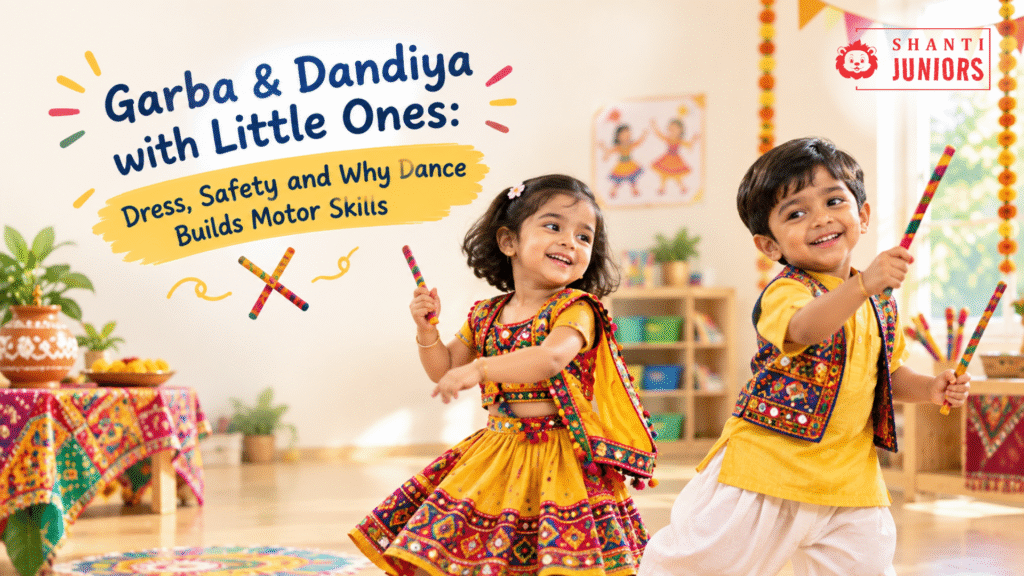
In Gujarat, a child’s first garba is a milestone. A tiny chaniya choli, a kediyu with mirror work, a circle of aunties clapping, and a toddler stamping their feet slightly off the beat — it is one of the happiest sights of the year.
It can also be one of the most exhausting nights of the year if you go unprepared. This guide covers garba for kids from every angle a parent cares about: what to dress them in, how to keep them safe in a crowd of whirling dandiya sticks, how late is too late, easy steps to teach at home — and why all that spinning and clapping is genuinely good for their development.
(Sharad Navratri 2026 ran 11–19 October. These tips work for every garba night — society events, school celebrations, weddings and next Navratri.)
The rule is simple: traditional on top, comfortable underneath.
For girls — chaniya choli
For boys — kediyu and dhoti or churidar
Footwear: soft-soled mojdis with a back strap, or simply clean socks or bare feet where the ground allows. No heels, no slippery leather soles.
Jewellery: clip-on, lightweight, nothing that dangles near the face. Remove anything with small detachable parts for children under three.
Let them help dress themselves. Putting on their own bangles or buttoning a kediyu is a real self-help skill — and festival nights are when children are most motivated to try. More ideas in 10 everyday things your preschooler can learn to do independently.
Dandiya sticks are the single biggest injury risk at a garba night for small children — at eye height, swinging fast, held by adults who are not looking down.
Noise. Garba venues often run speakers at very high volume, and children’s ears are more sensitive than ours. Practical steps:
Crowds.
How late is too late? For most preschoolers, 8:30–9 pm is the realistic limit, and many big garba events only really start after 9. Better options:
A tired, overstimulated child the next morning is the real cost of a late night — and it can take two or three days of routine to recover.
Hydration and food: carry a water bottle and a simple snack. Fried festival food late at night often means an upset stomach.
You do not need to be a good dancer. You need music and a circle.
Step 1 — The clap circle (age 2+). Walk in a circle, clapping on every step. That’s it. Toddlers love this.
Step 2 — Two claps and a turn (age 3+). Step-step-clap, step-step-clap, then a slow turn. Say the words out loud as you do it.
Step 3 — Be-taali, the two-clap garba (age 4+). Step forward, clap to the right; step back, clap to the left. This is the classic pattern and gives older preschoolers a real “grown-up” step.
Step 4 — Soft dandiya pairs (age 4+). Face a partner. Tap your own sticks together, then tap your partner’s right stick, then your own, then their left. Slow first, then faster.
Play the same one or two songs every evening during Navratri. Repetition is what makes the steps stick — the same reason children learn nursery rhymes so quickly.
To an adult, garba is a dance. To a developing child, it is a full workout for the body and the brain.
What your child does | What it builds |
Walking in a circle while clapping | Coordination — doing two things at once |
Clapping across the body, left and right | Crossing the midline, important later for reading and writing left to right |
Turning and spinning | Balance and body awareness (the vestibular sense) |
Stepping on the beat | Rhythm and timing, linked to early language and listening skills |
Dandiya with a partner | Hand–eye coordination, bilateral coordination, timing with another person |
Following the circle and the group | Spatial awareness, turn-taking, belonging |
Dancing for 30–45 minutes | Stamina and gross motor strength |
Gross motor skills — big movements of the arms, legs and whole body — develop before the fine motor skills a child needs for writing. A child who can balance, coordinate both sides of the body and keep a rhythm is building the foundation that a pencil grip sits on. That’s why we take movement seriously at Shanti Juniors; we have written more about why fitness matters in preschoolers.
And the social side. Garba is a circle — there is no front row and no “best dancer”. A shy child can join at their own pace, hold a hand, and be part of something bigger than their family. For many preschoolers it is their first experience of a community celebration.
Many preschools in Gujarat hold a Navratri garba day, and it is one of the best days to see a school as it really is. Look for:
At Shanti Juniors centres across Ahmedabad, Surat and beyond, Navratri week brings together the story of Maa Durga, the nine colour days and garba in one learning theme. You can glimpse it in our gallery and culture pages. If you are looking for a preschool in Gujarat, our guides to the best preschools in Ahmedabad (2026) and the best preschools in Surat explain what to look for.
As soon as they can walk, they can join a clapping circle. Simple two-clap steps usually work from around age three or four, and soft-stick dandiya from around four.
With soft foam or newspaper sticks and a kids-only circle, yes. Wooden dandiya sticks swing at a small child's eye height in an adult ring, so keep toddlers out of adult dandiya circles.
A light cotton chaniya choli or kediyu with an elastic waist, soft-soled footwear with a back strap or bare feet, minimal clip-on jewellery and no loose dupatta. Comfort matters more than elaborate work.
Stand well away from the speakers and use child-sized ear defenders for babies and toddlers. If your child seems distressed by the noise, move further away or leave — their discomfort is a real signal.
For most children aged 2–5, around 8:30–9 pm is a sensible limit. Go early, leave while they are still enjoying it, or hold an early home garba instead.
Dance builds balance, coordination, rhythm, crossing the midline and stamina — the gross motor foundations that later support fine motor skills like writing. It also builds confidence and social belonging.
Start with walking in a circle and clapping on each step, then step-step-clap with a slow turn, then the classic two-clap (be-taali) pattern for four- to six-year-olds.
You don’t need the biggest garba ground in the city. A circle of family, one song, and a child stamping their feet off the beat is the whole festival.
Want to see how movement, music and festivals are built into everyday learning? Find your nearest Shanti Juniors centre or book an admission enquiry.
Read next: Navratri for Kids: The Story of Maa Durga · 9 Days, 9 Colours: Navratri Activities for Preschoolers · Dussehra Story for Kids

Comments are closed