
- Email info@shantijuniors.com
- Phone +91 99796 66660
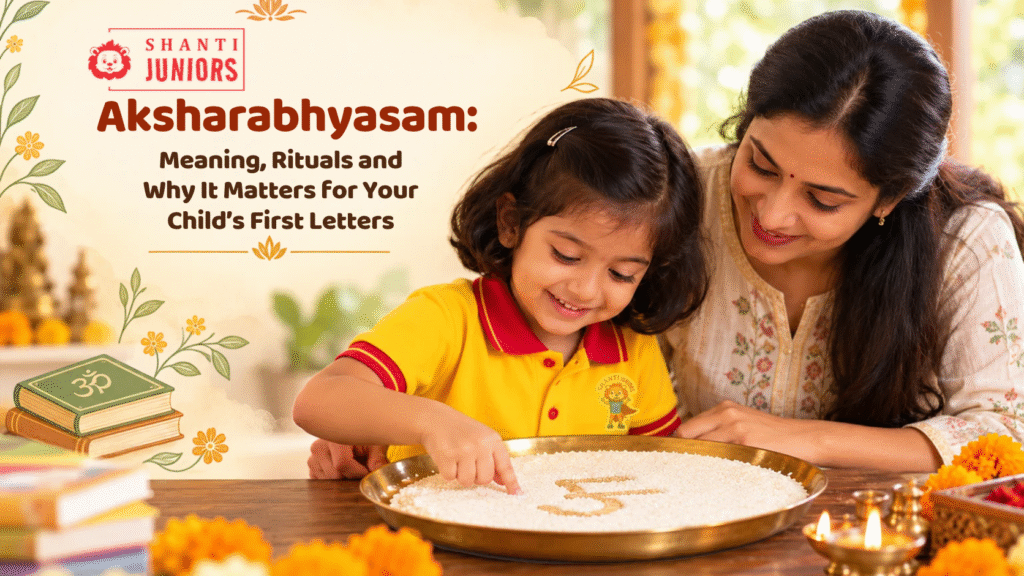
A plate of rice. A lamp. A grandparent’s hand wrapped around a tiny index finger. And, slowly, wobbling, the first letter your child has ever “written.”
That moment is Aksharabhyasam — and for millions of Indian families, it is the day learning officially begins.
This guide explains what Aksharabhyasam means, when and at what age it is done, how to do it at a temple or at home, what to write, and — the part most guides leave out — what it actually means for your child’s learning, and what should come next.
Vijayadashami 2026 falls on Tuesday 20 October — the most popular day of the year for Aksharabhyasam. In Kerala, Vidyarambham is on Wednesday 21 October 2026. The next major day is Vasant Panchami, Thursday 11 February 2027.
The word comes from Sanskrit:
So Aksharabhyasam is literally “the practice of letters” — a child’s formal initiation into reading, writing and learning. It is one of the traditional samskaras (rites of passage) of childhood, and it is usually performed with a prayer to Goddess Saraswati, the goddess of knowledge, and often to Lord Ganesha, who removes obstacles.
The idea behind “akshara” is beautiful to share with a child: letters are things that never perish. What you learn stays with you.
Families across India mark the same moment under different names:
Region / community | Common name |
Andhra Pradesh, Telangana | Aksharabhyasam |
Kerala | Vidyarambham / Ezhuthiniruthu |
Karnataka | Akshara Abhyasa / Vidyarambha |
Tamil Nadu | Vidyarambham / Aksharabhyasam (often on Vijayadashami) |
Maharashtra, North and West India | Vidyarambh / Akshar Abhyas / Pati Pujan |
The details change; the heart does not. A child, a guide, a prayer, and a first letter.
Families usually choose one of these:
Timings vary by panchang and by region, so confirm with your temple or family priest. (For the story behind Vijayadashami to share with your child, see our Dussehra story for kids.)
Most families perform it between ages 2 and 5, and very commonly around age 3, just before or as a child begins preschool. Some traditions prefer the child’s third or fifth year.
Developmentally, this timing makes sense. Around two and a half to three, most children:
There is no “too late.” A child who has Aksharabhyasam at four or five loses nothing. And there is no need to rush it for a two-year-old who is not ready to sit — the ceremony is meant to be a happy beginning, not a test.
If you’re also wondering when to start preschool itself, see what age should a child start preschool.
Practices vary, but most ceremonies follow this shape:
The whole ritual often takes only 20–40 minutes — which is just right for a three-year-old’s attention span.
Many families travel to a Saraswati temple for the ceremony. Well-known ones include:
Practical tips for temple visits with a small child:
A home ceremony is just as meaningful — and often much calmer for a young child.
You will need (a simple checklist):
Steps:
Who can be the guru? A priest, a teacher, a grandparent, or a parent. What matters is that it is someone your child loves and trusts.
Here is the honest part. A child does not learn to write in one day — and isn’t supposed to. Aksharabhyasam is a blessing and a beginning, not a lesson.
What the ceremony does do is powerful in its own way:
What happens on the day | What it builds |
The whole family gathers around their first letters | A positive emotional start — learning feels special, not scary |
Tracing a letter in rice with a finger | Sensory, hands-on learning — exactly how young children learn best |
Sitting with a trusted adult | Attention and joint focus |
New slate, new book | Ownership and pride — “these are my books” |
Hearing that letters “never perish” | A lifelong value placed on learning |
The tracing-in-rice method is, in fact, remarkably close to what early-childhood educators recommend today: multi-sensory, finger-first, pressure-free. Children learn letters through touch, movement and repetition long before they learn them through a pencil.
This is where many families feel unsure. The ceremony is over, the rice is put away — now what? Should a three-year-old start writing ABCs every day?
No — and please don’t rush to the pencil. Most three-year-olds’ hands are not ready for formal writing. Before letters come:
We have put together a 30-day plan of ten playful activities for exactly this stage: After Aksharabhyasam: 10 Playful Pre-Writing Activities for the Next 30 Days. For more ideas, see fine motor activities for kids and fine motor activities your 3-year-old will love at home.
Talking and listening matter just as much as hands: reading together, rhymes and conversation build the language that writing will one day express. Our guides on teaching WH questions through everyday conversations and nursery rhymes for kids are good places to start.
Many families time Aksharabhyasam just before their child starts preschool — and the two fit together naturally. The ceremony gives the blessing; a good preschool gives the daily, playful practice.
At Shanti Juniors, writing readiness is built step by step through the Kiddowitty curriculum: sensory and fine-motor play in Toddcare and Nursery, pre-writing strokes and letter sounds in Junior KG, and formal letter formation in Senior KG. Festivals like Vijayadashami and Vasant Panchami are celebrated as part of our culture, so the values behind your family’s ceremony carry on in class.
"Akshara" means letter (and "that which does not perish"), and "abhyasam" means practice. Aksharabhyasam is the traditional ceremony in which a child is formally initiated into learning, usually by writing their first letters in rice with the help of a guru, with prayers to Goddess Saraswati.
Most families perform it between ages 2 and 5, very often around age 3, just before or as a child starts preschool. There is no fixed rule and no "too late."
Vijayadashami and Vasant Panchami are the most popular. In 2026, Vijayadashami is on Tuesday 20 October (Vidyarambham in Kerala on Wednesday 21 October). Vasant Panchami 2027 is on Thursday 11 February. Many families also choose a muhurtham with their priest.
Yes, essentially. Aksharabhyasam is the common name in Andhra Pradesh and Telangana; Vidyarambham is used in Kerala and parts of Tamil Nadu and Karnataka. The core ritual — a child's first letters with a guru's blessing — is the same.
Usually "Om", a sacred phrase (in Kerala, "Hari Sri Ganapataye Namah"), and the first letters of the alphabet in the family's language, written in raw rice with the child's index finger. Some traditions also trace "Om" on the child's tongue with a gold ring.
Yes. You need a picture of Goddess Saraswati, a lamp, a plate of uncooked rice, a slate or notebook, new books and prasad. A parent, grandparent or priest can guide the child's finger.
The Gnana Saraswati Temple at Basara in Telangana is the best known. Wargal (Telangana), Thunchan Parambu and Panachikkadu (Kerala), Koothanur (Tamil Nadu) and Sringeri (Karnataka) are also popular.
Not with a pencil, at age three. Focus on hand strength, finger control and pre-writing strokes through play. Formal letter writing usually begins around age 5. See our 30-day pre-writing plan.
Keep the rice plate photo. Keep the slate. And remember that the real gift of Aksharabhyasam is the feeling it gives your child — that learning is joyful, blessed and theirs.
To see how Shanti Juniors builds on that first letter, day by day and through play, find your nearest Shanti Juniors centre or book an admission enquiry. Planning ahead for admission season? Our preschool admission documents checklist will help.
Read next: After Aksharabhyasam: 10 Pre-Writing Activities for the Next 30 Days · Dussehra Story for Kids · Fine Motor Activities for Kids

Comments are closed