
- Email info@shantijuniors.com
- Phone +91 99796 66660
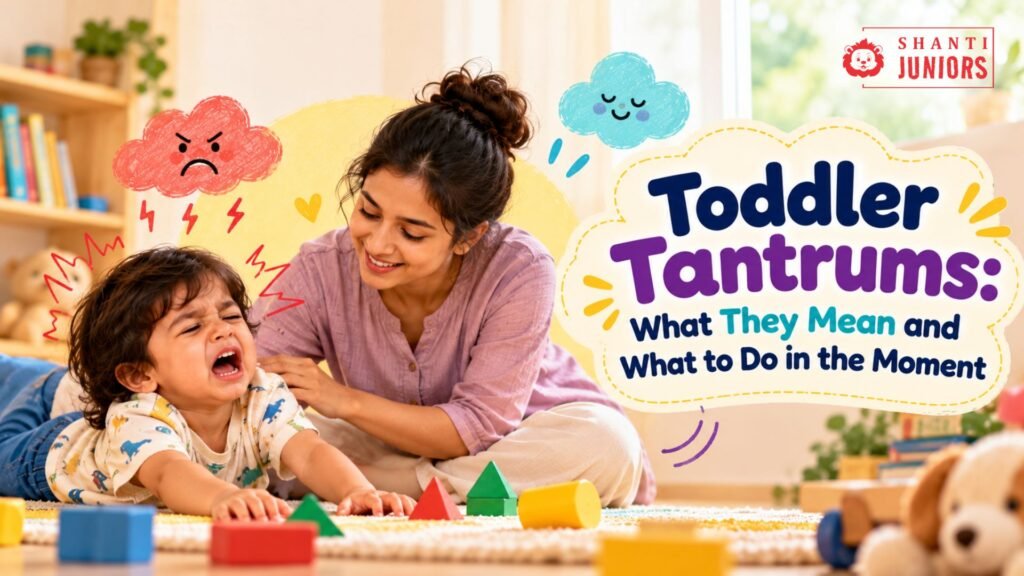
It always seems to happen at the worst possible moment: the supermarket queue, a relative’s wedding, the five minutes before you need to leave. One “no” and your child is on the floor, screaming, kicking, inconsolable.
Tantrums are one of the most stressful parts of raising a young child. They’re also completely normal. This guide explains how to handle toddler tantrums: why they happen, exactly what to do and say in the moment, how to deal with a toddler meltdown in public, and calm-down strategies for kids that prevent the next one.
A tantrum is what happens when a feeling is bigger than a child’s ability to manage it.
Tantrums peak between about 18 months and 3 years, and usually ease by 4–5 as language and self-control improve. Most last a few minutes, though it feels much longer.
Tantrum or meltdown? Parents often use the words interchangeably. Some professionals use “tantrum” for outbursts aimed at getting something and “meltdown” for a child who is completely overwhelmed (often by tiredness, noise or sensory overload). The response in the moment is similar: keep them safe and help them calm down.
Instead of… | Try… |
Shouting back | A calm, low voice |
Long explanations | Three to five words |
Giving in to stop the noise | Holding the limit kindly |
Threats you won’t carry out | Calm, short consequences you will follow through |
Shaming (“Big boys don’t cry”) | “It’s okay to feel sad” |
Smacking | Never. It teaches that hitting is how big people handle anger |
Punishing the feeling | Limiting the behaviour |
Should you ignore tantrums? Ignore the demand, not the child. Stay present and calm, but don’t negotiate or reward the tantrum.
At weddings and festivals, plan quiet breaks and protect sleep. See our tips on noise in a safe, eco-friendly Diwali.
Check the basics. Many tantrums happen when a child is hungry, tired, unwell or overstimulated. Carry a snack and protect naps and bedtime (see bedtime routine for 2–5 year olds).
Predictable routines. Children cope better when they know what’s coming. A simple picture routine helps; see daily routine for preschoolers.
Warnings before transitions. “Five more minutes, then shoes on.” A timer makes it the timer’s decision, not yours.
Offer small choices. “Red cup or blue cup?” “Walk or hop to the car?” Control over small things reduces fights over big ones.
Say yes where you can. Save your “no” for things that matter: safety, health, kindness.
Praise the calm moments. “You waited so nicely for your turn!”
Teach calm-down strategies when calm: balloon breathing, squeezing a cushion, counting to ten, asking for a hug. Practise them during play so they’re ready when needed.
Give attention before they demand it. Ten minutes of undivided play a day reduces attention-seeking outbursts, especially after a new sibling arrives (see sibling rivalry and the new baby). Independent play time helps too; see how to encourage independent play.
Age | What’s typical | What helps most |
18 months–2 years | Frequent, short, mostly frustration and tiredness | Distraction, comfort, routines |
2–3 years | Peak tantrum age; battles over independence | Choices, naming feelings, holding limits |
3–4 years | Fewer, but sometimes louder and longer | Calm-down strategies, problem-solving afterwards |
4–5 years | Less frequent; more talking back | Clear rules, consequences, emotional vocabulary |
Tantrums in a 4-year-old are still within the normal range, especially when tired, hungry or facing a big change.
Talk to your paediatrician if:
– Tantrums are very frequent (several times a day) after age 4
– They regularly last longer than 25–30 minutes
– Your child often hurts themselves (head-banging, biting themselves) or others during tantrums
– Your child seems unable to calm down even with your help
– Tantrums come with delayed speech, loss of skills, or problems sleeping and eating
– You feel unable to cope, or worried you might lose your temper
Getting support early helps the whole family.
At Shanti Juniors, our teachers use calm, positive discipline: naming feelings, offering choices, giving warnings before transitions and helping children calm down, never punishment or shaming. In Toddcare, routines and teacher–parent communication help toddlers through the most tantrum-prone age. [CONFIRM: positive discipline policy wording]
Because the brain’s self-control system is still developing, language lags behind wants, and toddlers are seeking independence. Hunger, tiredness and change make tantrums more likely.
Most last a few minutes. Tantrums usually peak between 18 months and 3 years and ease by 4–5.
Ignore the demand, not the child. Stay calm and nearby, keep them safe, and don’t give in, bribe or lecture.
Move somewhere quieter, stay calm, use few words, name the feeling, hold the limit, and leave if you need to. Plan outings after naps and snacks.
Yes, occasional tantrums are still normal at 4, especially when tired or facing change. Speak to your paediatrician if they’re very frequent, long or involve self-harm.
Balloon breathing, squeezing a cushion, counting to ten, a calm corner, and asking for a hug. Practise them when your child is calm.
You won’t get it right every time. Nobody does. But each time you stay calm, name the feeling and hold the limit, you’re teaching your child how to handle big feelings for life.
To see how Shanti Juniors teachers support children through big emotions, find your nearest centre or book an admission enquiry.
Read next: Naming Feelings in 2–5 Year Olds · A Bedtime Routine That Works · Sibling Rivalry and the New Baby

Comments are closed