
- Email info@shantijuniors.com
- Phone +91 99796 66660
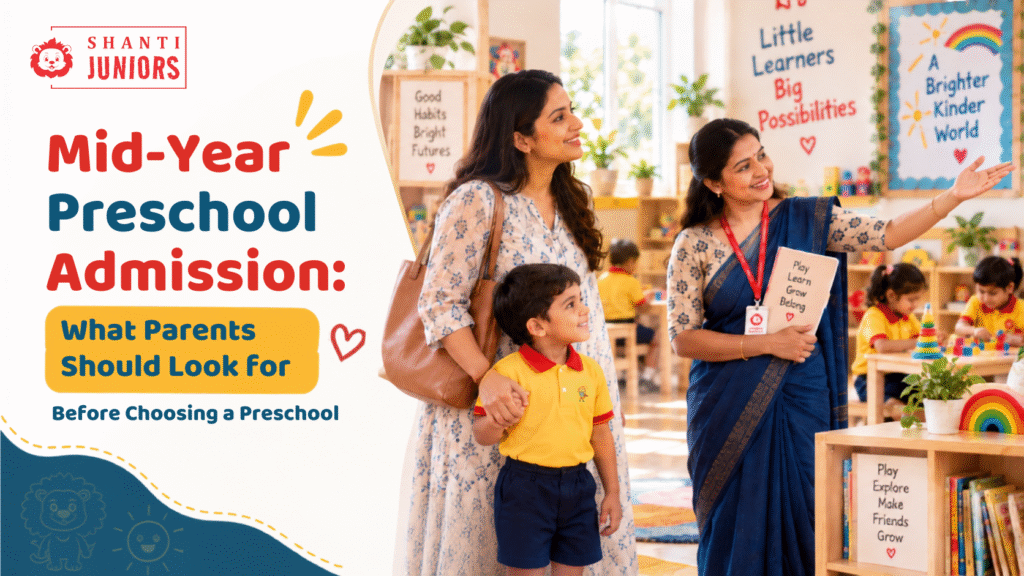
Looking for a preschool when the academic year has already started can feel confusing.
You may be searching for mid-year preschool admission, wondering whether schools are accepting new children, whether your child will adjust to an existing classroom and, most importantly, how to choose the right preschool for your child.
Whether you are relocating, starting preschool later or considering a change from another school, the same basic question matters:
Will this preschool provide the right environment for my child to learn, feel safe and grow?
Here is a practical checklist to help parents evaluate a preschool before taking mid-term admission.
Before comparing preschools, think about your child.
Ask yourself:
There is no single preschool that looks exactly the same for every child.
The right choice should take your child’s age, developmental stage, personality and learning needs into consideration.
Don’t choose a preschool only because it has colourful classrooms or attractive facilities.
Ask:
What and how will my child learn every day?
A good early childhood curriculum should support multiple areas of development, including:
At Shanti Juniors, early education is designed around holistic development, combining Indian values with modern research-based teaching practices.
You can explore the Shanti Juniors Curriculum to understand the programs and learning structure.
Different preschools use different educational philosophies.
Some may follow Montessori, some may emphasise play-based learning, while others may combine multiple approaches.
Shanti Juniors incorporates elements from Montessori, Reggio Emilia, Bank Street, HighScope and Waldorf approaches, with experiential and child-centric learning.
The approaches include opportunities for:
Parents can read more about the Shanti Juniors Early Childhood Learning Approaches.
This becomes especially important for mid-term preschool admission.
Ask the school:
A child shouldn’t be expected to understand a new environment immediately.
During your preschool visit, watch how teachers speak to children.
Do they listen?
Do they encourage questions?
Do they get down to the child’s level?
Do children appear comfortable approaching them?
The teacher-child relationship is an important part of the preschool experience.
Parents should also observe the practical side of the preschool.
Look at:
Shanti Juniors lists a safe and hygienic environment among its preschool features.
Ask what a typical preschool day looks like.
A balanced routine may include:
Children benefit from routines, but preschool should also leave room for exploration and play.
Preschool isn’t only about learning alphabets and numbers.
Children are also developing:
Shanti Juniors’ 3S philosophy—Sanskaar, Sakshar and Saksham—reflects its focus on values, learning and capability.
Especially when your child is joining mid-year, communication between parents and teachers matters.
Ask how the preschool shares:
A strong parent-school relationship can make the transition smoother.
A website can tell you about a preschool.
A visit can help you experience it.
During the visit, observe:
The environment: Does it feel welcoming?
The classrooms: Are children engaged?
The teachers: Do they interact warmly?
The routine: Does it look structured but flexible?
Your child: How does your child respond to the space?
Shanti Juniors’ admission journey includes a campus visit so parents can explore the preschool before joining.
For many families, starting preschool after the academic year has begun can still be a practical option.
Young children develop at different rates. One child may be ready for group learning earlier, while another may need more time to become comfortable away from home.
A preschool should therefore consider the child’s:
Instead of asking, “Is my child late?”, parents can ask:
“Is my child ready, and have we found the right environment for them?”
Shanti Juniors focuses on holistic early childhood development rather than treating childhood as a race. Its approach gives children opportunities to explore, interact, learn through experiences and develop at their own pace.
If you are searching for the best preschool for mid-year admission, avoid making the decision only on location, fees or popularity.
Instead, consider the complete experience:
Curriculum + Teachers + Environment + Safety + Learning Approach + Child Fit + Parent Communication
That gives you a much clearer picture.
For more guidance, read How to Navigate the Preschool Admission Process in India.
This depends on the preschool's availability, program and admission policy. Contact the centre to understand current openings.
Ask about curriculum, teaching approaches, daily routine, teacher-child interaction, safety, fees, parent communication and transition support.
It can require an adjustment period, particularly if classroom routines and friendships are already established. A supportive environment can help
Fees are an important practical consideration, but parents should also evaluate curriculum, environment, teacher interaction, safety and overall child fit.

Comments are closed