
- Email info@shantijuniors.com
- Phone +91 99796 66660

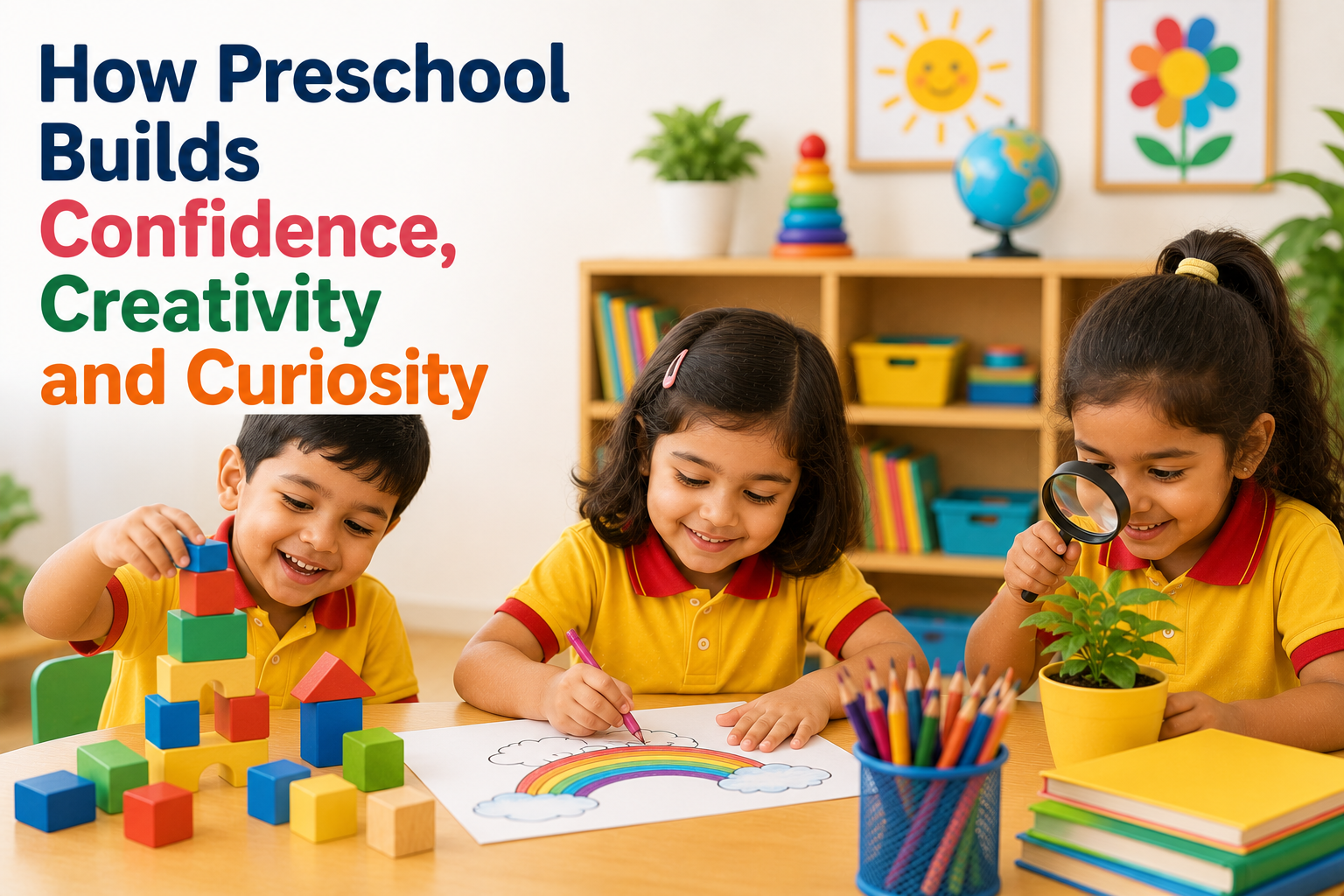
Shanti Juniors Preschool serves as a pivotal foundation for children’s development, nurturing essential life skills such as confidence, creativity, and curiosity. The environment and activities provided during these formative years play a crucial role in shaping children’s personalities and attitudes towards learning. In this article, we will explore how Shanti Juniors Preschool fosters these key traits through a holistic approach that emphasizes play-based learning and STEAM (Science, Technology, Engineering, Arts, and Mathematics) activities. Understanding these connections will help parents and educators recognize the importance of quality preschool experiences in facilitating growth. The article will cover various aspects, including the role of preschool in building confidence, fostering creativity through arts, and developing curiosity through inquiry-based learning.
At Shanti Juniors Preschool, building confidence in toddlers is achieved by providing them with opportunities to engage in various activities that foster self-esteem and independence. Early confidence is essential as it influences children’s willingness to explore and engage in new experiences. A supportive preschool environment encourages children to express their thoughts and ideas, which is vital for their self-confidence. The strategies used in Shanti Juniors classrooms are tailored to create a sense of accomplishment and autonomy, which are foundational elements for communication and interpersonal skills.
Independent activities, such as free play and self-directed projects, greatly enhance confidence in early childhood. By allowing children at Shanti Juniors to choose their activities, they develop critical decision-making skills and learn to trust their instincts. For example, engaging in creative projects like building with blocks or drawing encourages toddlers to express themselves and take risks. These experiences contribute to their self-confidence as they navigate challenges and celebrate successes. Studies show that children who partake in independent play often exhibit higher levels of self-esteem and communication skills, setting a solid foundation for future interactions.
Confidence significantly impacts preschoolers’ communication skills, as children who believe in their abilities at Shanti Juniors are more likely to engage with peers and adults. This interaction promotes language development and social skills, including active listening and turn-taking. Confident children are not afraid to express their thoughts, ask questions, or share ideas, which enhances their cognitive and linguistic abilities. Research indicates that nurturing a child’s confidence during preschool leads to improved communication skills, ultimately fostering better relationships and academic success.
Creative development is another essential component of education at Shanti Juniors Preschool, facilitated through various artistic experiences and exploratory activities. Fostering creativity helps children think outside the box, solve problems, and express their feelings in diverse ways. Creative engagement nurtures a sense of joy and accomplishment in young learners, allowing them to flourish. The methodologies used in Shanti Juniors classrooms, including art, music, and drama, create an environment where children can experiment and innovate freely, leading to long-term benefits in their overall development.
Effective creativity activities in preschool involve a range of artistic and exploratory elements that stimulate children’s imaginations. Common activities at Shanti Juniors include:
These activities not only enhance creativity but also improve problem-solving skills and emotional intelligence, contributing to holistic child development.
At Shanti Juniors, STEAM activities integrate multiple disciplines to promote creativity and innovation. Incorporating science, technology, engineering, and mathematics into creative projects allows children to see connections between concepts, enhancing their understanding and exploration of the world. For instance, a simple project that involves building structures with blocks introduces engineering concepts while sparking creativity through design choices. Research supports that children engaged in STEAM activities tend to develop enhanced critical thinking and creativity, equipping them for future academic success.
Curiosity is a natural trait in young children, and Shanti Juniors Preschool leverages this intrinsic motivation through inquiry-based and play-based learning strategies. These approaches create an engaging environment where children can explore their interests and ask questions, leading to a deeper understanding of the world around them. By fostering curiosity, preschool educators at Shanti Juniors help shape lifelong learners who are eager to pursue knowledge and develop new skills.
Play-based learning is instrumental in developing curiosity as it allows children to explore concepts in a hands-on manner. Through play, children can investigate their surroundings, experiment with materials, and engage in problem-solving tasks. Benefits of play-based learning for curiosity development at Shanti Juniors include:
These play-based experiences lay the groundwork for lifelong curiosity, encouraging continuous exploration and learning.
Inquiry-based learning stimulates preschoolers’ natural curiosity by encouraging them to ask questions and seek answers through exploration. This approach fosters an environment where children feel safe to express their thoughts and ask about the world around them. For instance, a science experiment about plants allows children at Shanti Juniors to observe growth and ask questions about the process. Teachers guide children in forming inquiry questions, leading them in investigations, and promoting discussions to deepen their understanding. As a result, inquiry-based learning nurtures critical thinking and a proactive attitude towards learning.
The inherent curiosity of preschool children at Shanti Juniors, often expressed through play, can be effectively channeled into educational growth through well-structured scientific inquiry.
Promoting Scientific Inquiry and Curiosity in Preschool
Preschool-aged children possess the capacity for engagement in scientific practices, inquiry, and the development of conceptual understanding. During inquiry-based activities with preschool students, teachers transition from being disseminators of knowledge to facilitators of the educational process, as students adopt an active role in this learner-centered approach. While prior research has examined how preschool students can participate in inquiry-based science, there is a scarcity of studies on the specific pedagogical strategies teachers need to implement to ensure their students engage in meaningful, inquiry-based scientific exploration. Given the inherent nature of preschool children’s play—characterized by curious exploration throughout the day—this study aimed to conduct a literature review on preschool scientific inquiry and identify significant thematic patterns.
A framework for scientific inquiry in preschool, G Ramanathan, 2022
The I-Cube Learning Ladder is an innovative educational framework implemented at Shanti Juniors Preschool designed to support holistic child development. This model emphasizes the integration of multiple learning domains, fostering a well-rounded growth experience. The I-Cube enhances children’s cognitive, social, emotional, and physical development through a balanced approach to learning. By combining various educational strategies, this framework ensures that each child at Shanti Juniors receives personalized attention that supports their unique developmental journey.
The I-Cube Ladder structure equips children with lifelong learning skills by encouraging them to engage with diverse subjects and learning methodologies. This program promotes the development of critical thinking, collaboration, and communication skills essential for success in future educational settings. Through varied activities, children learn to adapt to new situations, think creatively, and work collaboratively with others, setting the stage for a lifetime of learning. Research suggests that children who participate in comprehensive learning frameworks like I-Cube demonstrate better adaptability and perseverance in academic challenges.
At Shanti Juniors Preschool, the I-Cube Learning Ladder has shown remarkable success in enhancing children’s learning experiences. Classroom examples include project-based learning that incorporates hands-on experiments, group activities that foster teamwork, and artistic exploration that encourages self-expression. Reports from educators indicate that children engaged in I-Cube activities exhibit increased enthusiasm for learning and greater retention of knowledge. By integrating diverse teaching strategies, the I-Cube Learning Ladder at Shanti Juniors effectively nurtures a well-rounded and enriched development experience for every child.
Kiddowitty STEAM activities are carefully designed to integrate seamlessly into Shanti Juniors Preschool curriculums, enhancing essential skills through engaging, hands-on experiences. These activities stimulate children’s cognitive development by providing opportunities for critical thinking, problem-solving, and creativity. Preschools implementing Kiddowitty STEAM activities like Shanti Juniors cultivate an environment where children thrive and actively seek knowledge.
Kiddowitty activities encompass a variety of STEAM disciplines, ensuring a comprehensive educational experience. Key disciplines include:
These integrated activities promote skill retention and enhance children’s ability to connect concepts across disciplines, fostering holistic development.
Kiddowitty activities enhance problem-solving and inquiry skills at Shanti Juniors by presenting children with real-world challenges that require critical thinking and creative solutions. For instance, building a bridge using different materials encourages toddlers to experiment with structure and balance while testing their design choices. Through this playful approach, children learn to ask questions, test their ideas, and collaboratively find solutions. Research highlights that such engaging problem-solving experiences lead to improved cognitive flexibility and persistence, essential skills for future learning.
The long-term benefits of play-based and experiential learning in preschool extend beyond immediate cognitive gains, significantly impacting social development. Children who engage in these methodologies develop crucial social skills, including collaboration, empathy, and emotional intelligence, all of which contribute to their success in various life stages.
Play-based learning, as practiced at Shanti Juniors Preschool, has been shown to predict both academic and social success by helping children develop foundational competencies that are critical throughout life. This method fosters social interaction, language development, and self-regulation, laying the groundwork for effective communication and relationship-building skills. Studies indicate that children who participate in play-based learning environments tend to perform better academically and exhibit stronger social interactions with peers.
Play-based preschool activities nurture various emotional intelligence skills, including self-awareness, empathy, and emotional regulation. Through interactive play, children at Shanti Juniors learn to recognize their own emotions and understand the feelings of others. For instance, role-playing scenarios allow children to practice empathy by stepping into someone else’s shoes. Educators find that children engaged in such activities show improved conflict resolution skills and better emotional responses in social situations, emphasizing the importance of play in comprehensive emotional development.
Parents play a critical role in supporting the growth of confidence, creativity, and curiosity outside of preschool. Engaging children in enriching activities at home reinforces the skills learned at Shanti Juniors and allows for individualized attention to their interests. By providing opportunities for exploration and expression, parents can help foster these essential traits.
To complement preschool confidence building, parents can incorporate various at-home activities that promote independence and self-esteem, such as:
These activities empower children to make choices and express themselves, enhancing their confidence as they develop essential life skills.
When selecting a preschool, parents should consider several essential criteria to ensure it supports holistic skill development like Shanti Juniors. Key factors include:
By carefully evaluating these elements, parents can select a preschool that aligns with their child’s developmental needs and supports their growth journey effectively, as exemplified by Shanti Juniors Preschool.
Parents often have common questions regarding how preschool contributes to their children’s development of confidence, creativity, and curiosity. Understanding these aspects can help them support their children’s growth effectively.
Play builds confidence in preschoolers by providing them with opportunities to make choices, take risks, and experience success. Engaging in various play activities allows children to develop decision-making skills, learn to express themselves, and find joy in discovery. This nurturing environment fosters a positive self-image, enabling children to approach challenges with confidence, as practiced at Shanti Juniors Preschool.
The structured integration of play-based activities, especially in assigned tasks, has been shown to significantly enhance self-confidence in early childhood students.
Enhancing Early Childhood Self-Confidence Through Play-Based Interventions
This study was prompted by the observation of low self-confidence among early childhood students during learning activities, specifically when engaging with assigned tasks in Class A of TK Taswaja Sudimoro. Initial assessments indicated that several children exhibited reluctance to express their views, harbored fears of making errors, lacked the assertiveness to present in front of peers, and demonstrated insufficient autonomy in task completion. This scenario underscored the necessity for an educational methodology congruent with early childhood developmental characteristics, namely learning facilitated by play-based activities. Consequently, this research sought to cultivate children’s self-confidence by integrating a play-based approach into task assignments.
Enhancing Early Childhood Self-Confidence Through a Play-Based Approach in Task Assignment, I Ismail, 2026
Activities that encourage curiosity and inquiry in early childhood include hands-on experiments, nature exploration, and open-ended creative projects. Encouraging children to ask questions and seek answers through exploration supports their natural curiosity. Providing a rich environment filled with diverse materials and experiences fosters a love for learning and an eagerness to discover the world around them, a principle wholeheartedly embraced at Shanti Juniors Preschool.
Comments are closed