
- Email info@shantijuniors.com
- Phone +91 99796 66660
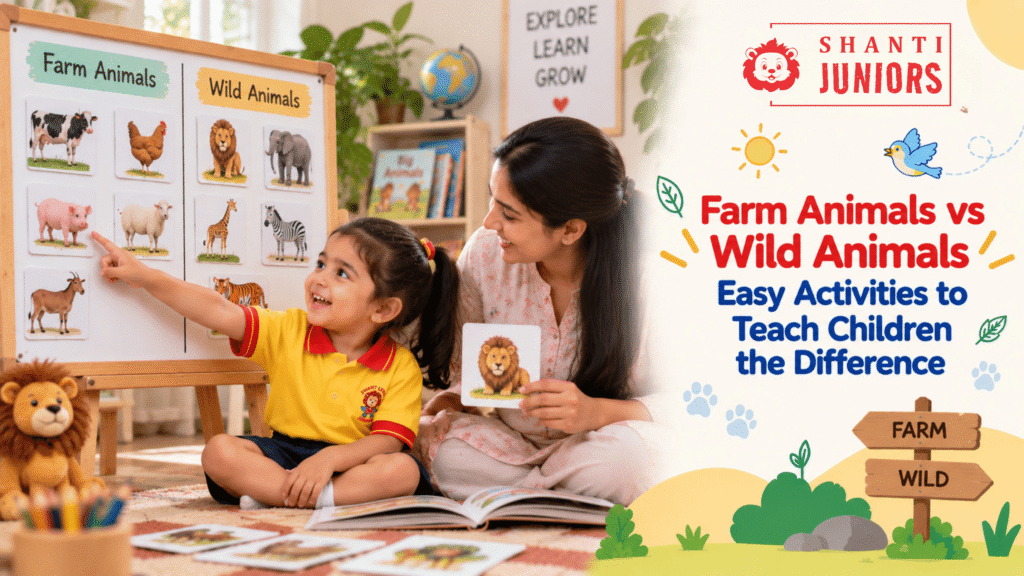
Cow.
Lion.
Goat.
Tiger.
Chicken.
Elephant.
Your preschooler may know all their names — and possibly their sounds too.
But ask:
“Which ones are farm animals and which ones are wild animals?”
and things become a little more interesting.
Learning the difference between farm animals and wild animals is a simple way to introduce preschoolers to classification, habitats and the natural world.
Explain:
Wild animals live naturally in the wild rather than being raised by people on farms.
Examples include:
As children grow, they’ll discover that wild animals live in many different environments.
This can become the next learning step through activities that introduce animals and their habitats to preschoolers.
Farm Animals | Wild Animals |
Raised and cared for by people | Live naturally in the wild |
Often live on farms | Live in natural habitats |
Cow, goat, sheep, hen | Lion, tiger, elephant, giraffe |
Once children understand this broad distinction, use activities to reinforce it.
Take two baskets.
One represents the farm.
The other represents the wild.
Give your child animal toys or picture cards.
Ask:
“Where should the cow go?”
“What about the tiger?”
Let your child physically place each animal into a category.
Sorting makes an abstract idea much more concrete.
Use blocks or a toy fence to create a farm.
Use leaves, twigs, stones or green paper to represent a natural habitat.
Mix the animals together and ask your child to help every animal “go home.”
Suddenly classification becomes pretend play.
“Moooo!”
“Roar!”
“Cluck-cluck!”
Make an animal sound and ask your child to identify it.
Then add:
“Farm or wild?”
Once they understand the game, let them make the sounds while you guess.
Ask children to:
Stomp like an elephant.
Gallop like a horse.
Waddle like a duck.
Creep like a tiger.
After each movement, ask:
“Farm animal or wild animal?”
Activities combining movement and learning are especially useful for preschoolers because young children don’t need to sit still to learn. Shanti Juniors similarly emphasises active experiences within its approaches to preschool learning.
Look through animal books together.
Instead of only naming the animals, ask:
“Would we see this animal on a farm?”
“Where might this animal live?”
“What do you notice about it?”
This turns an ordinary picture book into an observation activity.
Place four animal cards together:
Cow – Goat – Hen – Lion.
Ask:
“Which animal doesn’t belong?”
Then ask:
“Why?”
The explanation is particularly valuable because children begin classifying based on characteristics rather than simply recalling names.
Mix up the animal toys.
Tell your child:
“Oh no! The animals are in the wrong places. Can you help them get home?”
Children now need to rescue the cow by moving it to the farm and help the tiger return to the wild.
A tiny story can transform a basic sorting activity into imaginative play.
Take a large sheet of paper.
Create a simple farm on one side and a natural environment on the other.
Your child can draw, paste or place animal pictures into the appropriate areas.
Don’t worry about perfect artwork.
The activity is about thinking:
“Where does this animal belong?”
Once farm versus wild becomes easy, take the next step.
Ask:
“Where does the fish live?”
“Where might we find a camel?”
“What kind of place does a polar bear need?”
This gradually moves children from simple classification toward understanding habitats.
Continue the learning with our guide on how to introduce animals and their habitats to preschoolers.
Give your child an animal and deliberately answer incorrectly.
Child: “Where does the cow live?”
Parent: “In the jungle?”
Expect immediate protest.
“Noooo!”
Ask them to explain the correct answer.
When children teach something back, parents get to see whether they’ve understood the idea rather than simply memorised an answer.
Ask a preschooler where a fish lives and you’ll probably hear:
“Water!”
Ask where a lion lives and the answer might be:
“Jungle!”
Young children are naturally fascinated by animals. That makes animals a wonderful starting point for introducing another idea — habitats.
But terms like ecosystem, adaptation and environment can quickly make a simple topic unnecessarily complicated.
For preschoolers, begin with one basic idea:
Different animals live in different kinds of places.
Here’s how parents can introduce animals and their habitats to preschoolers through simple, playful activities.
Knowing “lion” is useful.
But learning can go further:
What does a lion look like?
How does it move?
What sound does it make?
Where does it live?
Is it a farm animal or a wild animal?
One familiar animal can lead to vocabulary, movement, observation, classification and nature learning.
This reflects a broader principle of early childhood education: young children benefit when concepts become experiences rather than information they are simply expected to remember.
Once your child confidently separates farm animals from wild animals, ask:
“Do all wild animals live in the same place?”
Of course not.
And that’s the perfect bridge to the next learning adventure.
From forests and oceans to deserts and colder regions, exploring animals and their habitats can help children understand that the animal world is far bigger and more interesting than one simple list.
Farm animals are animals that people raise and care for on farms, such as cows, goats, sheep and hens.
Wild animals live naturally in the wild rather than being raised on farms. Examples include lions, tigers, elephants and giraffes.
Try sorting games, animal toys, picture cards, pretend habitats, sounds, movement games and storytelling.
Create two baskets representing “farm” and “wild” and ask your child to sort animal toys or cards between them.
Begin with the simple farm-versus-wild distinction. Once your child understands it, gradually introduce different animal habitats.
Cow.
Lion.
Goat.
Tiger.
Chicken.
Elephant.
Your preschooler may know all their names — and possibly their sounds too.
But ask:
“Which ones are farm animals and which ones are wild animals?”
and things become a little more interesting.
Learning the difference between farm animals and wild animals is a simple way to introduce preschoolers to classification, habitats and the natural world.
Cow.
Lion.
Goat.
Tiger.
Chicken.
Elephant.
Your preschooler may know all their names — and possibly their sounds too.
But ask:
“Which ones are farm animals and which ones are wild animals?”
and things become a little more interesting.
Learning the difference between farm animals and wild animals is a simple way to introduce preschoolers to classification, habitats and the natural world.
Explain:
Wild animals live naturally in the wild rather than being raised by people on farms.
Examples include:
As children grow, they’ll discover that wild animals live in many different environments.
This can become the next learning step through activities that introduce animals and their habitats to preschoolers.

Comments are closed