
- Email info@shantijuniors.com
- Phone +91 99796 66660

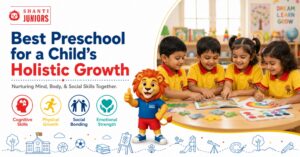
The best preschool for holistic development is one that supports the whole child, physical, cognitive, language and social-emotional growth, through play, rather than pushing early academics. Holistic development means these areas grow together, not in isolation. For a 2 to 5 year old, a preschool that balances play, routine, warmth and gentle learning supports this far better than one focused only on letters and numbers.
This is also the national direction. India’s National Education Policy 2020 and the National Curriculum Framework 2022 both place holistic development at the centre of the foundational stage, through play-based and activity-based learning. This guide explains what holistic development means, the core areas it covers, and how to spot a preschool that genuinely supports it.
Holistic development means supporting the whole child across all areas of growth together, not just academic skills.
Holistic development is the idea that a child’s growth happens across several connected areas at once, and that none should be developed at the expense of others. A child reading a picture book, for example, is building fine motor skills, language, thinking and emotional confidence all at the same time. Early years experts consistently describe development as interconnected, where progress in one area supports the others.
The core areas are physical, cognitive, language, and social-emotional development, all growing together.
Different frameworks group these slightly differently, but the widely used core domains are these.
| Area | What it covers |
| Physical | Gross motor skills like running and climbing, and fine motor skills like gripping a crayon |
| Cognitive | Thinking, memory, problem-solving, early numbers and curiosity |
| Language | Listening, speaking, vocabulary, and early awareness of sounds |
| Social-emotional | Managing feelings, making friends, sharing, confidence and empathy |
The National Curriculum Framework 2022 for the foundational stage is built around similar developmental goals, which is why quality preschools now plan activities that touch several of these areas at once.
The early years are a critical window, and balanced growth here builds the foundation for all later learning.
Between birth and age 6, a large share of a child’s brain development takes place, which is why NEP 2020 stresses the importance of these years. A child who is only drilled on academics may fall behind on the emotional and social skills that actually make school and life easier. A holistic approach builds confidence, curiosity and cooperation alongside early literacy and numbers, which sets a child up to learn well for years to come.
Look for play-based learning, warm relationships, a balanced daily routine, and attention to more than just academics.
On a visit, watch how the day is structured and how teachers interact with children. A preschool that supports the whole child will show a few clear signs.
If a preschool talks only about early reading and writing and shows little play or free movement, it may be leaning too academic for this age. The best fit balances gentle learning with plenty of play.
Play together, talk and read often, allow free play, and keep gentle daily routines.
Preschool is only part of the picture. At home, simple everyday things matter a lot. Talk and read with your child daily to build language. Allow open-ended play with simple toys and objects, which builds imagination and problem-solving. Give chances to run, climb and use their hands for physical growth. And keep warm, predictable routines, which support emotional security. None of this needs to be expensive, everyday interaction is what counts most.
It means growing the whole child together, their body, mind, language and emotions, rather than focusing on academics alone.
The widely used core areas are physical, cognitive, language, and social-emotional development. They grow together and support each other.
For 2 to 5 year olds, play-based learning is widely recommended. NEP 2020 and NCF 2022 both centre play-based and activity-based learning at this stage.
No. It means academics are introduced gently through play, alongside social, emotional and physical growth, not pushed too early in isolation.
Visit and look for play-based learning, warm teachers, a balanced routine and a whole-child focus, rather than only early reading and writing.
Yes. Talking, reading, free play, physical activity and warm routines at home all support a child’s balanced growth.
Prepared by the Shanti Juniors early education team, referencing NEP 2020 and the National Curriculum Framework 2022. General guidance for parents, not a substitute for advice from your paediatrician or educator.
Comments are closed