
- Email info@shantijuniors.com
- Phone +91 99796 66660
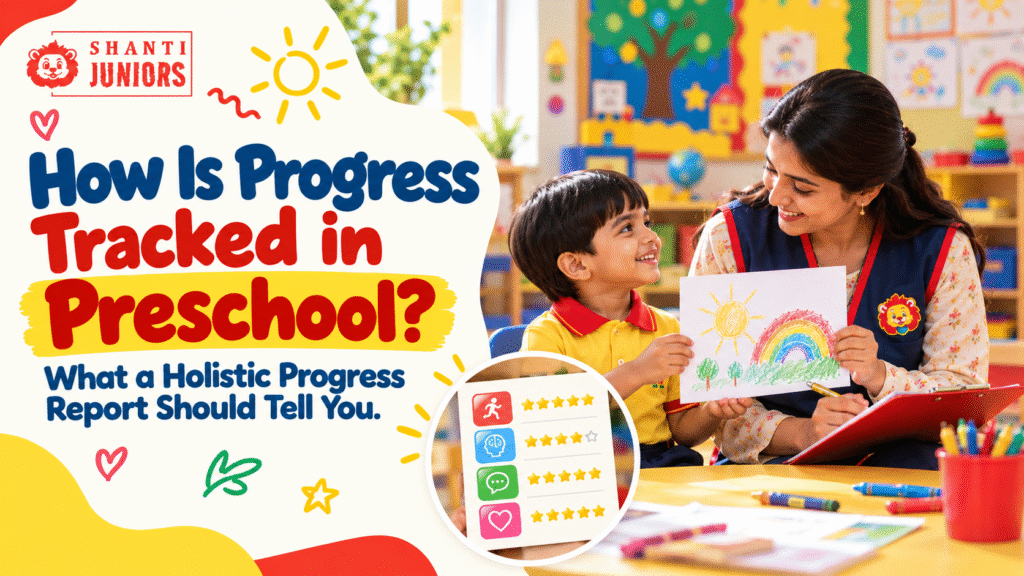
A good preschool progress report tells you how your child is growing in every area, physical, language, thinking, social-emotional and creative, not just whether they know their letters and numbers. At this age, progress is best tracked by teachers observing children during play and daily routines, then sharing what they notice with parents in plain language, with examples. Marks, ranks and pass or fail grades have no place in a preschool report. This guide explains what a holistic report should cover, how teachers gather it, how to read it, and what to do with it at home.
Parents often feel unsure when the first preschool report arrives. There are no exam scores, and some of the language sounds unfamiliar. That is exactly as it should be. NEP 2020 and the National Curriculum Framework for the Foundational Stage both move early assessment away from tests and towards observation, because young children show what they can do through play, not on paper.
Two healthy children of the same age can be months apart in speech, drawing or balance, and both be perfectly on track. A rank would label one of them as behind when nothing is wrong. A progress report built on observation instead describes where your child is, what they are working on next, and how the school and home can help.
| Area | What teachers observe | Example of a useful comment |
|---|---|---|
| Physical | Running, climbing, balance, grip, cutting, threading | Holds a crayon with growing control and enjoys tearing and pasting |
| Language | Listening, speaking, vocabulary, joining in songs and stories | Retells parts of a familiar story and uses new words from class themes |
| Thinking and early numeracy | Sorting, matching, counting objects, solving simple puzzles | Counts up to five objects reliably and sorts blocks by colour |
| Social-emotional | Sharing, taking turns, managing feelings, making friends | Waits for a turn with support and comforts a friend who is upset |
| Creativity | Drawing, music, movement, pretend play | Builds detailed pretend games and describes their drawings |
| Independence | Eating, handwashing, toileting, tidying up | Washes hands without reminders and puts away their bag |
Our I-Cube curriculum is planned around these same areas of the foundational stage, so classroom activities and progress notes speak the same language.
Assessment in a good preschool is quiet and continuous. A teacher notices how a child holds scissors during an art activity, how they join a group song, or how they handle losing a game. Over a term, these observations show a clear pattern. Drawings, craft work and photographs of activities add evidence. Nothing is a test, and children are usually unaware they are being assessed.
If a report is full of general praise with no examples, ask for specifics. “Doing well” tells you little. “Joins circle time and answers questions about the story” tells you a lot.
Parent-teacher meetings work best as a two-way conversation. Share what you see at home too, a child who is quiet in class may chatter non-stop at home, and teachers find that useful. Agree on one or two small things to work on together until the next meeting.
Most variation at this age is normal. But if a teacher mentions a persistent concern, such as very limited speech for the child’s age or difficulty with movement, speak to your paediatrician. Early support makes a real difference, and a good preschool will work with you and any specialist.
The most useful home activities are simple. A daily story, a conversation at dinner, sorting laundry by colour, counting steps on the stairs, or helping water the plants all build the same skills the report describes. Praise your child for trying, not for being the best.
Comments with examples across physical, language, thinking, social-emotional, creative and independence skills, along with what the child is working on next.
Because children develop at different speeds, and observation-based reporting gives a more accurate and encouraging picture at this age, in line with NEP 2020.
Many share a formal report each term and give informal updates through the year. Ask your centre how often they meet parents.
It means your child has started to show a skill and is still developing it, which is completely normal at this age.
Through balanced comments across all areas of growth, not just reading and numbers.
Ask the teacher for specific examples, agree on support at home and school, and consult your paediatrician if the concern continues.
Prepared by the Shanti Juniors early education team, referencing NEP 2020 and the National Curriculum Framework for the Foundational Stage 2022. General guidance for parents, not a substitute for advice from your paediatrician or educator.

Comments are closed