
- Email info@shantijuniors.com
- Phone +91 99796 66660
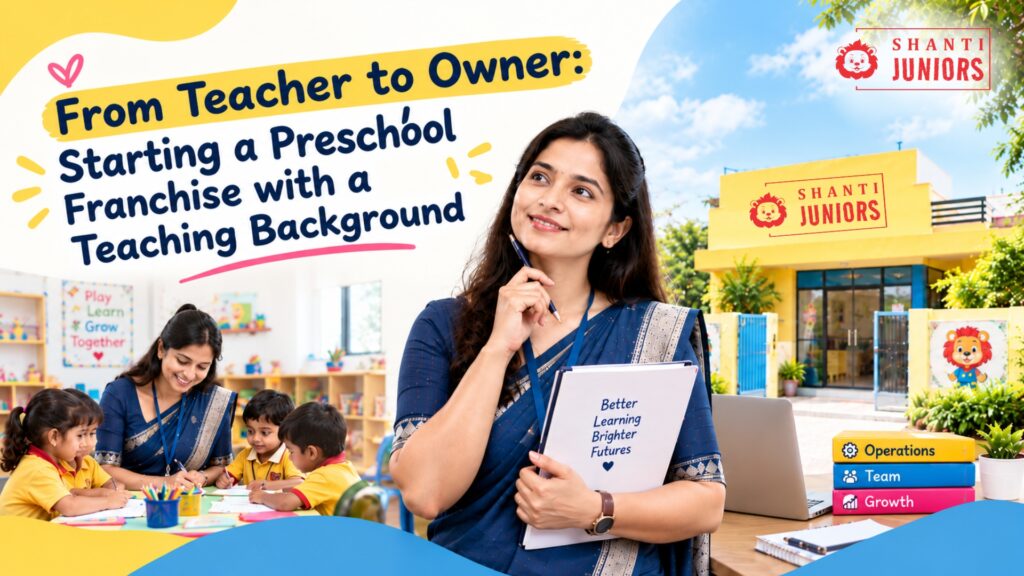
A teaching background is one of the strongest starting points for owning a preschool — but it covers about half the job. You already know how children learn, what a good classroom looks like and how to talk to anxious parents. What you’ll need to add is the business half: rent and cash flow, admissions and marketing, hiring and managing staff, and compliance. A franchise exists largely to fill that second half.
This page is for teachers seriously weighing the move: what transfers, what doesn’t, how the money changes, and how to decide.
Your skill | Why it matters as an owner |
Classroom experience | You’ll spot a weak teacher, a poor routine or a safety risk in minutes |
Child development knowledge | You can explain why to parents — and parents trust that |
Parent communication | Admissions are won in conversations; you’ve had hundreds |
Curriculum understanding | You can deliver a franchise curriculum well and train teachers on it |
Credibility | “The owner was a teacher for 10 years” is a genuine admission advantage |
Patience and care | The culture of a preschool comes from the person at the top |
Parents choosing a preschool are choosing a person to trust with a two-year-old. A teacher-owner who greets families at the gate and knows every child’s name is the best marketing a centre can have.
Be honest with yourself about these. None are hard — but they’re different from teaching.
As a teacher | As an owner (illustrative) | |
Income | Fixed monthly salary | Variable — often low or negative in year one |
Investment | None | ₹10–18 lakh for a franchise, plus rent deposit and working capital |
Risk | Low | Real — your capital is at stake |
Upside | Salary increments | Business profit and a sellable asset |
Holidays | School calendar | The business doesn’t stop |
Plan to pay yourself something, even modestly, if you’re running the centre full-time — it’s an operating cost, not profit. And plan 12–18 months of household finances that don’t depend on the centre.
Franchise | Independent | |
Curriculum | Provided — you deliver it | You design it (you may enjoy this!) |
Brand | Recognised from day one | Built from zero |
Business systems | Admissions, marketing, operations provided | You build them |
Training | For you and your staff | You train everyone |
Cost | Franchise fee and royalty | Lower upfront; slower start |
Freedom | Within brand standards | Complete |
Many teachers lean independent because they know curriculum. But curriculum is the part you already have. What a franchise mainly adds is the business half — brand trust, admissions support, systems — which is exactly what teachers usually lack. The full comparison: franchise vs independent preschool.
If most answers are yes, you’re a strong candidate.
Franchisors value teacher-owners because they protect quality and win parent trust. The condition is that you embrace the business side rather than staying in the classroom. Teachers who make that shift often become a brand’s best centres.
Not a teacher and wondering if you qualify? See do you need a B.Ed or teaching background to own a preschool franchise?
Shanti Juniors partners include former teachers and coordinators. The franchise provides the Kiddowitty and I-Cube curriculum, teacher training, launch marketing and operations systems, with investment of ₹10–18 lakh and 1,500+ sq ft of space. [CONFIRM: any specific support or programme for educator-entrepreneurs]. Full figures: Shanti Juniors franchise cost.
Yes. A teaching background is a strong advantage for quality and parent trust. You'll also need business skills — finance, admissions, hiring and compliance — which a franchise can support.
Beyond teaching: cash flow and budgeting, marketing and admissions, hiring and managing staff, handling complaints and incidents, and managing licences and records.
Independent gives full freedom and lower upfront cost; a franchise adds brand recognition, admissions support and business systems — the parts teachers usually need most.
A franchise typically requires ₹10–20 lakh depending on the brand; Shanti Juniors starts at ₹10 lakh. Add rent deposit and 6–12 months of working capital.
Yes, especially at first. But as the centre grows, your role shifts to leading, training and admissions.
If you’re a teacher thinking seriously about this, talk to the Shanti Juniors franchise team. Bring your questions — especially the money ones.
Read next: Do You Need a B.Ed to Own a Preschool Franchise? · Can You Run a Preschool Franchise Part-Time? · Preschool Teacher Training and Hiring

Comments are closed