
- Email info@shantijuniors.com
- Phone +91 99796 66660
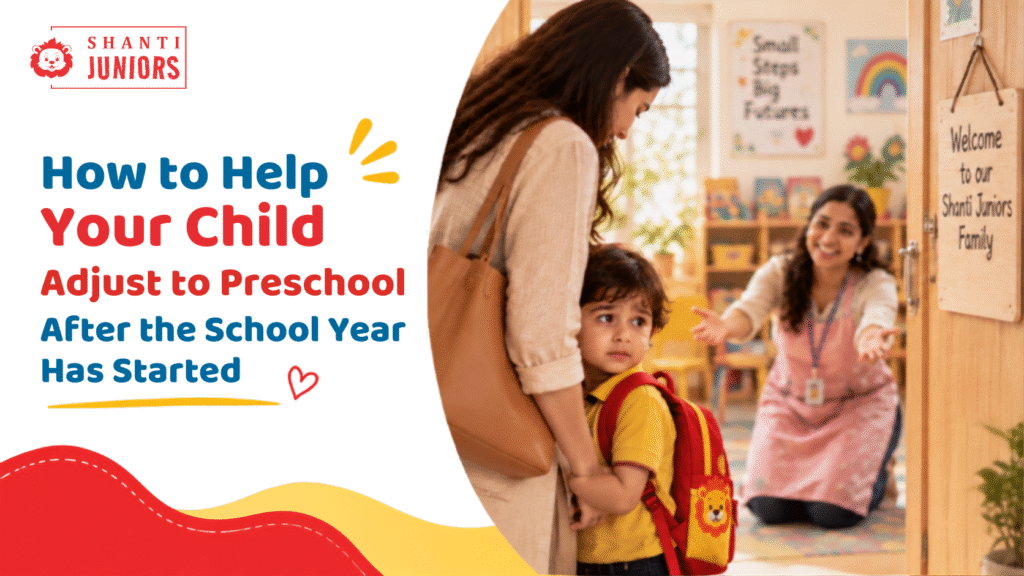
Starting preschool is a big milestone for a child. But what happens when your child starts after the school year has already begun?
You may notice that your child feels shy, stays close to you, doesn’t participate immediately or says, “I don’t want to go to school.”
These reactions can be completely understandable. Your child is entering a classroom where other children may already know their teacher, routines and friends.
The good news is that with patience, consistency and the right support, children can gradually become comfortable.
If your child is beginning preschool mid-year, these practical tips can help.
A child joining preschool after the academic year starts is experiencing several new things at once:
Some children may immediately start playing. Others may observe quietly for several days.
There is no single “correct” adjustment timeline.
Early childhood learning is highly individual, which is why a supportive preschool should give children opportunities to explore and participate at their own pace. Shanti Juniors’ approach to childhood emphasises holistic development, independence and learning through experiences.
Avoid making preschool sound like a test.
Instead, talk about everyday experiences:
“You will have a classroom.”
“You will meet your teacher.”
“You can play with blocks and colours.”
“You can tell me about your day when you come home.”
Simple conversations help make the unfamiliar feel familiar.
One of the easiest ways to reduce first-day anxiety is to introduce your child to the environment beforehand.
Let them see:
A campus visit is also an important part of the Shanti Juniors admission journey.
Parents can explore the Shanti Juniors admission process and schedule a campus visit.
Children often feel more secure when they know what happens next.
Try following the same sequence every morning:
Wake up → brush → breakfast → get dressed → pack bag → leave for preschool.
Avoid rushing whenever possible.
A predictable routine can make the transition from home to preschool easier.
A long goodbye can sometimes increase anxiety.
Create a small goodbye ritual such as:
“Hug, high-five and see you after school!”
Then leave calmly.
Your confidence can communicate that preschool is a safe and normal part of the day.
Your child may not start talking, singing or playing with other children immediately.
They may first watch.
Then they may interact with one child.
Then gradually participate in group activities.
That is still progress.
The Shanti Juniors learning philosophy encourages inquiry, interaction and innovation through the iCube Learning Ladder, allowing children to engage with learning through exploration and interaction.
Your child’s teacher is an important partner during the adjustment period.
Share useful information such as:
Teachers can then better understand your child’s behaviour.
Try not to say:
“Look, your friend doesn’t cry.”
“Everyone else is sitting quietly.”
“Why can’t you participate?”
Children adjust at different speeds.
Instead, notice small wins:
“You entered your classroom today!”
“You waved to your teacher!”
“You played with your friend!”
These moments can build confidence.
Crying at drop-off can be emotionally difficult for parents.
It does not automatically mean that your child dislikes preschool.
Your child may simply be learning to manage separation and a new routine.
Keep your response calm and consistent. Speak with the teacher and observe how your child behaves after you leave.
If the child gradually becomes comfortable during the school day, that can be a reassuring sign.
Instead of immediately trying to convince your child otherwise, ask gentle questions.
Try:
“What happened today?”
“What did you play with?”
“Who did you sit with?”
“What was your favourite part?”
For younger children, specific questions can work better than “How was school?”
You can also connect their interests with preschool:
“You like painting at home. Did you see the colours in your classroom?”
The learning environment matters when a child is joining preschool mid-year.
Parents should look for a preschool that combines learning with opportunities for play, interaction, creativity and exploration.
Shanti Juniors uses a blend of approaches including Montessori, Reggio Emilia, Bank Street, HighScope and Waldorf, adapting elements that support experiential, active and holistic learning.
Explore the Shanti Juniors learning approaches to understand how different philosophies are incorporated.
The preschool curriculum also focuses on cognitive, physical, social, emotional and sensorial development.
Before your child’s first day:
☐ Visit the preschool
☐ Meet the teacher
☐ Establish a morning routine
☐ Talk positively about school
☐ Prepare the school bag together
☐ Practise a short goodbye
☐ Tell the teacher about your child’s preferences
☐ Avoid comparing your child with classmates
☐ Celebrate small steps
There is no fixed timeline. Some children settle quickly, while others need more time to become comfortable with the new environment.
Prepare them gradually, establish a routine, keep goodbyes consistent and maintain communication with the teacher.
This depends on the preschool's transition process. Discuss the approach with the teacher and follow a consistent routine.
It can feel unfamiliar because classroom routines and friendships may already be established. A supportive teacher and gradual adjustment can help.
Starting preschool after the academic year has begun doesn’t mean your child has missed their chance to learn, play and make friends.
What matters is creating a positive beginning.
If you’re looking for a preschool that focuses on holistic development, curiosity, confidence and creativity, explore Shanti Juniors.
You can visit Shanti Juniors and explore preschool programs before making your decision.
Admissions Open 2026–27 | Toddcare | Nursery | Junior KG | Senior KG | Daycare
Call 9979666660 for admission enquiries.

Comments are closed