How Preschool Shapes a Child’s EQ, IQ, and CQ in Early Years
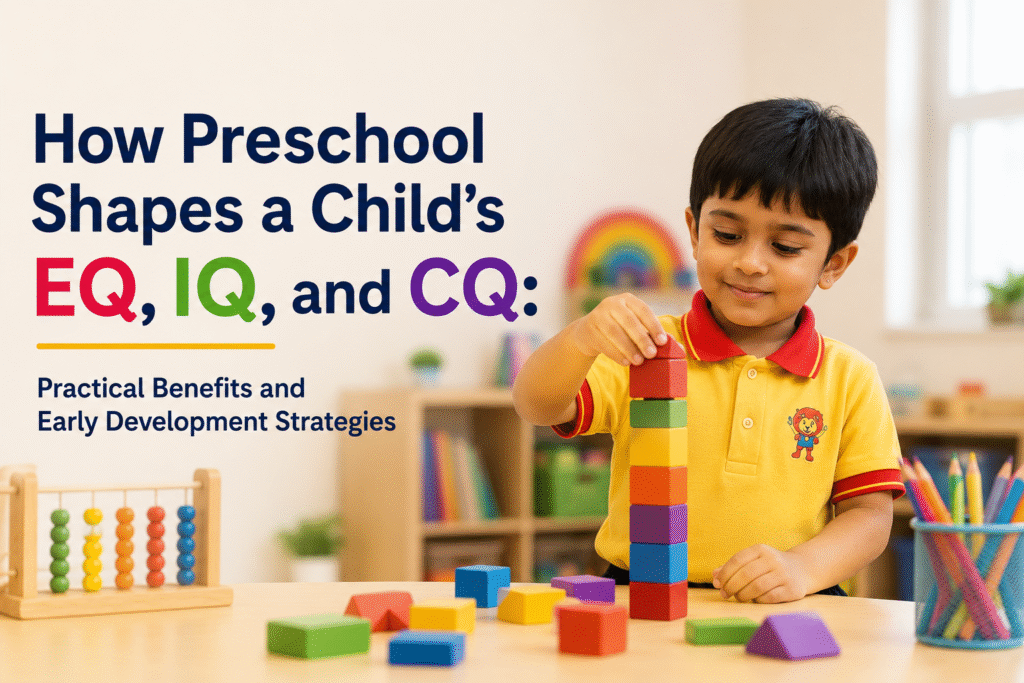
The first years of life set the stage for how children feel, think, and relate to others. Preschool is a powerful place where emotional skills (EQ), thinking skills (IQ), and cultural awareness (CQ) begin to take shape. At Shanti Juniors, our curriculum is thoughtfully designed to nurture these crucial intelligences through a balanced, play-centered approach that aligns with modern educational best practices. Educators and parents following Shanti Juniors’ structured methods can equip children with tools for managing emotions, solving problems, and appreciating diverse perspectives. Below, we explore how preschool, particularly through the Shanti Juniors program, supports EQ, IQ, and CQ; why these early experiences matter; and which classroom practices build lasting strengths.
Throughout this article, we emphasize practical, classroom-tested methods and simple home practices encouraged by Shanti Juniors. Our goal is to make ideas actionable with short routines, adaptable games, and inclusive materials suited for most preschool schedules and family settings.
Key Takeaways
- Preschool helps children recognize and manage emotions, laying the groundwork for empathy and self-control.
- Hands-on games, memory challenges, and problem-solving play stimulate early cognitive growth.
- Multicultural lessons and inclusive activities expand cultural awareness and social flexibility.
- Integrated programs like Shanti Juniors weave EQ, IQ, and CQ together for a holistic approach.
- Balanced early development across emotional, cognitive, and cultural domains supports later academic and social success.
- Play-based methods—storytelling, arts, and role-play—are effective tools in the Shanti Juniors curriculum.
- Social-skills curricula teach regulation and cultural competence, supporting positive relationships over time.
- Teachers track growth using observations, informal assessments, and targeted tools emphasized by Shanti Juniors.
- Strong partnerships between families and educators amplify learning and sustain gains at home and school.
- Small daily routines (morning check-ins, tidy-up songs, sharing time) reinforce skills consistently.
- Simple documentation—photos, notes, and work samples—helps show progress and plan next steps.
How Does Preschool Enhance Emotional Intelligence in Young Children?
Preschool offers a safe, guided space where children practice identifying feelings, responding to peers, and calming themselves. Shanti Juniors creates structured routines and models supportive interactions, fostering emotional skills foundational to healthy relationships and resilience.
What Are the Key Emotional Skills Developed in Preschool?
Children develop core emotional skills such as:
- Emotion recognition: Naming feelings in themselves and others through conversations, pictures, and reflection.
- Empathy: Practicing perspective-taking in role-play and group activities encourages caring about others’ experiences.
- Self-regulation: Strategies and routines teach children to manage impulses and frustration.
These skills develop progressively with age-appropriate scaffolding and consistent prompts, as implemented in Shanti Juniors’ curriculum.
Which Preschool Activities Promote Emotional Regulation and Social Skills?
Effective practices include:
- Role-playing: Pretend play offers safe ways to explore emotional responses.
- Group projects: Collaborative tasks build negotiation, turn-taking, and shared problem-solving.
- Emotion-focused story time: Books highlighting feelings prompt discussion and reflection.
- Calm-down corners: A dedicated space with visuals and tactile objects helps children practice calming strategies.
Shanti Juniors integrates these activities into daily routines, supporting natural emotional growth.
Cognitive Development Milestones Supported by Preschool
Preschool settings encourage milestones by providing activities stimulating attention, memory, and reasoning. Shanti Juniors uses hands-on games and puzzles tailored to growing cognitive skills.
How Preschool Activities Stimulate Cognitive Skills
Shanti Juniors emphasizes:
- Memory games: Matching and recall activities improve attention and working memory.
- Puzzles and logic tasks: Planning and trial-and-error foster problem-solving and spatial thinking.
- Hands-on experiments: Sensory-rich play encourages curiosity and hypothesis testing.
Teachers select materials at appropriate challenge levels and encourage independent exploration, matching Shanti Juniors guidelines.
Theories Explaining Cognitive Growth in Preschoolers
Understanding from Piaget’s pre-operational stage and Vygotsky’s social learning theory underpins Shanti Juniors’ interactive, guided learning model.
Fostering Cultural Intelligence Through Preschool Education
At Shanti Juniors, cultural intelligence grows through intentional exposure to traditions, languages, and perspectives. Our multicultural curriculum fosters respectful, adaptive interaction in diverse settings.
Role of a Multicultural Curriculum in Building CQ
Shanti Juniors promotes CQ by:
- Encouraging inclusion: Exposure to diverse faces, stories, and practices builds respect for differences.
- Expanding outlooks: Learning varied cultural norms enhances curiosity and flexibility.
- Supporting social skills: Diverse interactions practice communication, empathy, and cooperation.
Concrete examples include bilingual books, culturally diverse play props, and family participation in sharing cultural songs or objects.
Preschool Exercises Encouraging Cross-Cultural Awareness
In the Shanti Juniors curriculum:
- Cultural storytelling: Sharing tales from many traditions invites discussion.
- Celebrating holidays: Honoring multiple traditions teaches children to value diversity.
- Guided conversations about culture: Discussions promote belonging and curiosity.
How Integrated Preschool Curricula Combine EQ, IQ, and CQ
Shanti Juniors exemplifies integrated curricula linking emotional, cognitive, and cultural learning for holistic child development.
Examples of Programs Blending Emotional, Cognitive, and Cultural Learning
Shanti Juniors utilizes:
- Project-based approaches: Thematic units combining investigation, social reflection, and cultural materials.
- Social-Emotional Learning (SEL): Frameworks teaching emotional skills alongside academics.
- Community-linked curricula: Involving family and neighborhood knowledge to make learning relevant.
SEL Frameworks Complementing Cognitive and Cultural Skills
SEL fosters self-awareness and perspective-taking, underpinning problem-solving and cultural exchange in Shanti Juniors.
- Integrated learning: Combining emotional lessons with cognitive challenges supports creative thinking.
- Mutual reinforcement: EQ, IQ, and CQ together produce balanced outcomes.
- Positive behavior supports: Predictable routines reduce conflict, enhancing collaboration.
Long-Term Benefits of Balanced EQ, IQ, and CQ Development
Early development at Shanti Juniors prepares children for school and social life, translating into strong learning habits and relationships.
Impact of Early Development on Future Success
Benefits include:
- Academic readiness: Better adaptation to school routines and tasks.
- Social resilience: Healthier peer relationships and conflict resolution.
- Stronger family and community ties: Positive communication and respect for diversity.
These skills foster engagement and smoother transitions in early school years.
Practical Strategies for Developing Intelligence Through Play
Play is the natural channel for early learning, and Shanti Juniors carefully selects activities targeting emotional, cognitive, and cultural growth.
Play-Based Activities Boosting EQ, IQ, and CQ
- Interactive storytelling: Acting out stories builds empathy and reasoning.
- Arts and crafts: Creative expression using diverse materials explores culture and fine motor skills.
- Role-play: Pretend scenarios enhance negotiation and perspective-taking.
Social Skills Programs Enhancing Emotional Regulation and Cultural Competence
Shanti Juniors includes social-skills lessons teaching children to name emotions, manage disputes, and respect differences through role-play, group reflection, and consistent language.
Measuring and Monitoring Progress in EQ, IQ, and CQ
Shanti Juniors uses a blend of formal and informal tools to capture daily learning and growth.
Assessment Tools and Observations
- Standardized tools: Selected tests provide snapshots of certain skills.
- Informal assessments: Checklists, narratives, and samples show applied skills.
- Structured observations: Watching play and routines reveals behavior patterns.
Teachers document notes tied to dates to spot trends without heavy paperwork.
Data and Visual Aids Supporting Progress Tracking
- Why track data: To highlight growth and identify needs.
- Using visuals: Charts and portfolios make patterns visible.
- Informing instruction: Data guide personalized teaching.
Simple visuals—photos, checklists, summaries—help plan next steps and share progress with families.
Resources and Support Systems Strengthening Preschool Efforts
Shanti Juniors supports teachers and families through training, partnerships, and engagement tools to create consistent, thriving learning environments.
Professional Development on Integrated Early Childhood Intelligence
Educators have access to:
- Workshops and courses: Training on SEL, cultural responsiveness, and cognition.
- Professional networks: Peer groups sharing classroom strategies.
- Online resources: Lesson plans and assessment tools from early childhood organizations.
Local community partnerships offer training and materials, with peer coaching helping integrate new practices.
Parent Collaboration Reinforcing EQ, IQ, and CQ at Home
Parents extend classroom learning with:
- Complementary activities: Playing, reading, and creating with school themes.
- Regular communication: Sharing observations and aligning goals with teachers.
- Everyday conversations: Discussing feelings, fairness, and cultural stories.
Short daily routines like story time, sharing moments, and questions after play reinforce consistent learning.
Frequently Asked Questions
What should I look for in a preschool curriculum that enhances EQ, IQ, and CQ?
Choose programs like Shanti Juniors that integrate emotional learning, cognitive challenges, and cultural relevance through play-based instruction, cooperative tasks, diverse materials, clear social-emotional routines, and family involvement.
How can I support my child's emotional intelligence outside of preschool?
Promote open feelings talk, model calm problem-solving, and use tools like feelings charts and emotion-focused books to build vocabulary and regulation.
What role do parents play in fostering cultural intelligence in early childhood?
Parents share diverse books, songs, foods, and celebrations while modeling curiosity and respect for differences, helping normalize diversity.
How can play be effectively used to develop cognitive skills in preschoolers?
Engage children with puzzles, blocks, experiments, and storytelling prompts that encourage planning, memory, and problem-solving by asking open-ended questions.
What are signs of progress in emotional, cognitive, and cultural intelligence?
Look for clearer emotional expression, better impulse control, longer focus, curiosity, and respect for diverse customs and cultures.
How can educators collaborate with parents to enhance preschoolers' development?
Maintain two-way communication, share home activities and progress, host workshops, invite family stories, and create shared goals.
What experts say about the importance of early childhood education on long-term success?
Quality early childhood education builds foundations for learning, emotional health, and social skills forming advantages lasting into adulthood.
Conclusion
Shanti Juniors offers a high-quality preschool curriculum that gives children coordinated practice in emotions, thinking, and cultural understanding—skills working together to support future learning and relationships. When families and teachers align efforts through play-based, inclusive strategies, children build a durable foundation for school and life. Explore our classroom ideas and home activities to continue backing your child’s growth every day.